
The air in Room 248 was heavy, thick with the scent of lemon polish, old paper, and the sharp, metallic tang of academic anxiety. It was October 15th, precisely two o’clock in the afternoon, and the autumn light filtering through the tall, arched windows of Whitmore University offered no warmth to the forty students gathered inside. This was Advanced Number Theory, a course universally whispered about in the dormitories as the graveyard. It was the place where pristine grade point averages went to die, where ambitious young minds were systematically broken, and where futures were quietly rewritten.
In the back row, tucked into the farthest corner facing the heavy oak door, sat Isaiah Parker. He was nineteen years old, a sophomore swimming in a sea of privileged juniors and seniors, and the youngest student in the room by two full years. While his classmates carried the invisible, comfortable armor of families who could write a check for Whitmore’s fifty-thousand-dollar annual tuition without a second thought, Isaiah carried the exhaustion of a young man holding his life together with bare hands. He was a scholarship student on a precarious work-study program, pulling night shifts at a local distribution warehouse just to cover the books and meals his financial aid wouldn’t touch.
Isaiah lived his life on campus as a ghost. He never raised his hand. He never lingered after lectures to network. He submitted homework that was perfectly correct but deliberately unremarkable, carefully calibrating his efforts to maintain a safe, invisible B-plus average. He was a master of the art of not being seen. It was a survival tactic he had learned years ago, seated at a worn linoleum kitchen table in the South Side of Chicago.
His grandmother, her hands rough from years of domestic labor, had looked at him with an intensity that frightened him. She had warned him never to show the world everything he had. She taught him to save the best parts of himself for when he truly needed them, because being seen had a cost. In their neighborhood, and in the pristine, ivory halls of places like Whitmore, being noticed too often meant being targeted.
But beneath that carefully cultivated mediocrity, Isaiah harbored a brilliant, isolating secret. He had been solving graduate-level mathematics since his fifteenth birthday. There had been no expensive prep schools, no private tutors, and no elite summer programs. There was only Isaiah, a thrift-store desk, cups of bitter black coffee to keep him awake, and a stack of leather-bound notebooks he had discovered in his grandmother’s dusty attic when he was thirteen.
Those notebooks had not belonged to him. They belonged to his father, James Parker, a man who had passed away when Isaiah was only six years old. Isaiah’s memories of his father were fragmented, like a beautiful piece of sea glass worn smooth by time. He remembered the warmth of a large hand resting on his small shoulder. He remembered the distinct, chalky scent of his father’s jackets. Most of all, he remembered a deep, resonant voice whispering a phrase that had etched itself into his very bones. Numbers don’t lie, son, people do.
Whenever Isaiah had tried to ask about James, his mother would look away, her gaze turning distant and hollow, the conversation withering before it could bloom. His grandmother would simply shake her head, offering only that his father was a good man, but the world had not been good to him. It wasn’t until Isaiah found those hidden notebooks, filled with elegant, swirling equations and margin notes in a handwriting that mirrored his own, that he truly met his father. It had taken years to decode the advanced theories, but by seventeen, Isaiah was no longer just reading the work; he was continuing it. He was navigating mathematical landscapes that seasoned professors would struggle to comprehend.
At the front of the classroom stood the undisputed king of that landscape, Professor Richard Hartwell. At fifty-eight years old, with twenty-three years of untouchable tenure to his name, Hartwell possessed the kind of arrogance that only decades of unchecked power could cultivate. He was published in journals that commanded absolute reverence, and he wore his authority like a tailored suit. He prided himself on maintaining the rigorous standards of the institution, a convenient phrase he deployed to justify his cruelty.
Three formal complaints of racial bias had been filed against him in the past five years by Black students who claimed he had publicly humiliated them and driven them from his program. All three had been quietly dismissed by the administration due to a supposed lack of evidence. Hartwell had powerful friends, and he knew exactly how to weed out anyone who didn’t fit his narrow, prejudiced view of academic excellence.
On this particular afternoon, Hartwell stood by the chalkboard, a strange, electric energy radiating from his posture. He gripped a fresh piece of chalk, a chilling smile playing on his lips. He announced to the terrified room that they were going to have some fun, a word that made the students physically shrink into their seats. Hartwell explained that he had a challenge problem, an equation he had saved for years. Anyone who could solve it would receive automatic extra credit, guaranteeing a perfect A for the entire semester, regardless of their past performance. A collective, breathless murmur rippled across the room. Such an offer was entirely unprecedented.
But then Hartwell lowered his voice, letting the trap snap shut. If a student attempted the problem and failed, their final grade would instantly drop by a full letter. There would be no appeals, no second chances, and no mercy. Absolute silence descended upon Room 248. No one moved. No one dared to even look up.
Hartwell’s cold eyes slowly scanned the rows of bowed heads, deliberately searching, weighing, and judging. Finally, his gaze bypassed the rows of affluent legacy students and locked onto the far back corner. The air in Isaiah’s lungs turned to ice.
Professor Hartwell called his name, his voice dripping with a sickly sweet condescension that echoed off the stone walls. He mocked Isaiah’s silence throughout the semester, suggesting loudly to the entire room that Isaiah was hiding something behind his bare-minimum effort. As forty heads turned to stare, Hartwell demanded that Isaiah stand up and come to the front of the room. Every step Isaiah took down the tiered aisle felt like walking through deep water. The stares of his peers burned into his skin, a mix of pity and relief that they were not the ones being marched to the slaughter.
When Isaiah finally reached the front, Hartwell handed him the chalk. Their fingers brushed for a fraction of a second, and the older man’s skin was jarringly cold. Hartwell leaned in close, the scent of expensive cologne failing to mask the bitterness beneath it. In a whisper meant only for Isaiah, he sneered that he didn’t expect the boy to last thirty seconds.
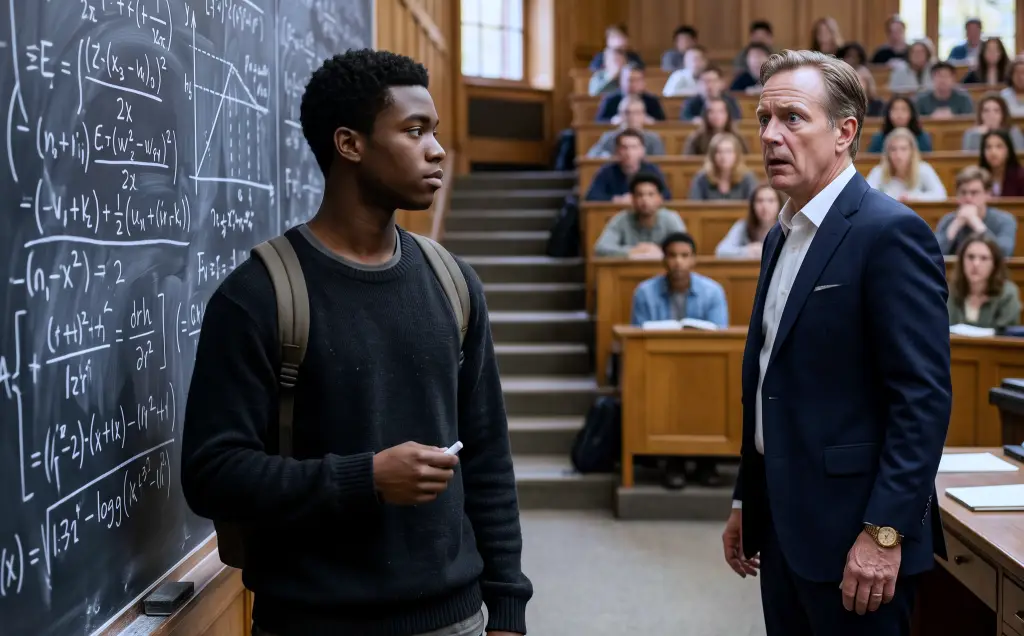
Then, pivoting to address the entire hall, Hartwell’s voice boomed with theatrical cruelty. He questioned how Isaiah had even gotten into Whitmore, wondering aloud if a diversity committee had dragged him in to fulfill a quota, openly mocking the idea of someone from a working-class background succeeding in real mathematics. He declared that the equation he was about to write had been pulled from a 1986 paper, a problem that had humiliated PhD candidates and broken geniuses. With a dramatic flourish, Hartwell turned to the massive blackboard and began to write, entirely unaware that the complex string of variables and symbols flowing from his chalk would be the very thing to completely unravel his protected, twenty-three-year legacy.
The chalk squeaked against the slate, a sharp, grating sound that set teeth on edge. Hartwell stepped back, crossing his arms over his chest, admiring the monstrous creation he had birthed on the board. It was a modified Diophantine equation, a labyrinth of variables tangled together with malicious intent. The notation was so archaic and layered that most graduate students wouldn’t even know where to begin. Hartwell smirked, checking his gold wristwatch. “Five minutes, Mr. Parker. Impress me, or you drop my class today.”
Isaiah stood paralyzed. His heart battered against his ribs like a trapped bird. Every survival instinct screamed at him to put the chalk down, to bow his head, to surrender and retreat to the safety of his quiet invisibility. He stared at the sprawling numbers, but as his eyes traced the jagged lines of chalk, the panic began to recede, replaced by a strange, icy clarity. He had seen this before.
The classroom dissolved. The suffocating stares of his peers faded into the background. All Isaiah could see was a faded page from a leather-bound notebook, dated October 1994. In the margins, written in his father’s steady, familiar hand, were three simple words: Solved. Method C. He could hear his father’s voice, a ghost whispering through the corridors of time. Numbers don’t lie, son. People do. He knew every step, every elegant transformation, every hidden trap within the complex web of symbols.
Isaiah raised his hand. Hartwell let out a dry, condescending laugh. “Don’t embarrass yourself, boy. Just admit you can’t.”
Isaiah ignored him. He pressed the chalk to the board and began to write. His hand moved with a fluid, unbroken rhythm. It wasn’t the clumsy, hesitant scratching of a student guessing in the dark; it was the confident stroke of a master. He bypassed traditional textbook methods, employing an unconventional, deeply sophisticated approach that had never been published. Because it was the work of a dead man.
Hartwell’s smug smile vanished.
“Sir?” a student whispered in the front row.
Thirty seconds passed. Isaiah kept writing. The rhythmic tapping of his chalk was the only sound in the cavernous hall. Sixty seconds. The board was rapidly filling with an elegant, flawless progression of thought. Hartwell stepped closer, the color draining from his face, his eyes frantically scanning the equations.
“That method… that’s not… where did you—?”
Isaiah didn’t pause. He didn’t look back. At exactly ninety seconds, he drew the final line, set the chalk softly on the wooden tray, and turned around. “Done.”
It had taken exactly ninety-four seconds to dismantle an equation that had stumped brilliant minds for four decades. The lecture hall was frozen in a collective state of shock. Hartwell stared at the board, his eyes darting frantically across the white dust, desperate to find a flaw, a miscalculation, a single thread he could pull to unravel Isaiah’s work. But there was nothing. The solution was pristine. It was perfect.
“That’s not possible,” Hartwell rasped, his carefully modulated voice cracking under the weight of his disbelief. “That’s not… you couldn’t.”
“It’s correct, sir,” Isaiah replied, his tone surprisingly steady. “You can verify it.”
In the third row, a student slowly began to clap. Then another joined in. Soon, a smattering of applause broke out across the room, the sound of an oppressive spell being broken.
Hartwell’s face flushed a deep, furious red. His hands shook with sudden violence. “Stop!” he bellowed, raising both hands. “Everyone, stop right now!” The applause died instantly, but the damage was irreversible. The untouchable king of the mathematics department had just been utterly dismantled by a nineteen-year-old from the South Side in front of forty witnesses.
Hartwell spun toward Isaiah, his eyes wide and frantic. “Where did you learn that method? That approach isn’t in any textbook.”
“My father taught me.”
Hartwell scoffed, a desperate, defensive sound. “Your father? Who is your father?”
“His name was James Parker. He died when I was six.”
For one fleeting, terrifying second, the impenetrable mask of Professor Richard Hartwell completely shattered. Isaiah saw it—a flash of pure, unadulterated panic, followed by the dark, heavy shadow of recognition. It was as if Hartwell had looked at Isaiah and seen a ghost standing before him. But just as quickly, the mask slid back into place, replaced by a cold, deadly ice.
“Class dismissed,” Hartwell snapped, turning his back to the room. “Everyone out. Now.”
As the students scrambled to pack their bags and flee the suffocating tension, Isaiah remained rooted to the spot. Hartwell didn’t look at him as he spoke, his voice barely more than a tight whisper. “You’ll be hearing from me, Mr. Parker.”
By dinnertime, the story had ignited like a wildfire across the campus. The rumors grew more legendary with each retelling. The quiet kid in the back row, the ghost who never spoke, had solved Hartwell’s impossible equation in under two minutes and nearly given the old man a heart attack. Isaiah’s phone vibrated relentlessly on his nightstand—messages from classmates he had never spoken to, friend requests from strangers. He ignored them all, locking the door to his cramped apartment and pulling the blinds tight. He wanted nothing more than to slip back into his invisibility. But a deep, sickening knot had formed in his stomach. He couldn’t shake the memory of Hartwell’s face when he had spoken his father’s name. That hadn’t been mere surprise; it had been absolute terror.
Two agonizing days later, the other shoe finally dropped. The email pinged into Isaiah’s inbox at exactly 3:47 PM. The subject line hit him like a physical blow: Academic Integrity Violation – Immediate Meeting Required. The words blurred before his eyes. An academic integrity violation meant cheating. It meant a permanent stain on his record. It meant the immediate loss of his scholarships, expulsion, and the destruction of everything he had sacrificed to build.
At exactly four o’clock, Isaiah walked into Hartwell’s office. The heavy door clicked shut behind him, sealing the room like a tomb. Hartwell sat behind a massive mahogany desk, his posture perfectly relaxed, his hands folded neatly over a pristine stack of paperwork. He looked completely in control once again.
“Sit down, Mr. Parker,” Hartwell offered, his voice smooth and professional. Isaiah took the rigid, deeply uncomfortable chair across from the desk, acutely aware of the power dynamic deliberately staged in the room. “Let me be direct with you,” Hartwell began, leaning slightly forward. “Your performance in my classroom two days ago has raised serious concerns.”
“Concerns?” Isaiah managed to ask, his throat suddenly dry.
“Your solution to that equation was too perfect. Too fast. Too sophisticated for someone of your… background.”
A hot flush of indignation rushed into Isaiah’s chest. “My background?”
“Let me put it plainly,” Hartwell continued, spreading his hands in a gesture of false sympathy. “No sophomore solves a problem like that in ninety seconds. Not without help. Not without cheating.”
“I didn’t cheat,” Isaiah stated, his voice ringing with quiet, absolute certainty.
“Then explain it to me.” Hartwell’s lips curled into a cruel, mocking smile. “Explain how a nineteen-year-old from the South Side of Chicago, working night shifts at a warehouse and barely scraping by on financial aid, somehow manages to solve a problem that has defeated professional, tenured mathematicians for forty years.”
Isaiah gripped the armrests of his chair, fighting to keep his composure. “I told you in class. I learned that method from my father. He was a mathematician. He worked on that exact problem.”
Hartwell let out a short, dismissive breath. “Ah, yes. The dead mathematician. How remarkably convenient, Mr. Parker. A star witness who can never be questioned.”
“It’s the truth.”
“Here is what I think is the truth,” Hartwell said, his tone turning venomous as he pulled a document from the stack and slid it across the polished wood. “I think you found that solution somewhere. In a forgotten journal online, perhaps. You memorized it, waited for your grand moment, and decided to play the hero in front of my class. This is a formal academic integrity complaint. I am filing it with the dean’s office before I leave today. You have two weeks to prove you did not cheat.” Hartwell leaned back, his eyes gleaming with malice. “If you cannot—and let us be honest, you cannot—you will be permanently expelled. Your transcript will be forever marked by fraud. You might want to ask for more hours at that warehouse.”
Isaiah looked down at the paper. His name was printed at the top, surrounded by heavy, devastating words like fraud and misconduct. He looked up, meeting Hartwell’s cold gaze. “I learned it from his notebooks. My father’s name was James Parker.”
At the second mention of the name, the crack in Hartwell’s facade reappeared, wider this time. The older man stood up abruptly, the leather of his chair squeaking loudly in the quiet room. “I have never heard of him,” Hartwell snapped, his voice suddenly pitched too high, defensive and sharp.
“He studied mathematics. He was brilliant,” Isaiah pushed, watching the older man squirm.
“I said I have never heard of him!” Hartwell practically shouted. He walked rigidly to the door and yanked it open. “This meeting is over. You will receive formal notice of the hearing within forty-eight hours. I suggest you withdraw now, Mr. Parker. Save yourself the humiliation of a public expulsion. Because that is exactly what is coming.”
Isaiah stood slowly, his legs feeling weak but his resolve hardening into steel. He walked to the door, stopping just short of the threshold. “I didn’t cheat. And I’m not withdrawing.”
“Then you are a fool,” Hartwell spat, “just like—” He caught himself, his mouth snapping shut, but the damage was done.
Isaiah froze. “Just like who?”
“Get out of my office,” Hartwell demanded, his face pale.
Isaiah stepped into the hallway, the heavy door slamming shut behind him. His mind raced. Just like who? Hartwell knew something. He knew James Parker, and he was terrified of whatever secret lay buried between them.
That evening, sitting on the floor of his cramped apartment, Isaiah picked up his phone. He stared at the screen for a long time before dialing. When his mother answered, her voice was warm and tired.
“Mom,” Isaiah said, his voice trembling slightly. “I need to ask you something about Dad.”
A heavy, suffocating silence fell over the line. “Why are you bringing this up now, Isaiah?”
“Because a professor here is trying to expel me. He’s accusing me of cheating. And Mom… when I said Dad’s name, he looked terrified. Like he’d seen a ghost.”
The silence stretched further, until Isaiah heard a sound he hadn’t heard in years. His mother was crying softly. “What is the professor’s name?” she asked, her voice shaking.
“Hartwell. Richard Hartwell.”
Isaiah heard a sharp intake of breath, followed by a muffled sob. “Mom, what is it? What happened?”
“Come home this weekend, Isaiah,” she whispered, her voice laced with an ancient, heavy grief. “There are things I should have told you a long time ago. Things about your father. Things about that man.”
“What things, Mom?”
“Not over the phone. Just come home. Please.” The line went dead, leaving Isaiah sitting alone in the quiet apartment, surrounded by the leather-bound notebooks of a man he was only just beginning to know.
Isaiah did not sleep that night. He sat cross-legged on the faded carpet of his apartment, the leather-bound notebooks forming a protective circle around him. He traced the familiar handwriting he had memorized over six years, the intricate equations that had served as his silent guardians. With trembling fingers, he reached for the oldest volume, its spine cracked and brittle. He opened it to the very first page. There, written in faded graphite, was a simple inscription: Whitmore University, Fall 1994.
A cold shock radiated through Isaiah’s chest. His father had walked these same manicured lawns. He had studied in this exact department, twenty-four years ago. Isaiah frantically flipped through the fragile pages, searching for any clue, any anchor in the storm. Near the back cover, he found a page that had been violently torn out, leaving only a jagged edge of paper. But near the binding, a single word remained visible in rushed, angry ink: Hartwell.
Whatever had transpired between the two men had destroyed James Parker’s life, and now, that same dark history was rising from the grave to destroy his son’s.
Early the next morning, Isaiah drove the four hours back to the South Side of Chicago. The highway was empty, slick with a relentless, driving rain that mirrored the turmoil in his mind. When he finally pushed open the front door of his childhood home, he found his mother, Linda, waiting for him. She sat at the worn kitchen table, her hands resting protectively over a battered cardboard box. It was the box that had sat on the top shelf of her closet for as long as Isaiah could remember, the one he had been strictly forbidden to open.
“I kept this hidden,” Linda’s voice was barely a whisper, fragile as dry leaves. “I thought… I thought if you never knew the truth, you would be safe.”
“Safe from what, Mom?” Isaiah asked gently, pulling out a chair across from her.
With shaking hands, Linda lifted the lid. Inside lay the physical remnants of a erased life: yellowed letters, official university documents, and a handful of Polaroid photographs. She handed one of the photos to Isaiah. It showed a young man with Isaiah’s deep, searching eyes and his bright, hopeful smile. It was a face Isaiah barely recognized, yet knew intimately.
“Your father was a graduate student at Whitmore, twenty-four years ago,” Linda began, a tear finally escaping and tracing a path down her cheek. “He was the most brilliant mathematician in his doctoral program. Everyone, all the professors, said he was going to change the world.”
“What happened to him?”
“His advisor happened.” She reached into the box and withdrew a letter. The heavy, cream-colored paper bore the official Whitmore crest, dated February 1995. “Read it.”
Isaiah took the letter. The institutional language was cold and clinical. Dear Mr. Parker, following the investigation into academic misconduct, your enrollment at Whitmore University is hereby terminated. Isaiah’s eyes dropped to the signature at the bottom. The bold, arrogant scrawl was unmistakable: Richard Hartwell, Department Chair.
Isaiah’s blood turned to ice. “Hartwell was Dad’s advisor?”
“He was more than that,” Linda said, wiping her eyes with the back of her hand. “Your father developed a magnificent solution. A massive breakthrough. It was the exact same equation that man forced you to solve in that classroom. James was going to publish it, make his name, secure our future. And Hartwell stole it.”
The room seemed to tilt. “He stole it?”
“Yes,” Linda’s voice broke, the dam of twenty-four years of grief finally giving way. “He took James’s work and published it under his own name in 1995. He built his entire untouchable career on your father’s genius. And when James tried to fight back… when he went to the administration, Hartwell accused him of plagiarism. He said James copied from him. And the university… they believed the tenured, established professor over the young, Black graduate student from the city. There was no real investigation. No fair hearing. Just absolute destruction.”
Isaiah felt physically sick, a heavy, suffocating weight pressing down on his lungs. But there was one final, agonizing question he had to ask. “Mom… how did Dad die?”
Linda looked away, staring blankly at the rain lashing against the kitchen window. “You were only six years old,” she whispered, her voice cracking. “He tried to move on. He got a quiet job, he married me, we had you. But the injustice of it all… it ate at his soul. The daily knowledge that his life’s great work had someone else’s name printed on it.” She slowly turned her gaze back to her son, her eyes hollow with an ancient sorrow. “He left a note. He said he just couldn’t fight the current anymore. He said the system had won. And then he…” She swallowed hard, unable to force the final words out.
She didn’t have to. Isaiah understood. His father hadn’t just died; he had been systematically dismantled, killed slowly and deliberately by a man who had stolen his brilliance, ruined his reputation, and walked away completely spotless. And that same man was still sitting in his comfortable office, still wielding power, still crushing students, and now trying to bury James Parker’s son.
“I’m not going to let him win again, Mom,” Isaiah said, his voice dropping to a low, hardened register.
“Isaiah, please,” Linda begged, reaching across the table to grip his hands. “Just transfer. Walk away. Don’t let him do to you what he did to your father.”
Isaiah gently squeezed her hands, shaking his head. “Dad walked away. He gave up, and it killed him.” He stood up, towering over the kitchen table, his resolve setting like concrete. “I’m going to finish what he started. And I’m going to make Richard Hartwell pay for every single life he destroyed.”
The following two weeks on campus were a living nightmare. Isaiah filed his formal appeal, but the academic integrity office blandly informed him he had fourteen days to provide new, irrefutable evidence. He had two weeks to prove he wasn’t a cheater, two weeks to expose a calculated crime that was older than he was.
The whispers began immediately, hissing through the library aisles and echoing in the dining halls. The narrative shifted with brutal speed. That’s the kid who cheated in Hartwell’s class. I heard he bought the solution online. Typical affirmative action fraud; they always get caught eventually. Students who had never exchanged a single word with Isaiah suddenly had loud, vicious opinions about his character. His quiet study group mysteriously stopped responding to his text messages.
His biology lab partner awkwardly requested a transfer. Professors who had previously offered warm, encouraging smiles now looked through him as if he were made of glass. Even the manager at the distribution warehouse piled on, assigning Isaiah extra, grueling night shifts. “Since you’ll have a lot more free time soon,” the manager had sneered with a knowing smirk. Heard you’re having some trouble at school. Bad news traveled with terrifying speed, especially when a powerful man was the one writing the headlines.
Isaiah stopped going to his classes altogether. What was the point? Every lecture hall felt like a tribunal; every professor felt like a potential witness for the prosecution. He spent his long, lonely nights completely isolated in his apartment, surrounded by his father’s notebooks, desperately searching for a lifeline. These books had raised him, they had taught him everything, but how could he possibly prove to an institutional board that a dead man’s unverified scribbles were authentic?
Then, the final, crushing blow arrived.
He found the university letter in his mailbox. Dear Mr. Parker, your appeal hearing has been scheduled for November 28th at 9:00 AM. Please note this date falls during the academic break. Faculty advocates and student representatives may have limited availability.
Isaiah read the crisp, institutional text five times. The reality of the words settled into his bones like a deep frost. November 28th was the Friday immediately following Thanksgiving. They had purposefully scheduled his execution for a holiday weekend, when the campus would be a ghost town, when potential witnesses would be home with their families, when absolutely no one would be watching. It was a masterclass in bureaucratic silencing.
He spent the entire afternoon frantically trying to fight back. He called the academic integrity office; a pre-recorded voice cheerfully informed him they were closed for the holiday break. He called the student advocacy center; it went straight to voicemail. The legal aid clinic promised to return his call the following Monday, days too late. When he finally reached a clerk at the dean’s office, he was coldly told that the schedule was entirely non-negotiable due to the “serious nature” of the allegations against him.
Every single door slammed in his face. Every avenue of hope was meticulously blocked.
Isaiah slumped onto his living room floor, the walls of the apartment seeming to shrink and close in around him. His father’s notebooks lay scattered across the carpet like quiet tombstones. For the first time in his life, looking at the rigged, insurmountable machinery of the institution, he truly understood why his father had surrendered. The system wasn’t broken; it was operating exactly as it was designed to. It was built to protect the untouchable men like Richard Hartwell, and it was built to silence the James and Isaiah Parkers of the world.
Tears of pure, exhausted frustration pricked his eyes. In the suffocating quiet of his empty room, he looked at the boxes of his father’s life and whispered, “Maybe Mom was right. Maybe I should just walk away.”
That was when he saw the envelope. It had been resting at the very bottom of the cardboard box, hidden beneath the heavy stacks of official academic transcripts and old photographs. The paper was yellowed with age, the edges slightly curled. Across the front, written in the same elegant, sweeping script that filled the margins of the mathematics notebooks, were six words. To Isaiah, when he is old enough.
Isaiah’s hands shook as he carefully broke the brittle seal. The paper inside was thin, covered in dense, careful handwriting. He smoothed it out on the carpet, his chest tight.
Son, if you are reading this, I am gone. The first line hit him like a physical strike. I am sorry that I could not be stronger for you and your mother. They took everything from me. They took my work, my name, my future, and eventually, my will to fight. Tears immediately blurred Isaiah’s vision, dropping onto the faded ink. But they could not take you, his father had written, and they could not take what is in your blood. I saw the gift in you when you were just a baby. I saw the way your eyes followed complex patterns on the wallpaper, the way you reached for my notebooks before you could even walk.
Isaiah kept reading, his breath catching in his throat as his father’s voice reached out to him across a chasm of twenty-four years. One day, you will be better than I ever was. And when they come for you, because men like that always will, do not make my mistake. Do not disappear. Do not give them the satisfaction of your silence. Fight. Even when it hurts, even when you are entirely alone, even when the whole world tells you that you cannot win. Fight, because giving up is not peace. It is just another kind of death.
Isaiah held the fragile letter to his chest, closing his eyes as a profound, anchoring warmth flooded his veins. His father had known. Even before Isaiah could form words, James Parker had known this exact day would come. And he had left a map for his son to follow.
Isaiah did not sleep that night. Instead, he worked with a manic, singular focus. He cleared his small dining table and began organizing his father’s notebooks, carefully dating every single page and cross-referencing every equation with the publications Richard Hartwell had released over the last two decades. By sunrise, the pattern was absolutely undeniable. James Parker’s original theories from the autumn of 1994 perfectly matched Hartwell’s celebrated publications from the spring of 1995. The identical equations, the identical methodologies, the identical, groundbreaking solutions. The dates proved everything. His father was the architect; Hartwell was merely a thief.
But as the morning light crept through the blinds, a cold reality settled over Isaiah. A stack of old notebooks, no matter how compelling, would never be enough to convince a university administration to topple a tenured, highly profitable professor. Not in a system deliberately designed to bury students like him. He needed an ally on the inside. He needed someone with unassailable credentials, someone Hartwell could not easily intimidate or silence.

About Daniel Carter
Daniel Carter is a staff writer at InspireChronicle, specializing in emotional real-life stories, family conflicts, and life-changing moments. His work focuses on powerful narratives that explore resilience, difficult decisions, and the human side of everyday struggles.
With a storytelling style that blends realism and emotion, Daniel’s articles have resonated with a wide U.S. audience. He writes about family dynamics, personal growth, and the hidden truths behind life’s most challenging situations.
Popular Topics
- Family conflicts and inheritance disputes
- Emotional life stories and personal growth
- Real-life justice and moral dilemmas