
The winter morning in the far north of the United States possessed a clarity so sharp it almost physically ached to look at it. Snow buried the mountain slopes in an unbroken, blinding sheet, catching the pale, fragile sunlight and throwing it back like a million shards of shattered glass. The air up there felt clean, but it carried a razor’s edge. It was the kind of deep, biting cold that slid straight into your lungs and simply stayed there, an arrogant reminder to anyone breathing it that survival in this pristine wilderness was never a guarantee.
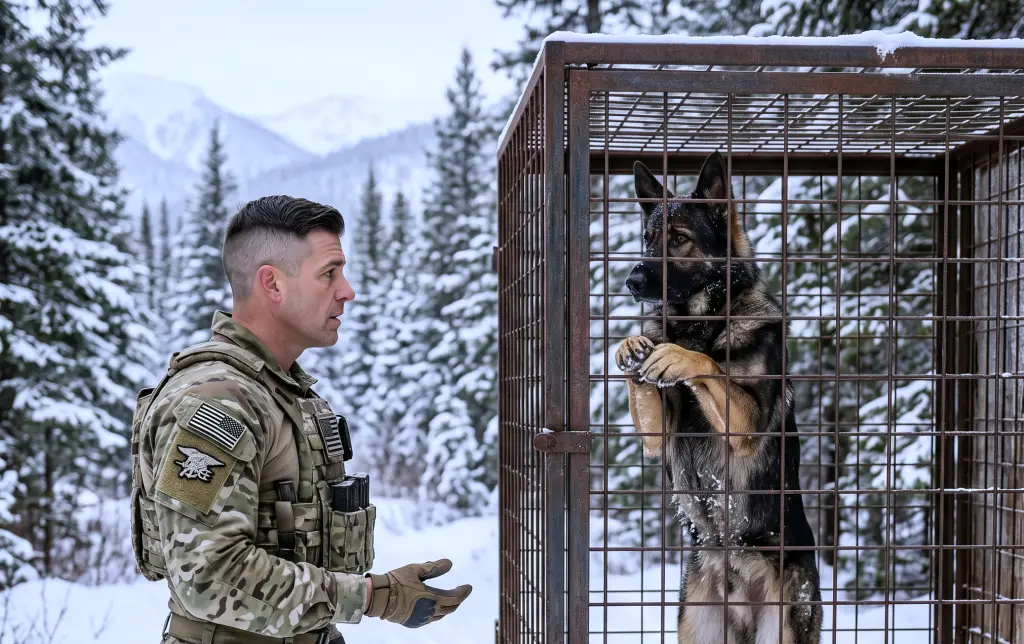
I was taking the forest service road slowly, letting the tires find their grip on the hard-packed ice. My hands rested lightly on the wheel of the truck, steady by habit. At forty, I had long since stopped trying to unlearn the physical habits of my past. My posture remained upright without any conscious effort, a byproduct of a life where discipline had settled deep into the marrow of my bones and decided to take up permanent residence. I wore a long-sleeved camouflage top that fit close to my broad shoulders, and the tactical belt secured at my waist felt as natural as a second skin. Even isolated out here, I kept my dark hair clipped in a neat undercut. My blue-gray eyes tracked the tree lines and the imposing snowbanks out of pure instinct, a scanning rhythm burned into me long before I ever retired to this quiet mountain road.
I wasn’t up here to take in the scenery. My phone had rung late the night before. It was Nolan Briggs, the local sheriff, his voice carrying the gravelly, exhausted weight of a man who had seen too much. Nolan, a stocky, practical man in his mid-fifties with thinning gray hair, possessed a streak of pragmatism that ran far deeper than the badge pinned to his chest. He had asked, with a quiet urgency, if I would mind taking a ride up to a remote stretch of the forest. The locals had been complaining about off-rhythm chainsaws echoing through the valleys—the erratic, hurried sounds that definitely didn’t belong to the permitted, legal logging crews.
Nolan trusted me with requests like this because I didn’t exaggerate, and I didn’t waste oxygen on unnecessary words. I had agreed immediately. After leaving the Navy SEALs, I had carved out a quiet, solitary existence in a small cabin near the town of Pineville. I kept strictly to myself and avoided the messy entanglements of civilian life, but the one thing I had never managed to unlearn was how to ignore a wrong sound in the woods.
As the truck climbed higher into the thin air, the dense pines gave way to jagged, exposed rock and wind-scoured drifts of snow. I eased my foot off the accelerator. Every instinct I possessed was suddenly humming, sensing that something was profoundly off a full minute before my eyes confirmed it.
And then, I saw it.
Sitting just beyond the edge of the tree line, right where the mountain plateaued into a narrow, desolate ridge, sat a structure that had absolutely no business existing in this landscape. It was a crude metal cage, elevated off the frozen earth on rough, splintering wooden supports. A thick crust of frost coated its heavy iron bars. Whoever had built it had bolted the pieces together with heavy, rusted wire and secured the main door with a corroded brass padlock.
A thin, pathetic metal pipe protruded from one corner of the enclosure, trailing a meager thread of gray smoke that drifted uselessly, helplessly, into the freezing expanse. The entire setup felt deliberate. It was careful, but in a deeply disturbing way. It looked exactly like the work of someone who had gone out of their way to ensure that suffering lasted as long as physically possible.
I shifted the truck into park and stepped out into the blinding white. My heavy boots crunched loudly against the compacted snow. The cold bit into my face immediately, stinging my cheeks, but my breathing remained perfectly even. I approached the structure with measured, silent steps, my right hand hovering instinctively near my tactical belt, even though the only visible threat was the howling wind.
Inside the rusted steel confines stood a dog. He was a German Shepherd, full-grown, with a massive, powerful frame that commanded respect even in his severely weakened, shivering state.
Clumps of snow and ice clung desperately to his thick black and tan coat, matting heavily along the dark, charcoal saddle of his broad back. His ears were pinned upright, trembling violently with the chill, but his amber eyes locked onto my movements with a razor-sharp, unwavering focus. The look in his eyes shattered me. It wasn’t the wild, frantic gaze of a panicked beast, nor was it the pleading look of a broken pet. It was hyper-alert, the deeply ingrained vigilance of a creature that had been forced to learn situational awareness as his only survival skill.
I noticed immediately that he favored one of his front legs, holding the paw slightly above the frozen floor grates. The subtle, painful limp whispered the story of an old, traumatic injury that someone had callously ignored.
He didn’t bark. He didn’t make a sound. And that absolute silence, more than the cage itself, told me everything. This was no accident.
I stepped up to the bars, my heart hammering a slow, angry rhythm against my ribs as I took in the horrific micro-details of the scene. An empty, dented metal water bowl was frozen solid to the floor. Around it, frantic, shallow scrape marks marred the icy metal where desperate claws had tried to dig for an escape. Around the shepherd’s thick neck, I saw a terrible, faint groove worn deep into his fur, a permanent indentation where a heavy collar or a short tether had pressed into him for months, maybe years.
This wasn’t the result of a panicked owner abandoning a dog on the side of a highway. This was methodical. This was a calculated execution.
Someone had locked this magnificent animal in here knowing exactly what the brutal mountain winter would do to him over the course of a few days. They hadn’t bothered to bring a gun. They clearly hadn’t wanted to leave blood in the pristine snow. They had simply assigned the silent, thorough winter to finish their dirty work.
I dropped slowly to one knee, bringing my face level with the dog’s, and met his piercing amber gaze. Up close, I could see his massive chest rising and falling in shallow, rapid hitches. His breath puffed in frantic white clouds. Every muscle in his body was pulled tight as a bowstring, as if he were holding his very life together by nothing but sheer, stubborn will.
His expression remained remarkably watchful. He was assessing me, weighing whether this stranger in camouflage was simply the next phase of the torture that had brought him here, or if I represented a break in the horrific pattern.
I reached my hand out toward the rusted bars, moving with agonizing slowness, keeping my palm open and flat.
“Easy,” I murmured. My voice was pitched low and steady—the exact tone I relied on when approaching volatile men who hadn’t yet decided if they were going to fight or surrender.
The shepherd’s dark nose twitched, pulling in my scent. He hesitated for a fraction of a second, then took one agonizing, cautious step forward. His heavy nails scraped against the icy metal floor.
It took me less than sixty seconds to destroy the lock. Pulling a compact, heavy-duty breaching tool from my belt, my hands worked through the intricate mechanics effortlessly, completely ignoring the biting cold numbing my fingers.
When the heavy iron door finally groaned open, the dog froze. His muscles coiled tight. It was as if the concept of open space, of freedom itself, had become an alien, terrifying thing to him. Then, inch by inch, he stepped out of the enclosure. It was only then, without the bars to support him, that the crushing, devastating weight of his total exhaustion became painfully visible. His back legs trembled so violently they nearly gave out.
Without a conscious thought, I shrugged off my heavy, insulated outer layer and draped it gently over his broad, shivering back. I scooped the massive animal into my arms, lifting him with a smooth, controlled effort. The contradiction of his weight shocked me. He was heavy with dense bone and muscle, yet terrifyingly light with starvation and loss.
As I turned my boots back toward the idling truck, the shepherd twisted weakly against my chest. He lifted his heavy head and looked back toward the dark, forbidding line of the forest below the ridge. His ears were pricked forward despite the paralyzing cold, his amber eyes drilling into the shadows of the pines. He wasn’t looking at the cage that had nearly been his tomb. He was looking far past it, deeper into the woods, as if something unseen, something terrible, still mattered in that darkness.
I paused mid-step, a horribly familiar, icy tightness forming in the center of my chest. In my former life, I had learned the hard way to pay deep, obsessive attention to quiet moments exactly like this. I knew better than to ignore the silent signals that offered no immediate explanation.
I carried him the rest of the way to the truck, settling his wrapped body incredibly gently onto the passenger seat, and cranked the heater dial all the way to maximum.
The drive back down the mountain was agonizingly slow. I kept my left hand firmly on the steering wheel and rested my right hand softly near his flank, feeling the violent, rhythmic tremors wracking his body begin to ease only a fraction as the artificial warmth washed over us.
I watched him closely out of the corner of my eye. I noticed the hyper-vigilant way he processed our environment. When the wind howled and buffeted the truck’s metal frame, his ears swiveled. When the suspension groaned over a deep rut in the ice, his muscles flinched. Every single noise was registered, cataloged, and committed to memory.
This was no lost family pet. This was an animal that had been given a job, a dog systematically trained to associate specific environmental patterns with brutal outcomes.
We were about a third of the way down the winding mountain pass when something happened that caused my grip to whiten on the steering wheel.
Without warning, the shepherd dragged his heavy head up from the seat and let out a low, terrifyingly restrained growl. It wasn’t an aggressive, senseless noise. It was an urgent, calculated warning. His amber eyes were blown wide, fixed rigidly on the passenger-side rearview mirror, staring at the empty, snow-covered road stretching out behind us.
I snapped my gaze to my own mirror, my pulse spiking.
There was absolutely nothing there. No headlights cutting through the glare, no movement in the brush, nothing but the endless expanse of white snow and the pale, uncaring sky. Yet, the dog’s body remained locked in a state of absolute tension. His breathing quickened into sharp, ragged pants. It became chillingly obvious that he wasn’t reacting to a current, physical threat. He was responding to a ghost. He was responding to a memory.
I pressed the brake pedal anyway, slowing the heavy truck to a crawl, my eyes scanning the dense tree lines for the slightest anomaly.
Eventually, the low growl faded back into his chest, replaced by an intense, thousand-yard stare directed out the windshield. But the heavy, suffocating weight of that moment lingered in the cab, thick with unanswered, dangerous questions. Whoever had hauled this magnificent creature up a mountain to die, their work wasn’t finished.
By the time my truck finally crunched up the driveway to my secluded cabin near Pineville, the morning sun had crested higher into the sky, turning the surrounding snowfields into an ocean of blinding light.
I gathered him into my arms again and carried him through the front door, bypassing the furniture to set him down gently on a thick rug right beside the cast-iron wood stove. I moved with deliberate, calming slowness, offering him tiny, measured amounts of tepid water in a bowl, knowing that rushing his hydration could send his compromised system into shock.
He lapped at the water weakly, accepting the lifeline, but he never surrendered his tactical awareness. His eyes tracked my every movement across the small room; his ears flicked toward the window at the faintest sound of shifting snow.
As the ice finally melted from his coat, the true map of his suffering revealed itself. I gently parted the fur along his shoulder and found thick, raised ridges of old scar tissue. And there, tangled deep in the matted fur near his ribcage, I found a horrific keepsake: a small, blackened piece of scorched nylon, burned and melted directly into his coat.
It looked exactly like a fragment of a heavy-duty canine tactical harness, violently destroyed by heat or direct flame. It was a brutal souvenir from a former life.
I walked over to the kitchen counter, leaned my hips against the wood, and crossed my arms, studying the animal breathing quietly by the fire. In any other civilian life, a normal man would have reached for the telephone. He would have called animal control, filed a report, and washed his hands of the tragedy.
But the brutal, unforgiving mountain hadn’t randomly selected another man. It had specifically chosen that icy road, that precise, desperate hour, and it had chosen me.
I felt the familiar, heavy mantle of responsibility settle squarely onto my shoulders. It was the exact same, cold feeling in my gut that used to wash over me in the final, agonizing minutes before a black-ops mission, right when you realize that the margin for error has completely evaporated.
I had no idea who had bolted that dog into the freezing iron cage, and I didn’t yet know why. But I knew one thing with absolute, chilling certainty: this was not a story that was simply going to end with a successful rescue.
The shepherd finally let out a long, shuddering sigh and lowered his massive chin to his paws. His breathing was starting to even out, the frantic hitches smoothing into a steady rhythm. He lifted his gaze and met my eyes across the room. His stare was steady, unblinking, and profound. He wasn’t overwhelmingly grateful, and he certainly wasn’t afraid. He was simply present. He was ready.
I gave him a single, slow nod, offering a silent vow of acknowledgment.
Outside the thick log walls, the brutal wind continued to tear through the pines, carrying the lethal cold down from the high ridges. But inside the four walls of my cabin, a fragile, definitive line had just been drawn against the darkness. Somewhere out there, hidden just beyond the safety of the tree line, a deeply unanswered question was waiting. And I understood, with a profound, icy calm that frankly surprised me, that I had officially crossed over into that waiting darkness the exact second I shattered the padlock.
The pale winter sun vanished behind the towering pines, dragging the isolated town of Pineville into that heavy, blue-gray quiet that always precedes true night. My cabin sat near the edge of the tree line—not totally off the grid, but far enough away to discourage casual visitors. Inside, the cast-iron wood stove radiated a steady, patient heat, exactly the way I liked to keep my life. I had laid the shepherd on a thick, folded wool blanket right beside the hearth, taking extra care with his damaged front leg. I watched closely as the warmth finally touched him, but he didn’t melt into the fabric the way a normal, exhausted stray would.
Instead, he curled tightly inward. His heavy muscles remained locked in a state of permanent anticipation, as if the mountain’s freezing cruelty had seeped directly into his marrow and simply refused to thaw. In the flickering firelight, the sheer size of him was undeniable. Even severely emaciated, he easily weighed ninety pounds. His thick, weather-built coat cast a striking silhouette against the rug, though the dark, charcoal saddle along his spine looked almost charred where frost and old grime clung stubbornly to the fur. Every time the wood stove cracked, every time the brutal wind whispered against the frosted windowpanes, his upright ears swiveled like radar dishes. Whenever he shifted his weight, that injured front paw hovered just a fraction of an inch above the floor, unwilling to trust the ground beneath him.
And his amber eyes rarely left me. It wasn’t a pleading look, nor was it fueled by fear. It was a deeply measuring gaze. I knew that specific look intimately. I had seen it staring back at me from bathroom mirrors years ago, in the immediate aftermath of overseas deployments where my body had returned to American soil, but my mind had remained hyper-alert, endlessly waiting for the next door to be breached.
I dialed Dr. Mara Voss while I waited for the kettle to boil. Mara was a godsend in these parts—a woman in her early forties who possessed a quiet, unshakable competence born from countless midnight emergencies. Her battered Subaru Outback crunched up my icy driveway less than thirty minutes later. She stepped into the cabin, shrugging out of her heavy parka, moving with an unhurried grace that instantly lowered the temperature of the room. Her brown hair was pulled back into a practical, low tie, framing a face that was sharp, intelligent, and deeply kind. Her hands bore the faint, silvery scars of a woman who had dedicated her life to healing terrified creatures that didn’t always understand they were being helped.
She knelt beside the dog immediately, her voice dropping to a soft, melodic hum. She didn’t reach for him right away; she simply offered her leather-gloved hands, letting him pull her scent in, letting him establish the boundary.
“Severe hypothermia,” Mara murmured after several long minutes of careful examination, her professional tone doing a poor job of hiding her quiet heartbreak. “Profound dehydration. And we’re looking at early-stage pneumonia, if I’m reading the rattle in these lungs correctly. But Cade… look at this.”
She gently parted the thick ruff of fur around his neck with two fingers, revealing the permanent, devastating groove worn deep into his skin. “He was tethered. On a very short, very heavy chain. It wasn’t recent, but he was held there long enough for it to physically shape him.”
She rocked back on her heels and looked up at me, her dark eyes piercing. “You didn’t stumble across him by accident up there, did you?”
“No,” I replied, the word tasting like ash in my mouth. “Someone put him there. On purpose.”
Mara’s jaw tightened. She nodded once, swallowing whatever rage she was feeling to focus on the patient. “Then we stabilize him first. Slow warmth. Fluids. Heavy antibiotics. No rushing.”
“His nervous system has been trapped in emergency mode for God knows how long,” she continued, expertly preparing a syringe. She administered a careful injection and wrapped the wool blanket more securely around his trembling frame, explaining each step of her process aloud, speaking as much to the dog to soothe him as she was to me. When she finally finished, she stood up, wiping her hands on a clean towel, her eyes lingering sadly on the massive animal.
“He’s not feral, Cade,” she added softly before stepping out into the cold night. “He’s highly trained. Or, at least, he was.”
That night, I didn’t sleep in my bed. I dragged a heavy armchair closer to the stove and stayed there, my boots still laced up, my jacket draped over the armrest within easy reach. The shepherd barely slept at all. He dozed in agonizingly short, ten-minute intervals, his head snapping up at the slightest ambient noise in the house. When the howling wind rattled the stone chimney, a low, rumbling growl vibrated deep in his massive chest. It wasn’t loud enough to sound an alarm, but it was just enough to announce to the empty room that he was awake, and he was aware. I watched him through the shadows, saying absolutely nothing. In my life, I had learned the profound value of total silence when dealing with a broken soul that was trying to decide if you were worth trusting.
By the time the morning sun washed the cabin in pale light, his legs had found a fraction of their strength. He began to pace the small perimeter of my living space. I noticed immediately that he always positioned his massive body between me and the front door, or between me and the large bay windows. He was establishing a defensive perimeter.
Later that afternoon, I reached for a heavy coil of nylon rope resting near my workbench to tie off a loose tarp outside. The moment my hand touched the cord, the dog froze solid. The hackles along his spine shot up like needles, his breathing hitching into a rapid, panicked rhythm.
I dropped the rope instantly, holding both my empty hands up, and took three slow steps backward. The intense physical reaction faded from his body, but the memory of his terror stayed burned into my mind.
“Bishop,” I said softly later that evening, testing the sound of the name as he stood squarely in the center of the doorway, watching the evening snow begin to fall. The name fit him perfectly. It matched the regal, serious way he held his damaged frame—grounded and stoic, like a battered knight guarding a deeply sacred truth.
At the sound of the word, his large ears twitched. He didn’t turn his head to look at me, but the rigid line of his shoulders softened by a fraction of an inch. I took that subtle relaxation as total acceptance. He was Bishop now.
Over the course of the next two days, Bishop’s strength returned in small, carefully measured increments. He began to drink fresh water without hesitation, he ate the small meals I prepared with slow, deliberate bites, and he finally allowed Mara to properly examine his injured leg when she returned. Her diagnosis was blunt: an old, untreated fracture that had healed crookedly, forcing the dog to compensate his movements, leading to a life of chronic pain managed entirely through stoic habit.
He accepted Mara’s gentle touch, but his amber eyes never stopped scanning the room. He reacted violently to the sound of heavy commercial logging trucks grinding their gears on the distant highway below town, a terrifying, guttural rumble building in his throat every time one passed. He also physically recoiled from the sharp, chemical smell of gasoline when I stepped outside to refuel the backup generator.
These were not random, generalized fears. These were highly specific associations—dark patterns burned into his mind by brutal repetition.
Late on our third night together, the war finally came to my front door.
I was standing at the kitchen sink, quietly scrubbing a cast-iron skillet, when Bishop suddenly vaulted up from the floor. His body went absolutely rigid, his amber eyes locked in a death stare at the heavy oak of the front door. Without making a single sound, he crossed the room, nudged his wet nose insistently against my thigh, and then turned back, pressing his face against the doorframe.
My heart kicked into a familiar, elevated gear. I didn’t hesitate. I grabbed my heavy canvas jacket and stepped out into the freezing blackness of the porch.
The midnight cold bit hard at my exposed skin, but Bishop pushed past my legs, leading me straight to the edge of the wooden steps. There, sitting menacingly, half-buried under a dusting of fresh snow, lay a massive steel animal trap. Its serrated iron jaws were heavily rusted but fully engaged, set to snap on a hair-trigger. The heavy steel chain attached to the trap trailed off, disappearing into the dark tree line.
Just beyond the trap, the pristine snow of my driveway was marred by deep, aggressive tire tracks. They were shallow but incredibly fresh, the crisp tread patterns still perfectly defined in the ice.
I crouched down, hovering my bare hand just above the freezing metal of the trap. The surrounding snow was kicked up and disturbed in a way that screamed of minutes, not hours. Someone had just been standing on my porch.
Someone had tracked us down from the mountain.
I stood up slowly, my eyes raking over the impenetrable darkness of the pines. There was no retreating engine noise, no flash of taillights, no physical enemy to confront. They had slipped away like smoke. Bishop stayed glued to my side. He wasn’t panicked, but his entire body was a coiled spring, his eyes tracking the invisible depths of the woods with terrifying intensity.
I felt the old, cold calculations surfacing in my mind—the deeply buried part of my brain that automatically measured distance, hostile intent, and reaction timing. Leaving this trap wasn’t a reckless prank. It was hostile reconnaissance. It was a test to see how I would react.
I carefully disarmed the heavy trap, carried the rusted iron inside, and locked the deadbolt. I spent the remainder of the night sitting wide awake in the dark, watching the tree line.
When morning broke, I called Sheriff Nolan. He arrived before midday, his heavy winter coat dusted with fresh powder, his lined, weathered face tightening into a furious scowl the second I showed him the trap on my kitchen table.
“We’ve had scattered reports all winter,” Nolan muttered, rubbing his jaw in frustration. “Rumors of organized poaching, illegal logging operations tearing up protected land… but nothing concrete. Nothing we could make stick.”
He slowly turned his gaze toward Bishop, who was sitting perfectly still, watching the sheriff with steady, assessing eyes. “But this right here… this changes the game entirely.”
Bishop remained anchored near my side throughout the entire conversation, his massive presence projecting a calm, deliberate strength. When Nolan finally stood up to leave, Bishop followed him silently to the door. Then, the dog stopped. He sat down squarely in front of the exit, physically blocking the door until Nolan was forced to turn around and look at him. For a long, silent moment, the veteran sheriff and the battered dog simply regarded each other.
Nolan let out a heavy breath and nodded slowly. “Looks like he’s made his choice on who he trusts,” he said quietly.
That evening, as the violet light faded from the sky once again, I sat down on the top step of the porch. Bishop immediately settled in right beside me, his solid weight pressing against my leg. The surrounding forest was eerily quiet, wrapped in that deceptive, beautiful stillness that perfectly hides malevolent movement.
I rested my bare hand flat against Bishop’s broad neck, feeling the strong, steady pulse of real warmth flowing through him now. As I sat there in the freezing air, I realized something with a startling, crystalline clarity.
Whatever brutal crimes had been committed against this dog, they were far from over. And whatever dark secrets Bishop held locked inside his memory, they were going to matter. A warm fire and a safe room could save a broken body, but it could not erase a violent history written directly into muscle and instinct. And I, a man who had learned the hard way that a haunting memory is not an enemy but a crucial warning signal, fully accepted that our story was only just beginning.
The heavy, deliberate knock against my front door echoed just after noon. It was a sharp, practiced rhythm that immediately felt wrong—it didn’t hold the polite hesitation of a neighbor or the friendly rap of a delivery driver. I heard it from the back of the cabin, but Bishop registered the disturbance a full half-second before the sound waves even reached me. The massive dog pushed up from his resting place by the frosted window, his entire body stiffening into a rigid line. His ears locked forward, and a deep, unsettling vibration started deep within his chest, a primal rumble that never quite escalated into a full growl.
I wiped my hands on a towel, crossed the scarred wooden floor, and pulled the door open.
Three men stood on my porch. The snow clung thick to their heavy work boots, and they carried a relaxed, entitled confidence that felt entirely rehearsed. They were dressed in the uniform of the mountain—scuffed canvas jackets, thick cargo pants stained with dark pine sap and dirt, and insulated gloves. To a passing glance, they looked exactly like any other seasonal logging crew drifting through Pineville to chase winter wages. But their eyes told a much colder story.
The man positioned in the center was tall, with a long, narrow jawline and a beard that was trimmed just neatly enough to look calculated. His eyes were restless, constantly flicking past my shoulder, greedily trying to catalog the interior of my home. The man to his left was built like a cinderblock, his wide face flushed a dark, mottled red from either the biting cold or cheap liquor. He possessed an anxious energy, his heavy hands moving constantly, thick fingers tapping a restless, counting rhythm against his thigh. The third man, shorter and possessing a tightly coiled, wiry frame, lingered slightly behind the others. His pale, hooded eyes were utterly devoid of emotion, a blank, deadened expression that my past life had taught me to deeply distrust.
“We’re out looking for our dog,” the tall man announced. His tone was casual, aggressively friendly in a way that set my teeth on edge. “Name’s Bishop.”
He pulled a smartphone from his jacket pocket, tapped the screen, and shoved it toward my face. It displayed a grainy, poorly lit photograph of a German Shepherd taken from a considerable distance. The blurry animal in the image could have been any large dog on the continent if you didn’t know the specific scars to look for. “He went missing on us a few days back. Word around town is that you brought a stray down off the mountain.”
Before I could even draw a breath to respond, Bishop moved.
He stepped out from the shadows of the living room and planted his heavy frame squarely between my legs and the open doorway. His entire demeanor transformed in a heartbeat. His broad shoulders squared off, his magnificent head lifted high, and the thick ridge of dark fur along his spine stood straight up. He didn’t bare his teeth, but his jaw was tight, absolutely ready for violence if required. His glowing amber eyes locked onto the three men with a freezing, unblinking intensity that made the wiry man in the back immediately shift his weight.
This wasn’t a display of canine fear. This was absolute, undeniable recognition. I felt the truth of it click securely into place inside my chest.
“He’s recovering from severe trauma,” I said, keeping my voice utterly calm and flat. “If you genuinely believe he belongs to you, there’s a legal process to follow.”
The red-faced man let out a wet, dismissive snort. “Process?”
“A microchip scan, verified veterinary records, and legal proof of ownership,” I replied. My tone remained conversational, almost bored, but I didn’t shift an inch from the threshold. I let Bishop hold the front line. “He was discovered locked inside a rusted cage up on the high ridge, severely hypothermic and suffering from long-term injuries.”
The tall man’s artificial smile grew paper-thin. “Accidents happen out there in the timber. Dogs wander off.”
With exaggerated, theatrical care, he reached into his inner pocket and produced a piece of folded white paper, smoothing the creases against his leg. “Here you go. Bill of sale. Breeder information. This should be more than enough to clear things up.”
I reached out and took the paper, but I didn’t bother looking down at it. I kept my eyes locked on their faces, carefully noting the way the tall man leaned into my personal space, trying to crowd the doorway, and the sinister way the quiet, wiry man’s eyes tracked the subtle tremor in Bishop’s injured front leg. Bishop let out a low, precise growl at the man’s lingering stare, and the red-faced man’s tapping fingers instantly froze against his thigh.
I finally glanced at the document. It was a joke. It was a generic, cheaply printed template. The supposed breeder’s name was blatantly misspelled, and the dates of the transaction contradicted each other. I held it back out to him.
“I’ll have the local sheriff review this,” I said evenly. “Until then, the dog stays with me.”
The tall man’s jaw muscles feathered. “Listen, buddy. You don’t have to make this difficult for yourself.”
“I’m not making it difficult,” I answered smoothly. “The law is.”
Bishop took one deliberate half-step forward. His heavy nails clicked a single, sharp warning against the wooden floorboards. The three men exchanged a loaded, silent glance. The red-faced man turned his head, spat a wad of saliva into the pristine snow beside my stairs, wiped the back of his hand across his mouth, and let out a humorless, dry laugh.
“You’re holding onto valuable property that isn’t yours,” he sneered.
I met his bloodshot eyes and held them. “And you’re standing on my porch.”
The silence stretched between us, brittle and dangerous as thin ice. Finally, the tall man took a slow step backward, raising his gloved hands in a gesture of mock surrender. “Fair enough. We’ll be back,” he said, his voice dropping its friendly pretense. “Once you’ve had a little more time to think things through.”
As they turned their backs and trudged toward their heavy work truck, the shorter, wiry man glanced over his shoulder one last time. His pale eyes narrowed as he stared at Bishop, committing every detail of the dog, and my home, to memory. The truck’s massive engine roared to life at the bottom of my driveway, the heavy tires spinning aggressively, spitting gray slush across the yard before finally finding traction.
Bishop didn’t relax a single muscle until the harsh sound of their engine was entirely swallowed by the mountains. Only then did he let out a long, slow exhale. The tension in the air eased, but the threat lingered like smoke. I pushed the door shut, engaged the heavy deadbolt, and crouched down on the floor beside him. I pressed my palm flat against his broad chest.
Beneath his thick fur, I could feel his heart hammering a frantic rhythm against his ribs. It wasn’t beating out of panic, but from something much older and far darker. “You know exactly who they are,” I murmured softly, not expecting any answer. Bishop’s tall ears twitched in response.
I grabbed my phone and dialed Sheriff Nolan immediately. Nolan pulled up to my cabin less than an hour later, his heavy uniform coat unbuttoned in his haste, his breath pluming in white clouds as he listened to my recounting of the confrontation. He studied the absurd, misspelled bill of sale I had managed to photograph, let out a sharp, disgusted snort, and tucked his phone away.
“We’ve been hearing whispers all season,” Nolan said, his expression grim. “Unmarked, illegal traps turning up, clear-cutting in protected zones where no crews should be operating. These phantom teams move fast, strip the land, and leave nothing behind but rumors and damaged trails.”
He looked down at Bishop, who was standing a protective watch at my knee. “This beautiful animal didn’t just wander into trouble, Cade. Trouble used him.”
By late afternoon, the main road winding below the town saw a heavier flow of commercial traffic than usual. The deep, grinding roar of heavy diesel engines echoed up the valley. Every single time a truck shifted gears in the distance, Bishop’s entire body stiffened, and that low, dangerous sound rumbled deep in his throat. He paced restlessly back and forth in front of my windows, lifting his dark nose to the drafty glass, catching faint, metallic scents carried on the wind that my human senses couldn’t detect—the sharp tang of gasoline, the heavy odor of machine oil, the smell of cold, raw steel. These weren’t random anxieties. They were meticulously cataloged trauma responses, hardwired into his brain under immense, cruel pressure.
I stepped out the back door just before dusk to check the fuel levels on the generator. Bishop shadowed my every step, but he stopped dead right at the edge of the cleared yard. He lowered his massive head, took a long, deep sniff of the powdery snow, and then moved with intense, deliberate focus to a specific spot near the encroaching tree line. He sat down heavily and simply stared at the brush.
I walked over, knelt in the freezing snow, and used my gloved hand to gently brush away the fresh layer of powder.
Hidden beneath the snow lay a bright, synthetic strip of red survey tape. It was tied loosely to a low-hanging pine branch, fluttering faintly, almost invisibly, in the evening wind. It was a marker. It wasn’t a physical threat just yet—it was a silent, arrogant message.
A coldness that had absolutely nothing to do with the winter air washed over me. This was no coincidence. One of those men had been close enough to my home to physically tag my propertyline, slipping in and out entirely unseen while I was distracted.
I pulled the red tape free from the branch and shoved it deep into my pocket. Bishop remained perfectly still, his eyes tracking the darkening woods for several long seconds before turning to meet my gaze. There was no panic in his amber eyes. There was only absolute certainty.
In that freezing moment, I fully understood the massive miscalculation those three men had made. Bishop wasn’t just a piece of valuable equipment they wanted to reclaim. He was a survivor. He was a living witness to their crimes.
That night, I meticulously secured every window and door of the cabin, walked the outer perimeter twice, and slept with one eye open. In the darkest, coldest hours of the early morning, Bishop woke me with a gentle, insistent nudge of his nose against my hand. He waited until I sat up, fully alert, before circling twice and settling back down on the rug, satisfied that I was standing watch.
Morning arrived in shades of flat, unforgiving gray. Nolan called my cell right at sunrise to confirm my suspicions: reports were trickling in of similar, rough-looking men asking pointed questions at the local diner and the gas station, flashing rehearsed smiles and waving thin, worthless papers.
I looked down at Bishop. He sat tall beside my chair, his posture regal and steady, quietly guarding a dark truth that violent men desperately wanted buried under the mountain snow. They had tried to lay a claim on him, but their claim rang hollow against the reality of his scars.

About Daniel Carter
Daniel Carter is a staff writer at InspireChronicle, specializing in emotional real-life stories, family conflicts, and life-changing moments. His work focuses on powerful narratives that explore resilience, difficult decisions, and the human side of everyday struggles.
With a storytelling style that blends realism and emotion, Daniel’s articles have resonated with a wide U.S. audience. He writes about family dynamics, personal growth, and the hidden truths behind life’s most challenging situations.
Popular Topics
- Family conflicts and inheritance disputes
- Emotional life stories and personal growth
- Real-life justice and moral dilemmas