
Part 1
The first thing I noticed was the smell—sharp antiseptic and something metallic under it, like pennies rubbed between fingers. The second was the light. It came from above in an unforgiving white, washing the room clean of shadows and leaving nowhere for the truth to hide.
My eyes fluttered open and a ceiling tile swam into focus. My body tried to sit up and immediately regretted it. Pain ran along my ribs in a hot line, and my left arm felt like it had been replaced with a heavy plank.
A nurse’s voice floated near my ear. “Easy. Don’t move too fast.”
I turned my head, and that’s when I saw him.
Grant sat in the chair beside my bed, leaning forward like a devoted husband in a daytime drama. His hair was neatly combed. His shirt was the good one. He had that practiced half-smile, the one he used with waiters and neighbors and anyone who might later tell a story about what a nice man he was.
“There she is,” he said softly. He reached up and brushed my knuckles with his thumb, gentle enough for anyone watching to believe it. “Hey, babe. You’re okay. You’re safe.”
Safe. The word sat on my tongue like a lie I couldn’t swallow.
I tried to speak and my throat scraped. “Where…?”
“Hospital,” he said quickly, as if he’d been waiting for the cue. “You fell. I heard you cry out. I ran up the stairs. You must’ve slipped.”
His eyes held mine with a steady warmth that would have fooled a stranger. But I knew where the warmth ended and the calculation began. I knew which parts of him were real and which were costume.
I blinked and the memory came in flashes—kitchen tile under my bare feet, the smell of dish soap, Grant’s voice rising over something stupid, me saying I didn’t want to argue, his hand slamming the counter, my heart starting to gallop. Then his fingers in my hair. A sudden pull. A shove that sent the world sideways. My back hitting something hard. The room tilting away. Sound draining out like water from a tub.
I swallowed the memory back down because it hurt in ways the bruises didn’t.
A doctor in blue scrubs stepped in, a clipboard tucked under one arm. She had calm eyes and a face that didn’t try too hard to be kind. Her badge read: Dr. Patel.
“Good morning, Nora,” she said, glancing at the monitor. “I’m Dr. Patel. How are you feeling?”
Grant answered before I could. “She’s a little shaken. She fell down the stairs. She’s always been kind of clumsy.” He laughed lightly, as if it were a shared joke.
Dr. Patel looked at him, then at me. “Nora?”
I shifted my gaze to the bed rail. My mouth wanted to form the easiest answer, the one that would keep the peace. That reflex lived deep in me after eight years. It was automatic, like flinching away from a hot stove.
“I—” I began.
Grant squeezed my hand. Not hard. Just enough to remind me he could.
Dr. Patel’s eyes moved to my hand, to his hand on mine, to the bruising that had blossomed across my wrist like dark ink.
Her voice stayed neutral. “We did some imaging. You have two fractured ribs and a fracture in your left forearm. There’s also bruising consistent with impact.”
Grant nodded vigorously. “Stairs are dangerous. We’ve been meaning to fix the carpeting.”
Dr. Patel didn’t nod back. She flipped a page on the clipboard. “Nora, have you fallen before?”
My heartbeat thudded in my ears. I kept my eyes lowered. In my mind, a list unrolled like a scroll I couldn’t stop: the time I “walked into” a cabinet door, the time I “slipped” in the shower, the time I “tripped” over a curb, the time I “got dizzy” and fell in the laundry room.
Grant’s voice cut in again. “She’s had a few accidents. She’s stressed. Work’s been a lot.”
Dr. Patel’s eyes returned to me. “Do you feel safe at home?”
Grant’s thumb paused on my knuckles. The room seemed to hold its breath.

I could have said yes. I had said yes before. I had said yes to police officers who’d shown up after a neighbor called about shouting. I had said yes to friends who asked why I stopped coming around. I had said yes to myself in the mirror, whispering it like a spell.
Yes kept me alive, I told myself. Yes kept the storm from breaking.
But something in Dr. Patel’s gaze made it hard to lie. It wasn’t pity. It wasn’t anger. It was recognition, like she’d seen this story before and knew exactly where the script usually went.
My lips parted. I looked at Grant’s smile. His confidence. The way he sat there like the hero of my life.
And I thought about what happened when I passed out. He hadn’t called 911 because he panicked. He’d called because he needed the story. He needed witnesses. He needed paperwork that said accident.
He needed me alive so I could keep being his.
Dr. Patel stepped closer, voice still even. “Nora, I’m going to ask Grant to step out for a moment so I can speak with you privately. It’s standard procedure.”
Grant’s smile tightened. “Is that necessary? I’m her husband.”
“It’s policy,” Dr. Patel said.
Grant’s gaze flicked to mine, sharp under the softness. He held it there, warning without words. Then he stood slowly, chair scraping the floor, and set his hand on my forehead like a blessing.
“I’ll be right outside,” he murmured, for the room’s benefit.
When the door clicked shut behind him, the silence changed. It wasn’t empty. It was space.
Dr. Patel pulled the curtain partly closed and lowered her voice. “Nora, I need you to hear me clearly. You are not in trouble. I’m not here to judge you. But your injuries don’t match a simple fall.”
My throat tightened. “What does that mean?”
“It means,” she said gently, “that I’m concerned someone hurt you.”
The words landed like a stone dropped into still water. Ripples spread through my chest, and suddenly I couldn’t stop shaking.
I stared at my hands. My voice came out small. “If I say something… he’ll—”
Dr. Patel’s tone stayed steady. “If you say something, we can help you. We can involve a social worker. We can keep you here until you have a safety plan. And yes, we can contact law enforcement if you want. But you don’t have to decide everything in one minute.”
My vision blurred. I tried to blink it away.
In my mind, Grant’s voice echoed from a hundred nights. No one will believe you. You’re too emotional. You can’t make it on your own. You’ll ruin everything.
I swallowed hard and finally looked at Dr. Patel. “He did it,” I whispered. “It wasn’t the stairs.”
Dr. Patel didn’t gasp. She didn’t look shocked. She just nodded once, like she’d been waiting for the truth to have somewhere safe to land.
“Okay,” she said. “Thank you for telling me. You did the right thing.”
I didn’t feel brave. I felt terrified.
Dr. Patel opened the door just enough to speak to someone in the hall. “Can you ask social work to come to room twelve? And security, please.”
I heard footsteps. Voices.
Then Grant’s voice, light and confused. “Everything okay in there?”
Dr. Patel stepped into the doorway, blocking his view of me. “We’re still evaluating Nora. We’ll update you soon.”
Grant’s smile appeared again, but it didn’t reach his eyes. “Sure. Of course.”
Through the narrow gap, I saw his face change when he realized he wasn’t in control of the room anymore.
It was subtle. A flicker. A crack.
But I saw it.
And for the first time in a long time, I thought: maybe he isn’t untouchable after all.
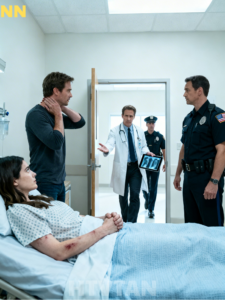
Part 2
The social worker’s name was Denise. She had a warm voice that didn’t try to force comfort and a clipboard that looked like it had been through wars. She pulled a chair close to my bed and spoke like we had all the time in the world.
“First,” she said, “we’re going to make sure you’re safe in this hospital. Security is outside. Your husband will not be allowed in without your permission.”
My heart jumped. “He’ll be angry.”
Denise nodded as if anger were weather. “He might be. But here, you’re protected.”
Protected. Another word I didn’t trust yet, but I wanted to.
Dr. Patel returned with printed scans and spoke in calm, precise language. She pointed out bruising patterns, older healing injuries I hadn’t even realized were visible on imaging, the kind that didn’t come from slipping on stairs. Her voice stayed clinical, but the truth beneath it was loud.
Denise asked questions gently. “Has he choked you?” “Has he threatened you?” “Does he have access to firearms?” “Do you have anyone you trust?”
Each question felt like stepping on thin ice. I answered quietly, my words sticking.
“Yes.” “Yes.” “No.” “I don’t know.”
I had people. I’d just been trained to believe I didn’t.
Eight years ago, when I met Grant, I was twenty-six and hungry for stability. My childhood had been chaotic—parents who fought, bills that piled up, a constant feeling of needing to be easy to love so no one would leave. Grant arrived like a solution. He was charming, attentive, protective in a way I mistook for devotion.
He loved that I was organized. He loved that I had ambition. He loved that I laughed at his jokes.
Later, he loved that I listened. Then he loved that I stopped talking.
The first shove happened a year into marriage. We were arguing about something small—his drinking, my “tone,” the way I didn’t fold towels the right way. He shoved me, not hard enough to leave a mark, just enough to make me stumble.
His face changed immediately after, panic and regret turning into tears.
“I don’t know what came over me,” he said. “I’d never hurt you.”
And I believed him because I needed to. I told myself it was a one-time slip.
Then the slips became a pattern.
Over time, Grant learned how to hurt me in places clothes covered. How to apologize in ways that made me feel guilty for being afraid. How to isolate me without ever saying, You can’t see your friends.
He’d just sulk if I went out. He’d pick fights before plans. He’d text constantly while I was away—Where are you? Who’s there? Why aren’t you answering?
Eventually, staying home felt easier than paying the emotional tax.
He handled the finances “to help.” He encouraged me to quit my job “so you can focus on us.” When I resisted, he called me selfish. When I cried, he called me manipulative.
When I started keeping track of things in my head—the dates, the bruises, the threats—it wasn’t because I was plotting revenge. It was because I needed proof that I wasn’t crazy.
Grant’s favorite weapon wasn’t his fists. It was the way he rewrote reality.
That’s not what happened.
You’re exaggerating.
You’re too sensitive.
You fell.
You always fall.
Now, in the hospital, those words felt thinner, like paper held up to light.
Denise leaned in. “Nora, would you like us to contact the police?”
My stomach clenched. “If I do… he’ll come after me.”
Denise nodded. “That fear is real. We can help you request an emergency protective order. We can arrange a domestic violence advocate to meet you here. We can help you leave without him knowing where you’re going.”
Leave.
The word made my breath catch.
I had imagined leaving a thousand times and then imagined the consequences: Grant showing up at my parents’ house, Grant calling my employer, Grant telling everyone I was unstable, Grant smiling in court while I shook.
But I also imagined the other consequence: staying.
Denise slid a phone toward me. “There’s an advocate on call. You can talk to her without committing to anything.”
I stared at the phone like it might bite.
Then I took it.
The advocate’s name was Kelsey. She spoke softly, asked what I needed, didn’t push. She told me about shelters, about transitional housing, about legal help. She told me that the most dangerous time in an abusive relationship is when you try to leave, which made my blood run cold, but she said it in a way that felt empowering, not paralyzing.
“Planning is strength,” she said.
Grant was kept out for hours. He paced the hall, according to a nurse. He demanded updates. He tried to charm. He tried to intimidate. Each attempt was recorded in tiny notes on my chart and in security logs. Every time he raised his voice, the hospital quietly documented it.
At one point, Dr. Patel returned and said, “He’s insisting you fell down the stairs. I’m obligated to document my concerns. Hospitals are mandatory reporters in cases of suspected abuse. That means this is going to be taken seriously.”
I exhaled, trembling. “What happens now?”
“Now,” Dr. Patel said, “we make sure you don’t go back to danger.”
Later that afternoon, a police officer came to speak with me. She was a woman with tired eyes and a calm presence. She asked me what happened. I told the truth in pieces, stopping when my voice broke, starting again when I could.
The officer didn’t blame me. She didn’t ask why I stayed. She didn’t say anything that made me feel stupid. She took photos of my injuries with my permission. She noted the doctor’s findings. She asked if I wanted to press charges.
I looked at the ceiling tiles and thought about Grant’s certainty. His belief that I would always be quiet.
“Yes,” I whispered. “I do.”
When Denise returned, she had paperwork in hand. “We can arrange discharge to a safe location,” she said. “Do you have someone you trust?”
A name floated up from somewhere I’d buried it.
My cousin, Talia.
I hadn’t seen her in years, not because she didn’t care, but because Grant had made sure I felt too ashamed to reach out.
“Can I call her?” I asked.
Denise smiled softly. “Yes.”
My fingers shook as I dialed.
Talia answered on the second ring. “Nora?”
Something cracked open in my chest. “Talia,” I whispered. “I need help.”
There was a pause, then her voice turned clear and fierce. “Tell me where you are. I’m coming.”
For the first time in years, I didn’t feel like I was floating alone in deep water.
I felt a hand reaching in.
Part 3
They didn’t let Grant see me again.
When the nurses brought my discharge papers, they did it behind a closed door, with security outside and Denise standing between me and the hallway like a human shield. They gave me a small bag with pain medication, instructions for follow-up, and a card with hotline numbers printed in plain font.
The police officer returned with an update. “We’ve taken a statement. We’re filing an incident report. The doctor’s documentation is strong.”
Strong. Another word that felt strange pressed against my skin, but I held it anyway.
Talia arrived with a coat draped over her arm and a look on her face that made me want to cry and laugh at the same time. She didn’t bombard me with questions. She didn’t say I told you so. She hugged me carefully so she didn’t hurt my ribs, and when she pulled back her eyes were wet.
“We’re going,” she said, like it was the simplest thing in the world.
The hospital had an exit plan. They walked me through a side corridor and out a staff entrance into a parking lot where Talia’s car waited. The air outside was cool and smelled like wet asphalt. I felt exposed, like the sky could see everything I’d hidden.
We drove without speaking for a few minutes. My phone buzzed in my bag like a trapped insect.
Grant.
Grant.
Grant.
Talia glanced at me. “Want me to toss it out the window?”
I gave a shaky laugh that turned into a cough. “No. Evidence.”
“Look at you,” she muttered, half proud, half furious. “Already smarter than he thinks you are.”
At Talia’s apartment, she had a spare room ready. A clean bed. Soft light. Water on the nightstand. The kind of care that made me realize how starved I’d been for basic kindness.
That night, the fear arrived in waves. Every sound outside made my stomach clench. Every time Talia’s neighbor’s footsteps thumped in the hall, I flinched.
Grant sent messages that swung wildly.
Where are you?
Nora, please.
This is embarrassing.
You’re ruining my life.
Come home and we can talk.
You fell, you know you did.
If you do this, you’ll regret it.
I’m sorry, I’m sorry, I’m sorry.
By midnight, the apology texts turned colder.
You’re nothing without me.
No one will believe you.
You think you’re safe? You’re not.
Talia sat beside me on the couch, reading them over my shoulder, her jaw tight.
“We’re calling the officer back,” she said.
The next day, a victim advocate met us at a courthouse. I wore a borrowed sweater and sunglasses even though the sky was cloudy. Not for fashion. For hiding. For feeling less visible.
The advocate explained the process for an emergency protective order in clear steps. She didn’t sugarcoat the risks, but she didn’t paint me as helpless either.
I signed paperwork with my non-dominant hand because my left arm was splinted. My signature looked shaky and unfamiliar, like it belonged to a different woman.
Maybe it did.
A judge reviewed the request and granted a temporary order. It wasn’t a magic force field. It didn’t rewrite the past. But it was a line drawn in legal ink that said: he is not allowed near you.
When the officer called later to confirm Grant had been served, I felt my body exhale in a way I hadn’t realized it was holding.
Grant didn’t take it quietly.
He called my mother and told her I’d had a breakdown. He emailed my old boss, claiming I’d stolen money from work. He posted a vague social media status about “false accusations” and “betrayal.” He tried to control the story the only way he knew how: by making me look unstable.
But now, I wasn’t alone, and I wasn’t silent.
Talia helped me contact my parents first. My mother cried. My father went quiet in the way men sometimes do when they’re trying not to explode.
“Come home,” my mom said.
I almost said yes. The idea of childhood comfort tugged at me.
Then Kelsey, the advocate, reminded me gently: “Home can be safe, but it can also be a location he’ll check first.”
So we didn’t go to my parents.
We went to a confidential address through a local program that helped survivors relocate temporarily. It wasn’t a shelter exactly, more like a protected apartment with extra security and a staff member who checked in.
It felt strange to need that.
It also felt like relief.
Over the next weeks, I did things I’d been too afraid to do for years. I opened my own bank account. I applied for a replacement credit card in my name. I found my birth certificate, which Grant had kept in a “safe place.” I met with a legal aid attorney to start divorce proceedings.
Each task was small and exhausting, like lifting bricks one by one, rebuilding a life with sore hands.
Grant sent gifts to the apartment I wasn’t supposed to be found at—flowers, chocolates, a handwritten letter that smelled like his cologne. The staff intercepted them and documented everything.
One afternoon, Kelsey sat with me at a table and said, “I want you to understand something important. His charm is part of the abuse. The calm apology, the sweet voice, the gifts—it’s not separate from the violence. It’s the cycle.”
I nodded slowly. I knew it, but hearing it named made it harder for my mind to slip into old confusion.
Then Kelsey said, “And the hospital was the crack. The place where he lost control of the narrative.”
I thought of Dr. Patel’s steady eyes. The way she didn’t buy his story. The way she made space for my truth.
It wasn’t just that the doctor froze him.

Daniel Carter is a senior staff writer at InspireChronicle, specializing in legal conflicts, family disputes, and real-life justice stories. His work focuses on high-stakes situations involving inheritance, betrayal, and complex moral decisions. Through detailed storytelling, he explores how ordinary people navigate extraordinary challenges and the long-term consequences that follow.
His articles have gained significant traction online for their emotional depth and realism, resonating with readers across the United States.
He writes extensively about justice, personal responsibility, and the hidden dynamics within families.