
Part 1
The morning it happened, the kitchen smelled like burnt toast and old resentment.
Our house had always been loud, the kind of loud people mistook for warmth. Cabinets slammed. The TV stayed on even when no one watched it. Someone always had a complaint, a joke, a warning. As a kid I thought noise meant life. As an adult, I learned noise can be a shield, a way to keep truth from landing.
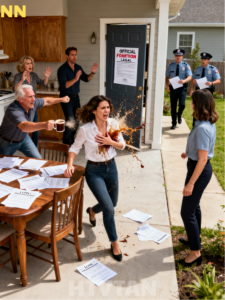
Dad stood at the counter in his work shirt, sleeves rolled, jaw tight like he was chewing nails. Mom hovered by the sink, hands busy with nothing, rinsing a clean mug as if she could scrub the tension out of the air. Clare sat at the table, twisting her wedding ring, eyes red. She didn’t look up when I came in.
James did.
He looked up the way a man does when he’s sure the room belongs to him. He had that easy smile that always arrived a beat early, like his face was trained to win arguments before they started. He was leaning back in Dad’s chair as if it had always been his. A set of paperwork lay spread across the table, crisp and official, with a pen placed on top like a trap baited with ink.
Dad tapped the papers. “Sit.”
I didn’t sit. I set my keys down slowly and looked at the stack. Car loan documents. Co-signer line waiting like a cliff edge.
“For Clare and James,” Dad said. “They need a reliable co-signer. You’ve got the best credit in the family.”
Clare’s shoulders tightened. Still she didn’t speak.
James lifted his hands, palms out, playing innocent. “It’s just to help us get approved. You won’t even feel it.”
I stared at him. It took everything in me not to laugh. Of course I would feel it. My credit would feel it. My future would feel it. Every apartment application, every mortgage, every job that ran a check would feel it. That’s what co-signing meant. It meant your name was collateral. It meant you were on the hook when the person who couldn’t qualify proved exactly why they couldn’t qualify.
“I’m not signing,” I said.
Dad’s face changed instantly, like someone flipped a switch. “You will sign,” he snapped.
I didn’t raise my voice. “No.”
Mom finally turned from the sink. “Honey, please. It’s your sister.”
Clare flinched at that, as if being reduced to a bargaining chip hurt worse than the obvious.
James leaned forward, voice soft and friendly. “Come on, man. It’s family.”
I held his gaze. “Family doesn’t require contracts.”
Dad stepped closer. He wasn’t a tall man, but he knew how to fill space. He’d been doing it my whole life, expanding his presence until everyone else shrank to make room. “You think you’re better than us,” he said. “You think because you did things the ‘right way’ you can stand there and judge. That’s not how family works.”
I could feel my heart pounding, not from fear but from that old reflex to give in, to smooth things over, to keep the peace even if it cost me something.
But there are moments when the cost becomes impossible to ignore.
“I’m not judging,” I said. “I’m protecting myself. And honestly, I’m protecting Clare.”
Clare’s head snapped up at that. Her eyes met mine, and in them I saw a flash of panic. Not at what I said, but at what I might say next.
Dad didn’t notice. Dad never noticed anyone else’s fear unless it threatened his control.
James sighed, exaggerated patience. “You’re making this dramatic.”
Dad slapped the table hard enough that the pen jumped. “Sign it, or get out of this family!”

The words hit like a door slamming. Mom’s mouth opened, closed. Clare’s hands clenched into fists. James sat back, smug, letting Dad do the dirty work like always.
I looked at the papers again. I’d seen this play before, just different costumes. Dad demanded, Mom softened, Clare absorbed, James benefited. In our family, love came with conditions and threats wore the mask of duty.
I shook my head. “No.”
Dad reached for his mug.
It happened fast enough that my brain registered the movement before it registered the intent. His hand, the ceramic mug, the arc of it leaving his grip. For a split second I thought he was going to throw it at the wall. I thought he was throwing a tantrum.
Then the boiling coffee hit my chest.
Heat slammed into me. Not just heat, pain that arrived in a delayed explosion, like my skin waited a heartbeat to understand it had been attacked. My shirt soaked through instantly. Steam curled up in front of my face, fogging the air between me and my father.
Time did something strange. It slowed and sharpened at the same time.
I didn’t scream. I didn’t flinch the way he wanted. I looked down at the spreading stain on my shirt, at the way the fabric clung to my skin, and my mind went perfectly, frighteningly calm.
Dad’s chest heaved. His eyes were wild, righteous. “That’s what happens when you disrespect me,” he spat.
Mom made a strangled sound, half gasp, half sob. “Oh my God.”
Clare stood up so quickly her chair scraped back. “Dad!”
James didn’t move. He just watched, expression tightening in annoyance, like my pain was inconvenient.
I lifted my head and met Dad’s eyes. “You just assaulted me,” I said quietly.
Dad’s lips curled. “You’re going to threaten me now?”
I didn’t answer. I reached up and peeled the hot, wet fabric away from my chest carefully, biting down on the pain that surged when air hit burned skin.
Then I did the thing nobody expected.
I turned around, walked to the front door, and left.
I didn’t slam it for drama. I let it close behind me with a steady click, the sound of a boundary locking into place.
Outside, the air was cold enough to sting, which helped. I walked down the front steps, each movement measured, the pain radiating across my chest like a warning flare.
Behind me, muffled through the door, Dad’s voice rose again. Mom cried. Clare said my name.
I kept walking.
Because they didn’t know what was already on their door.
Not yet.
Before sunrise, I had nailed something there. Not a threat. Not a rant. Not a dramatic letter dripping with revenge.
Truth.
Sealed in a thick packet, heavy with evidence, addressed to them and to anyone who tried to pretend this was just family drama. A smaller envelope sat beneath it with a simple line printed on the front.
Open immediately.
They hadn’t opened it when I was in the kitchen. They’d been too busy trying to break me. Too sure of their authority. Too confident I’d fold like I always had.
I walked to my car, hands shaking for the first time, and sat behind the wheel. My shirt stuck to my skin. My chest throbbed. My stomach churned with a mix of pain and fury and something colder than both.
I started the engine.
And then I heard it.
A scream from inside the house, sharp and high.
Mom’s first.
Clare’s second.
Dad’s voice last, not angry now but confused, unraveling.
I didn’t turn back.
I drove away while the truth did its work.
Part 2
When I was a kid, Dad used to tell people I was “the steady one.”
He’d say it at barbecues, at church events, at family dinners where everyone drank too much and pretended our dysfunction was just personality. He’d clap a hand on my shoulder like he was proud of the weight he’d placed there.
“This one,” he’d say, “this one will hold us together.”
I believed him. I believed Mom too when she whispered, “You’re the only one who can talk sense into your father.” I believed Clare when she called me at midnight because her feelings were too big for her own chest and she needed somewhere safe to put them.
I became steady the way people become steady in unstable houses: by learning to anticipate storms.
Clare and I grew up navigating Dad’s moods like weather patterns. We learned what days to avoid him, what subjects to dodge, what tone of voice made him feel respected. Mom did what she always did: smoothed, soothed, swallowed her own opinions until she barely had any.
Then James entered the family like a shiny new solution.
He showed up at a Fourth of July cookout five years ago with a cooler full of beer and a story for every person he met. He laughed loud, shook hands hard, made Dad feel like a king by acting impressed at everything Dad said. Dad fell for him immediately.
“Finally,” Dad said to me later, “Clare picked a man.”
I remember Clare’s face when Dad said that. She smiled like she’d won something. She wanted his approval like oxygen. We both did, even if we pretended otherwise.
James knew that. He knew what each of us needed and offered it like a salesman. To Dad, he offered admiration. To Mom, he offered politeness and “ma’am” and little compliments about her cooking. To Clare, he offered romance and promises and the thrill of being chosen.
To me, he offered a handshake and a grin that never reached his eyes.
At first, the damage was subtle.
James had “cash flow issues” between jobs. Clare covered rent. James “forgot” his wallet. Clare paid. Dad insisted, “Young couples struggle. We help.”
Then Dad started “investing” in James’s ideas. A landscaping business. A flipping venture. A “consulting firm” James claimed would take off once he secured the right vehicle, the right equipment, the right contacts.
Money disappeared in spoonfuls until suddenly the pantry was empty.
I didn’t notice right away. Not because I was careless, but because I had my own life. I worked hard, stayed out of trouble, built my credit slowly like a brick wall. I lived in a small apartment across town and visited family out of duty more than desire.
But I see patterns. Numbers talk to me. I can glance at a bank statement and feel when something is wrong the way some people feel a storm in their bones.
The first time I felt it was at Mom’s kitchen table, months ago, when Dad asked me to help him “organize paperwork.”
Dad shoved a stack of statements at me. “You’re good with this stuff. Tell me what’s going on.”
It was framed like a compliment. It was always framed like a compliment.
I sorted through the documents, scanning transactions. Payments to unfamiliar companies. Charges that repeated in clean intervals, like subscription drains. Transfers out of accounts I knew weren’t supposed to move that way. A personal loan in Mom’s name that Mom claimed she’d never taken.
“Mom,” I asked lightly, “did you sign for this?”
Mom blinked at the page like it was written in another language. “No. Why would I?”
Dad snatched it back. “Probably a bank error. Don’t get dramatic.”
James walked in right then, whistling, and Dad’s posture shifted—softer, eager. “Hey, son,” Dad said, because that’s what he called James. Son. Like the word belonged to him.
James clapped Dad on the back. “What are we looking at? Numbers? Man, I hate numbers.”
He laughed, and Dad laughed with him, the two of them bonding over pretending incompetence while I stared at the paper and felt something cold settle in my gut.
Later that week, Clare came to my apartment.
It was late, past ten. When I opened the door, she was standing there with mascara streaked down her cheeks, hair pulled into a messy knot, hoodie sleeves covering her hands like armor.
“I can’t breathe,” she whispered.
I pulled her inside and sat her on my couch. She stared at my living room like the quiet was unfamiliar.
“What happened?” I asked.
She shook her head, trying to speak, failing. Finally she pushed a folded letter toward me with trembling fingers.
It was a notice. Past due. Collections. Her name printed in bold. A debt she didn’t recognize.
“I didn’t do this,” she whispered. “I didn’t take out that loan.”
I read it twice, anger rising with every line. “Then who did?”
Clare’s lips trembled. “James.”
The word fell like a stone.
She swallowed hard. “He said it was temporary. He said he’d fix it. He said… he said Dad would make you sign the next one so it wouldn’t matter.”
My hands clenched into fists so tightly my nails bit into my palms.
“How many?” I asked.
Clare looked down. “Two,” she whispered. “Maybe three. I don’t even know anymore. He handles the mail now. He says it stresses me out.”
I stared at my sister, the girl who used to climb into my bed when thunderstorms hit, the woman who had been trained her whole life to equate love with obedience.
“Have you told Mom and Dad?” I asked.
Clare let out a bitter laugh. “Dad would kill me. He’d say I’m ungrateful. He’d say I’m ruining my marriage. Mom would cry and ask me what I did to make James act like that.”
She looked up at me, eyes wide with terror. “Please don’t say anything. Not yet.”
I should have exploded. I should have stormed into Dad’s house and thrown the truth on the table like a grenade. But I knew my family. I knew how they worked.
They didn’t listen to warnings. They listened to consequences.
So I did something else.
I shifted.
I told Clare, “I’m going to help you. But you have to do exactly what I say.”
Clare nodded quickly, desperate.
“First,” I said, “you stop signing anything. Nothing. If James hands you paper, you say no. If he pressures you, you leave the room. If he threatens you, you call me.”
Clare nodded again, tears falling.
“Second,” I continued, “you start copying everything. Statements, emails, messages. Anything you can get your hands on. Quietly.”
Clare wiped her face. “He’ll notice.”
“Then we get ahead of him,” I said.
Over the next weeks, I moved like a man building a case, because that’s what it was. Not a family argument. A case.
I pulled my free credit reports and helped Clare pull hers. I found accounts she didn’t recognize. Inquiries she didn’t authorize. A web of small frauds woven into something bigger.
I researched the LLC names in the transactions. Shell companies. Empty. Addresses that led to mailboxes or rented rooms.
I saved everything. Screenshots. PDFs. Copies. I made backups in multiple places because people like James count on panic and forgetfulness. They count on you losing receipts, deleting texts, doubting yourself.
And then I did the hardest part.
I waited.
Not out of cowardice. Out of strategy.
Because I knew the day would come when Dad would demand my signature like it was his right. And when he did, I needed to be ready.
I needed truth that couldn’t be laughed off as “drama.”
So I built it.
Page by page.
Until the morning Dad threw boiling coffee at me, the evidence was already assembled, sealed, and nailed to their door like a judgment they could not outrun.
Part 3
The burn on my chest was real, but the deeper ache was familiar.
It’s strange what your body does when someone you love hurts you. The pain has layers. The skin screams, yes, but underneath it the brain tries to rewrite reality in a thousand ways to make it make sense.
Maybe he didn’t mean it.
Maybe it wasn’t that hot.
Maybe I deserved it for pushing back.
Maybe I should have just signed.
Those thoughts drifted through my head like smoke as I drove to urgent care, jaw clenched so tight my teeth hurt.
I didn’t call anyone. Not Clare. Not Mom. Not Dad. I’d spent my whole life being the phone call people made when they wanted to dump chaos in my lap. For once, I let my own silence be a boundary.
At urgent care, the receptionist glanced up at my soaked shirt and flinched. “Sir, what happened?”
I met her eyes. “An accident,” I said, because the truth felt too big for a waiting room. But my voice didn’t shake.
A nurse took me back quickly. She peeled the shirt away with careful hands, making a low sound in her throat when she saw the skin.
“Burn,” she said gently. “We’ll clean it, treat it, dress it.”
She asked how it happened again, quieter this time. I hesitated. There’s a moment when you decide whether you’re going to keep protecting the people who hurt you.
I looked at the nurse and said, “My father threw coffee at me.”
Her eyes sharpened. “On purpose?”
“Yes.”
She didn’t react with disbelief or excuses. She just nodded, professional, and said, “I’m sorry.” Then, “We document that.”
Those two sentences did something in me. They made it real in a way my family never would.
After they treated the burn, wrapped it, and gave me instructions, I sat in my car in the parking lot and stared at my phone.
Missed calls. Voicemails. Text messages flashing across the screen like panic.
Mom: Please come back.
Clare: Please answer. Please.
Dad: You better not do something stupid.
James: Call me. We can work this out.
That last one made my stomach turn.
I didn’t respond. Not yet.
Instead I opened a folder on my phone and checked the photos I’d taken before sunrise. The packet on the door. The nail driven through the top corner. The smaller envelope beneath it.
I hadn’t put their private business on display in the open air. I hadn’t plastered bank statements for neighbors to gawk at. That wasn’t the point.
The point was a shock. A crack in the illusion.
So on the outside of the packet I’d attached one page, visible through a clear sleeve, like a cover.
A summary.
It listed, in plain language, what was inside:
Copies of fraudulent loans.
Evidence of forged signatures.
Screenshots of transfers.
A timeline.
A statement from Clare.
A statement from me.
A note that reports had been filed.
And beneath all that, a line in heavy print:
This is not a family dispute. This is identity theft and loan fraud.
No bold, no theatrics. Just words that shifted the frame from “family drama” to “crime.”
I’d also included a QR code linking to a private, secured folder where the same documents lived, in case James tried to steal or destroy the physical packet.
I started the engine and drove to my apartment. I needed a shower, clean clothes, and a moment to plan my next moves.
But my phone kept buzzing, so I pulled into a grocery store parking lot and listened to the first voicemail.
It was Mom.
Her voice was ragged, panicked. “I opened it. I opened the packet. Oh my God. Oh my God, what is this? Please tell me this isn’t real. Please. Your father—he—James is saying you’re lying, that you made it up because you’re jealous. Clare is screaming. I don’t know what’s happening. Please come back.”
Jealous.
The word made me laugh, but it came out more like a cough.
Then a new voicemail came in. Clare.
Her voice was shaking, but underneath the fear was relief so raw it hurt.
“He’s lying,” she said. “He’s lying and Dad is yelling at me and James is trying to grab my phone and Mom keeps saying we can ‘talk it out’ and Dad—Dad read the part about the accounts in Mom’s name and he’s… he’s freaking out. Please don’t leave me alone here.”
My chest tightened. Not from guilt, but from old instinct.
I wasn’t coming back to be burned again. But Clare didn’t deserve to be trapped in that house with a man like James and a father who only knew control.
I texted her one line:

Daniel Carter is a senior staff writer at InspireChronicle, specializing in legal conflicts, family disputes, and real-life justice stories. His work focuses on high-stakes situations involving inheritance, betrayal, and complex moral decisions. Through detailed storytelling, he explores how ordinary people navigate extraordinary challenges and the long-term consequences that follow.
His articles have gained significant traction online for their emotional depth and realism, resonating with readers across the United States.
He writes extensively about justice, personal responsibility, and the hidden dynamics within families.