
Frank Hale died on a Tuesday in October, leaving behind a television still murmuring the morning news and a mug of black coffee that had not yet lost its heat. Margaret found him in his worn leather recliner, his head tilted back against the headrest as if he had simply closed his eyes to listen to the weather report. The paramedics, when they finally arrived to shatter the quiet of the house, told her it was his heart. Margaret could have told them that without a stethoscope. His heart had been a failing engine for years. She had spent the better part of a decade watching the vibrant color drain from his cheeks, watching him surrender to the staircase, watching him abandon his daily walk to the mailbox, and finally, watching him drop the exhausting pretense that he was fine.
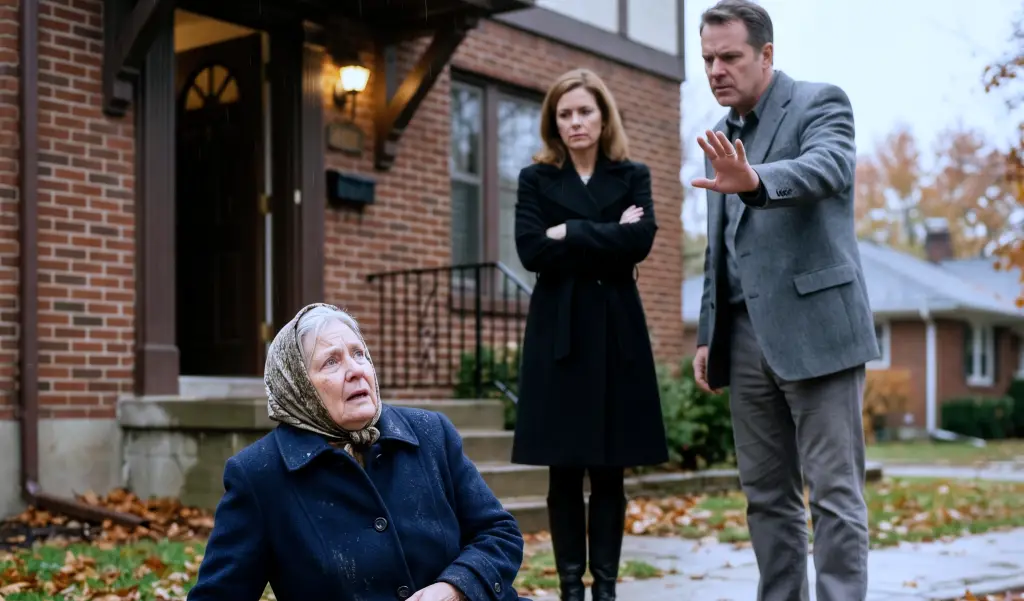
The funeral was an exercise in tasteful restraint. David, their forty-seven-year-old son, made absolute sure of that. He ran the insurance agency his father had built from the ground up, and he managed the memorial service like a high-stakes corporate mixer. Clad in a tailored charcoal suit, David shook every offered hand, his voice pitched to the perfect frequency of managed grief. Beside him stood Karen. At forty-four, Margaret’s daughter had perfected the art of appearances, wearing a tailored black dress and a string of pearls, occasionally pressing a pristine tissue to eyes that never actually spilled a tear.
Three hundred people filed past the casket. Margaret stood for hours, her feet aching terribly in her sensible pumps, thanking each face that swam into her vision. Her chest felt entirely hollowed out, a cavern where her life used to be. But she remained standing. She stood because that was what a wife did. You stood, and you endured.
Two weeks later, David called a family meeting. He used those exact, clinical words over the phone, as if they were gathering to discuss a timeshare or a Thanksgiving menu. Margaret drove to his sprawling suburban home, the very same house she and Frank had drained their savings to help him buy fifteen years ago. She took a seat at his heavy mahogany dining table, resting her hands in her lap, and looked across the polished wood at her two children.
Karen had a thick manila folder. David had a legal pad. They had been busy.
“Mom, we need to talk about Dad’s estate,” David said, folding his hands over his notes.
Margaret gave a slight nod. She had expected this. Frank had built a solid, comfortable life. The mortgage was paid off. The insurance agency was highly profitable. There was a substantial cushion in savings, plus the investment and retirement accounts she and Frank had contributed to for decades.
“We’ve been going over the paperwork,” Karen said, her tone brisk. She opened the folder, spreading a fan of documents across the table like a dealer at a casino. “The house, the accounts, the agency. We want to make sure everything is handled properly.”
“Of course,” Margaret said quietly.
David cleared his throat, adjusting his posture. “The house? Dad put my name on the deed twelve years ago. We discussed it after his first hard episode. It was a practical decision. Estate planning.”
Margaret looked at him, her expression unreadable. “I remember.”
“So technically, the house is mine,” David said. He did not look away, but a faint flush crept up his neck. “I’m not kicking you out, Mom. But I’ve been thinking about it, and Heather and I could really use the space. The kids are getting bigger, and then there is the question of maintenance, property taxes, upkeep. It’s a lot for you to manage alone at your age.”
Margaret felt a cold, heavy stone settle in the pit of her stomach. “You want me to leave the house.”
“Not leave. Transition,” Karen interjected smoothly, leaning forward. “I found a beautiful assisted living community in the suburbs. It has lovely gardens…”
“I am seventy, David,” Margaret said, her voice dropping a register. “I am not eighty-five.”
Karen jumped back in, her tone shifting to patronizing sweetness. “Mom, nobody is saying you can’t take care of yourself. We just think it would be easier. Safer.”
“And the bank accounts?” Margaret asked, refusing to let them steer the current.
Karen glanced sideways at her brother. “We moved the funds into a trust for estate management purposes. David and I are co-trustees.”
“You emptied the accounts.”
“We secured the accounts,” David corrected defensively.
Margaret sat perfectly still, listening to the hum of the central air conditioning. Forty-two years of marriage. Every single dollar she and Frank had carefully saved. Every late night she had spent sitting at the kitchen table doing the accounting for the agency while Frank built the business. Every vacation they had skipped, every new dress she had left on the rack. Her children had neatly divided and swallowed forty-two years of her sacrifice in a single afternoon.
“And the car?” Margaret asked, her voice dangerously calm.
“Karen is going to take it,” David said, shuffling his legal pad. “You don’t drive much anymore anyway. It just sits in the garage.”
“I drive every day, David.”
“We will arrange rides for you. There are transport services.”
Margaret looked deeply at her children. She studied the faces across the table—the faces she had wiped clean of tears, the foreheads she had kissed through childhood fevers, the children she had read to until her throat went dry. David had Frank’s stubborn jaw and her own eyes. Karen had her smile, though Margaret suddenly realized she could not recall the last time Karen had actually offered that smile to her.
“Is there anything left?” Margaret asked, the silence ringing in her ears.
David and Karen exchanged a brief, fleeting look.
“Well, there’s Grandpa Henry’s farm,” Karen said. A short, dismissive laugh escaped her lips. “The one in Kentucky. Dad always said it was completely worthless. The county sent letters about back taxes a few years ago. We just threw them away.”
“How much in back taxes?” Margaret asked.
David checked the top page of his pad. “About eleven thousand. The property is assessed at less than the taxes owed. Nobody in their right mind would buy it. It’s just sitting out there rotting.”
Margaret nodded slowly, feeling the phantom weight of brass in her coat pocket. “I’ll take it.”
David blinked, completely thrown off his script. “Take what?”
“The farm. I will take the farm.”
Karen leaned across the table, her brow furrowed. “Mom, there is nothing there. The house is falling apart. There’s no water, no electricity…”
“You said it is mine. My father left it to me. Not to a trust. Not to you. To me.”
“It’s worthless,” David repeated, shaking his head.
“Then you won’t mind if I keep it.”
Neither of them argued. Why would they? They had systematically stripped away everything of value. The colonial house, the cash, the car, the thriving agency. The old Kentucky farm was nothing but a punchline to them, a yellowed piece of paper representing a debt nobody wanted to pay.
Margaret left David’s house that evening carrying only her purse, her wool coat, and her father’s pocket watch. She had kept that watch in her purse since Henry died twenty-two years ago. It was a heavy brass timepiece, deeply engraved on the back with four numbers she had always assumed were a date. Her father had pressed it into her palm during her final visit to the farm, back when she was forty-eight and he was suffocating from emphysema.
“Keep this,” Henry had wheezed, his rough hands trembling over hers. “You’ll know when you need it.”
She had never known what he meant. But she had kept it all the same.
Margaret endured David’s guest bedroom for three excruciating weeks. They made sure she felt her displacement every single day. Heather, David’s wife, would let out a long, theatrical sigh whenever Margaret so much as boiled water in the kitchen. The grandchildren were constantly shushed and told to keep it down because Grandma needed rest, a thinly veiled translation for the fact that Grandma was in the way. David left glossy brochures for assisted living facilities on her nightstand. Sunrise Gardens. Peaceful Meadows. Places with manufactured names designed to help you forget you were being warehoused.
On the twenty-second day, Margaret packed her belongings. She owned exactly one suitcase now. Everything that mattered fit inside it.
She took a Greyhound bus from Columbus, Ohio, to a speck of a town called Dawson in rural Kentucky. The ticket cost her thirty-seven dollars. The cabin smelled strongly of diesel fumes and ancient, dusty upholstery. Margaret took a seat by the streaked window and watched the flat, paved geometry of the Ohio suburbs give way to the rolling, untamed hills and bare timber of Kentucky. She did not shed a single tear. She had done all her crying in David’s guest bedroom, pressing her face into a decorative pillow at three in the morning when the house was silent. She was entirely done with crying now.
Dawson was barely a town. It consisted of a two-block main street offering a hardware store, a faded diner, a post office, and a brick church. The bus deposited her at a gravel gas station on the absolute edge of the county line. She dragged her suitcase inside and asked the attendant for directions to the old Hale farm.
The teenager looked at her as if she had asked for the quickest route to Mars. “Henry’s place? Ma’am, that’s about four miles east on County Road Nine. Nobody has been out there in decades. You family?”
“I am his daughter,” Margaret said, lifting her chin.
“Huh.” The boy scratched his neck. “Didn’t know Henry had family. He kept to himself.”
Margaret walked. She marched for four miles along a winding two-lane road that offered absolutely no shoulder, her heavy suitcase bumping bruised against her calf with every other step. It took her nearly two hours. Midway through, a rusted pickup truck slowed down, and the driver, a heavyset woman in a faded feed cap, rolled down her window.
“You need a ride, hon?” the woman called out over the idling engine.
“I am almost there,” Margaret called back, wiping sweat from her brow.
“Where’s there?”
“The Hale farm.”
The woman’s eyebrows shot up into her hairline. “That old place? You sure?”
Margaret nodded firmly. The woman gave a slow shrug, rolled up the glass, and drove on, leaving Margaret in a cloud of fine brown dust.
When the farm finally materialized, it was vastly worse than she remembered. The driveway had been entirely reclaimed by nature, choked with knee-high weeds and aggressive saplings that had punched their way through the gravel over the last twenty years. The house sat silently at the end of the path, a two-story wooden structure that had once proudly worn white paint. Now, the paint had flaked away to expose gray, weathered wood on nearly every wall. One of the upstairs bedroom windows was shattered. The front porch sagged dangerously on the left side where the support beams had succumbed to rot.
Behind the house stood the barn. It had been a vibrant red during her childhood, but now it was the color of a winter sky. The roof had partially caved in on the southern end, the beams jutting out like broken ribs. And there, hanging heavy on the main sliding doors, was a thick steel padlock, rusted orange but stubbornly intact.
Margaret dropped her suitcase at the end of the driveway and took a long, deep breath. Eleven thousand dollars in back taxes. A farmhouse that might buckle under the weight of the first winter snow. A barn her father had kept fiercely locked away her entire life.
She picked up her bag and walked toward the front door.
It was unlocked. It had always been unlocked. Henry Hale never locked the front door of his house, reserving all his security, all his paranoia, for the barn out back.
Margaret pushed the heavy wooden door, the swollen hinges groaning in protest. Inside, the air was thick, carrying the sharp, stale scent of trapped time and dry rot. Dust layered every visible surface like a gray, woolen blanket. She set her suitcase down in the narrow front hallway, her footsteps echoing hollowly against the hardwood as she wandered through the rooms of her childhood.
In the kitchen, through the hazy light filtering in from the dirty windows, she saw plates stacked in the glass-front cabinets. They were the same sturdy ceramic dishes with the faded blue flower pattern she remembered from when she was ten years old. In the living room, her father’s worn leather recliner still sat exactly where he had left it twenty-two years ago, angled precisely so whoever sat in it would have a clear, unobstructed view of the barn. In the fireplace, a pale mound of ash rested cold on the grate. Twenty-two-year-old ashes.
She found the fuse box in the hallway and pushed the heavy main breaker switch. A dull metallic clack sounded, but no lights flickered to life. The house remained dead. She walked to the kitchen and twisted the cold water knob on the tarnished sink. Nothing but a dry, rattling wheeze came from the pipes.
Margaret walked back to the living room, lowered herself onto the very edge of her father’s leather chair, and looked out the window at the weathered gray siding of the barn. She was seventy years old. She had forty-seven dollars in her purse. She possessed no vehicle, no cellular phone plan, no income, and no immediate prospects. Her own flesh and blood had systematically stripped her of a lifetime of security, leaving her with this neglected ruin.
Yet, as she sat there breathing in the dust, a strange, profound calm washed over her. For reasons she could not entirely articulate, sitting alone in a lightless, waterless house felt infinitely more like a home than David’s immaculate, temperature-controlled guest bedroom ever had.
That first night, Margaret slept on a bare, yellowed mattress in her father’s old ground-floor bedroom. The ticking smelled faintly of damp wool and old cedar, but the springs held her weight without complaint. She pulled a heavy, patchwork quilt from the cedar closet, running her fingers over the mismatched squares of fabric. Her mother had stitched it together entirely by hand before Margaret was even born. The seams were fraying at the edges, the colors muted by decades of storage, but it trapped her body heat perfectly.
She woke at dawn to the sharp, clear calls of birds. They were real, wild birds, singing close to the glass, entirely unlike the muffled, distant traffic sounds she had tolerated in the suburbs for four decades. Margaret lay perfectly still for a long time, watching the morning light crawl across the cracked ceiling plaster. Then, she pushed the heavy quilt aside, tied her gray hair back, and got to work.
She scrubbed and swept for three days straight. She pushed a broom across every plank of flooring, wiped down every counter, and scraped thick, black mold from the bathroom tiles using an old butter knife she found in a drawer. She hauled endless armloads of dead leaves, dried vines, and abandoned animal nests out the back door, piling them into a massive heap near the old fire pit. Her lower back throbbed, her knuckles bled, and her shoulders ached with a fiery intensity, but she did not stop. It was a physical purge, a cleansing of both the house and her own grieving spirit.
On the afternoon of the second day, a neighbor driving a rusted pickup half a mile down the road spotted the smoke from her burn pile and turned down her long driveway.
“You actually living here?” the man asked, leaning his arm out of the truck window, eyeing her soot-stained clothes.
“I am,” Margaret said, wiping her forehead with the back of her wrist.
“County shut the water off years ago,” he noted, glancing at the house. “You’ll need to call them to get it flowing again. Electric, too.”
“Do you know how much that will cost?”
“Couple hundred for the deposits, probably,” he said, shifting his truck into gear. “Good luck to you.”
Margaret thanked him and watched him drive away. Two hundred dollars. It might as well have been two million. She had exactly forty-seven dollars left. That deposit was a brick wall she simply could not climb over.
But the next morning, when she walked to the end of the driveway to check the rusted rural mailbox, she found a plain white envelope sitting inside. There was no return address. She tore the flap open. Inside rested fifteen crisp twenty-dollar bills and a small piece of lined paper with shaky, cursive handwriting.
Henry was a good neighbor. Welcome home.
Margaret stood frozen at the edge of the county road, clutching the cash in her bruised hands. She looked up and down the empty stretch of asphalt. She did not know who had sent it, and she decided right then that she would never ask. She walked to the neighbor’s house that afternoon, politely asked to borrow his telephone, and arranged for the county to restore the utilities.
By the end of her first week, the farmhouse was functional. It was certainly not comfortable, and it was far from pretty, but it was a shelter that lived and breathed. The plumbing coughed up brown sludge for the first twenty minutes before running cold and clear. The electricity hummed to life in every room except the upstairs bathroom. In the root cellar, she discovered rows of ancient canned goods—peaches and beans with labels so faded they were entirely white. She threw the commercial cans away, but tucked in the back corner were heavy glass mason jars filled with preserved vegetables, the wax seals still impeccably tight. Her father’s careful preservation work, untouched by time.
She cooked her first hot meal on the finicky gas stove. It was nothing more than white rice, salt, and a can of crushed tomatoes she had purchased at the hardware store in town. She sat alone at the kitchen table, chewing slowly, her eyes drifting inevitably out the window.
The barn.
Her father had never permitted her to step foot inside it. Not once during her entire childhood. “That is my workshop, Maggie,” he would say, his voice brooking absolutely no argument. “Nothing in there for little girls.
When she was twelve years old, curiosity had gotten the better of her. She had crept around to the side and tried to peek through a warped gap in the wooden siding. Henry had caught her by the arm, and it was the only time in her entire life he had ever raised his voice to her. She had never tried to look again.
Now she was seventy, Henry was long gone, and the barn sat under the Kentucky sun, a massive, weathering question mark sealed with a rusted padlock.
On the morning of her eighth day, Margaret walked across the overgrown yard carrying a heavy steel claw hammer. She wedged the forged claw directly behind the padlock’s hasp, braced her boots in the dirt, and pulled with all her remaining strength. The rusted screws groaned, held fast for a terrible second, and then violently tore free from the rotted wood. The heavy lock clattered uselessly into the weeds.
She grabbed the edge of the sliding door and hauled it open.
A thick shaft of daylight cut through the interior gloom, illuminating millions of dancing dust motes. Collapsed roof beams lay in a jagged, splintered pile on the south side. Ancient, gray hay coated nearly the entire surface. Hand tools hung from pegboards on the walls, rusted so completely they looked like modern art sculptures. A heavy wooden workbench sat against the far wall, its surface buried under years of debris and bird droppings.
Margaret stepped inside, placing her feet carefully, testing the floorboards.
But it did not feel like wood. It felt unnervingly solid.
She stopped, frowning, and used the side of her shoe to kick away a thick layer of hay near the entrance. She looked down. Concrete. Smooth, professionally poured concrete, extending wall to wall across the entire footprint of the structure.
That was not right. Barns in this county had dirt floors, or packed clay, or occasionally rough wooden planks to keep the moisture down. They did not have six-inch poured concrete slabs. Not unless the person who built it was desperate to ensure that whatever was buried underneath could never be dug up.
Margaret began to walk the length of the floor, methodically sweeping the hay aside with her boots. The concrete was immaculate. There were no settling cracks, no uneven seams. It had been poured by someone who knew exactly what they were doing.
When she reached the northeast corner, she stopped. The texture of the surface here was subtly different. It was smoother. Perhaps poured a few days later than the rest, though still decades old. She lifted her boot and brought her heel down hard against the stone.
The sound shifted entirely. It was not a dull thud. It was a hollow, resonant echo.
Margaret slowly sank to her knees. She pressed the side of her face against the cold floor and rapped her knuckles against the concrete. The sound bounced back at her, deep and echoing, suggesting a vast, empty space right beneath her.
Her father had poured a massive concrete slab inside his barn specifically to seal something underneath. Something he had spent his entire adult life aggressively protecting. Something he had taken to his grave without ever whispering a word to a living soul.
Margaret reached into her jacket pocket and pulled out the heavy brass pocket watch. She turned it over in her palm, letting the dim light catch the deep grooves of the four numbers engraved on the back. She ran her thumb over them. She realized with sudden clarity that she could not break through this slab alone. She needed heavy machinery. She needed muscle. And more importantly, she needed someone in this town she could implicitly trust.
She slipped the watch back into her pocket, pulled the heavy door shut, and walked back to the house. Tomorrow, she would go into Dawson.
The walk into Dawson was slightly easier in the crisp morning air, though Margaret’s legs still throbbed with a dull ache from the relentless labor of the past week. Patterson’s Hardware sat squarely in the middle of Main Street, looking as though it hadn’t changed a single display window since the late seventies. When she pushed the heavy glass door open, a brass bell chimed a cheerful, sharp announcement. The interior smelled wonderfully of machine oil, fertilizer, and raw pine lumber.
A woman behind the front counter, wearing wire-rimmed glasses resting halfway down her nose, looked up from a newspaper crossword puzzle. “Help you find something this morning?”
“I need a sledgehammer,” Margaret said, her voice steady. “And a heavy pry bar.”
The woman paused, her pen hovering over the newspaper. She took a long, assessing look at Margaret. Margaret was seventy years old, stood five foot four, and weighed perhaps a hundred and thirty pounds soaking wet. She was asking for serious demolition equipment.
“What exactly are you taking apart, hon?” the woman asked.
“A barn floor. Poured concrete.”
The woman’s eyebrows rose, but she merely pointed the back of her pen toward the rear of the dimly lit store. “Aisle three. You are going to want the ten-pound sledge, not the sixteen. Save your back.”
Margaret navigated the narrow aisles, located the heavy steel tools, and wrestled them to the front counter. The sledgehammer rang up at forty-two dollars. The pry bar was eighteen. She reached into her purse, her fingers brushing against the rapidly thinning stack of bills from the anonymous envelope. She had just over two hundred dollars left to her name. She desperately needed that money for groceries, for gas to keep the stove running, and for the mountain of property taxes she still had absolutely no idea how to pay.
She was carefully counting out twenty-dollar bills when the front door swung open. A man stepped inside, bringing the scent of damp earth and morning frost with him. He was tall and broad-shouldered, with closely cropped gray hair and large, calloused hands that spoke of a lifetime of physical labor. He wore a heavy canvas work jacket and leather boots heavily caked with dried clay.
“Morning, Tom,” the woman behind the register said, smiling warmly.
“Morning, June,” he replied in a deep, gravelly baritone. He set a small cardboard box of wood screws on the counter and then paused, his eyes falling on the heavy demolition tools resting next to Margaret’s delicate purse. “That is a whole lot of sledgehammer for one person.”
“I will manage,” Margaret said, keeping her chin up.
“Which barn?”
Margaret hesitated. She had spent a lifetime keeping Frank’s secrets, keeping her children’s secrets, smoothing over the messy truths of her family. But she was exhausted, and something about this man’s direct, unblinking gaze made her want to simply lay the truth bare.
“Henry Hale’s place,” she said. “Out on County Road Nine.”
The man’s expression immediately shifted, softening into something resembling quiet recognition. “Henry’s place. I haven’t been out that way in years. You must be his daughter.”
“Margaret.”
He gave a slow, respectful nod. “Tom Briggs. I live about two miles past your property line. Your father and I used to talk sometimes. He would come into town for supplies, and we’d sit on the wooden bench outside the post office. He was a very quiet man, but he was good company.”
“That sounds exactly like him,” Margaret said, a faint, sad smile touching her lips.
Tom looked down at the massive steel hammer again. “What exactly are you doing with the barn out there?”
Margaret took a breath. “There is a solid concrete floor poured inside it. I need to see what is buried underneath it.”
Tom raised a thick gray eyebrow. “Concrete floor in a timber barn. That is highly unusual.”
“I know.”
“And you are planning to swing a ten-pound sledge at a slab of concrete all by yourself?”
“I was planning on it, yes.”
Tom was quiet for a long moment, studying her face. He didn’t offer pity, which she would have rejected, and he didn’t offer condescension, which she would have resented. “I have a pneumatic jackhammer sitting in my shed,” he said finally. “Runs off a gas compressor. It will save you a solid week of back-breaking work and probably three herniated discs.”
Margaret looked at him, her guard instantly rising. “Why would you help me?”
“Because Henry was a genuinely good man,” Tom said simply, picking up his box of screws. “And because swinging a sledgehammer at concrete at your age is a very good way to end up in the county hospital with nobody to drive you there.”
Margaret felt her defensive posture soften. “I cannot pay you, Mr. Briggs.”
“I didn’t ask you to.” Tom tipped his chin toward the door. “I will come by tomorrow morning. Does seven o’clock work for you?”
“Seven works perfectly.”
Tom Briggs pulled his dented Ford pickup truck up the gravel driveway at a quarter to seven the next morning. A heavy yellow air compressor and a jackhammer were strapped securely into the bed. Margaret was already awake and waiting. She had found an old metal percolator in the back of a kitchen cabinet and managed to brew a pot of coffee. The rich, dark scent of the roasted beans filled the damp farmhouse, making it feel, for a fleeting moment, incredibly alive.
They sat together on the sagging front porch, drinking from thick ceramic mugs in comfortable silence. The morning air was biting and crisp, the sky bruised with a pale, bruised gray, and the overgrown fields stretched out flat and isolated in every direction.
“I actually helped your father repair this exact porch about thirty years ago,” Tom said, wrapping his large hands around his steaming mug. “He did most of the heavy lifting himself. He just needed someone to hold the long boards steady while he drove the nails.”
“He built things,” Margaret murmured, staring out at the dew-soaked grass. “Always building, always fixing something. He just never told us what.”
Tom finished the last of his coffee and set the empty mug gently on the wooden railing. “Let’s go take a look at that floor.”
Inside the dim barn, Tom walked the perimeter in silence while Margaret watched from the doorway. He used the toe of his heavy boot to kick the ancient hay aside, studying the surface of the concrete, occasionally kneeling to knock a heavy knuckle against the stone. When he reached the northeast corner—the exact spot where Margaret had heard the distinct change in pitch—he stopped.
“There is absolutely something under here,” Tom said, looking back at her. “This section sounds completely different. The rest of the floor is a solid pour, probably eight inches thick. But right here, the sound is shallow. It’s thinner, like it was poured directly over a void. A hatch, maybe.”
“Can we open it?” Margaret asked, her pulse accelerating.
Tom stood up and brushed the gray dust from his denim knees. “Only one way to find out.”
He hauled the heavy compressor off the truck bed, set it up just outside the barn doors, and ran the thick rubber hose inside to the jackhammer. When he pulled the starter cord, the engine roared to life. The noise was absolutely tremendous, a violent, percussive shattering that echoed wildly off the wooden walls and rattled the rusted tools hanging on their pegboards. Margaret stepped back, tying a cotton rag over her nose and mouth to block the sudden plume of pulverized dust.
Tom worked with practiced, methodical rhythm. He drove the heavy chisel point into the concrete, biting away a three-foot square area, peeling back layers of stone that crumbled into pale gray rubble. He worked relentlessly for forty minutes, sweat soaking through the back of his canvas jacket.
Suddenly, the steel chisel struck something that did not give. A sharp, clear metallic clang rang out through the barn, cutting cleanly through the deafening roar of the hammer.
Tom instantly killed the compressor. The ringing silence that followed felt enormous, pressing in against their ears. He dropped to his knees, using his bare hands to sweep away the fractured chunks of concrete. Margaret stepped closer, her heart hammering against her ribs.
Beneath the broken stone, dull gray steel caught the morning light.
“It’s a hatch,” Tom breathed, wiping his brow with his forearm. “Solid steel plate. Probably a quarter-inch thick. This looks like military-grade hardware.”
Working together, they cleared the remaining debris, widening the jagged hole until the full outline of the door was visible. It was roughly four feet square, anchored into a massive steel frame that had been bolted directly into a secondary foundation beneath the floor. On the side closest to them, a heavy-duty, industrial combination lock secured a thick latch.
Tom sat back on his heels, his chest heaving. “Your father put this here, Margaret. This is a serious, expensive installation. This is not something a humble farmer puts in his barn to store winter potatoes.”
Margaret did not answer. She reached into her jacket pocket and withdrew the heavy brass watch. She turned it over in her palm, letting the dim light catch the deep grooves of the four numbers engraved on the back. She ran her thumb over them. Decades of confusion suddenly crystallized into absolute clarity. Not a date. Not a year. A key.
“Let me try something,” she said quietly.
She knelt in the dust beside the heavy steel hatch. Her fingers trembled slightly as she grasped the cold metal dial of the lock. She turned it left to the first number. Right to the second. Left to the third. Right to the fourth.
A heavy, satisfying click echoed from inside the mechanism. The shackle popped free.
Tom stared at her, astonished. Margaret looked down at the open lock, her hands suddenly steady.
“That is what the watch was for,” she whispered, the revelation washing over her. “He gave it to me right before he died. He told me I would know when I needed it.”
Tom reached for the heavy steel handle of the latch. “Do you want me to pull it open?”
“No,” Margaret said firmly, placing both her hands flat against the cold steel. “I will do it.”
The hatch was incredibly heavy, the hinges groaning loudly from decades of disuse, but with Tom lifting beside her, it swung upward and back. A rush of remarkably cool, dry air rose from the dark square opening. It carried a scent Margaret could not immediately place—something rich, earthy, sweet, and undeniably old. Below them, bolted to the concrete wall, a solid steel ladder descended into the pitch black.
“I’ll go first,” Tom offered, clicking on a heavy Maglite he pulled from his belt.
“No, Tom,” Margaret said, stepping to the edge of the void. “This is my father’s. Whatever is down there, he left it for me. I am going first.”
Tom nodded respectfully and handed her the heavy flashlight. Margaret gripped the top rung of the cold steel ladder and swung her body out over the opening. She climbed down slowly, counting her steps. Eight rungs. About ten feet down. Her leather shoes finally met a smooth, solid floor.
She turned on the flashlight, sweeping the bright white beam across the darkness.
Margaret entirely stopped breathing.
The underground vault was massive. It stretched the entire length and width of the barn above it, a subterranean cavern dug deep into the dense Kentucky clay, perfectly lined with flawlessly poured concrete walls and reinforced with heavy steel I-beams across the ceiling. The air down here was pristine, managed by a faint, humming ventilation system hidden somewhere in the walls.
But it was what filled the room that made her mind go blank.
Row after row, stretching from the floor to the ceiling, were heavy wooden shelving units. Hundreds of them. And resting on those shelves were thousands upon thousands of thick glass bottles. Every single one was meticulously sealed with deep red wax. Every single one bore a pristine, handwritten paper label.
Margaret walked slowly forward, her legs feeling like lead. She reached out and carefully slid a heavy bottle from the nearest shelf. The glass was thick and cool. The label, written in the unmistakable, careful script of her father, read: Hale Reserve. 1958. Barrel 7. Bottle 43. She shined the flashlight directly through the glass. The liquid trapped inside was a flawless, translucent amber.
Whiskey. Her father had been making, aging, and hiding whiskey.
Tom’s heavy boots echoed on the ladder behind her. His flashlight beam joined hers, cutting through the dark, and they stood side by side in the center of a buried fortress that defied all logic.
“Good Lord above,” Tom whispered into the silence.
Margaret walked slowly down the aisle, illuminating the shelves. The collection was perfectly chronologically organized. She found careful rows dating from 1951 all the way to 1968. Eighteen consecutive years of master-level production. Meticulously bottled, perfectly preserved, and completely forgotten by the world above.
“There must be five thousand bottles down here,” Tom said, his voice echoing slightly as he quickly calculated the depth of the shelves. “Maybe more.”
Margaret gently placed the 1958 vintage back in its rightful spot. Her mind was racing, tearing down everything she thought she knew and hastily rebuilding it. Henry Hale. The painfully quiet man in faded overalls. The man who patched his own roof and died with nothing but lint in his pockets. He had been quietly operating a massive, high-end distilling operation directly beneath their feet for two decades.
At the far end of the vault, near the base of the ladder, Margaret spotted a long wooden workbench. Unlike the ruined version in the barn above, this bench was pristine. Copper tubing, heavy glass beakers, and delicate scientific hydrometers sat perfectly arranged in custom wooden racks.
And there, resting dead center on the spotless wood, weighed down by an empty glass bottle, was a sealed envelope.
Margaret walked toward it. The paper was slightly yellowed at the edges but perfectly intact, preserved by the flawless climate control of the vault. Her name was written across the front. It was the same careful handwriting she had seen on the bottle labels, the same script from the grocery lists of her childhood.
She turned the envelope over. The back was sealed with red wax, stamped with the impression of a coin. She broke the seal and pulled out the folded pages.
Tom clicked off his flashlight and stepped backward into the shadows, offering her the only privacy a buried concrete room could afford.
Margaret unfolded the heavy paper, held her light steady, and began to read.
Margaret, if you are reading this, I am gone. And I owe you the truth about why I was never the father you deserved.
She leaned her hip against the edge of the heavy wooden workbench, the flashlight trembling slightly in her grip, and continued to read.
I started this in 1949. The war was over, and I came home to absolutely nothing. Your mother and I were living in a two-room house with a dirt floor and a well that ran bone-dry every August. I had sixty acres of land that wouldn’t grow a single crop worth selling, but I had a skill I had learned from my own father back up in the mountains. I knew how to make whiskey.
It was illegal, of course. Federal crime, state crime, county crime—none of that mattered to me. I was twenty-four years old, my wife was pregnant with you, and I could not feed her on what that barren dirt was earning. So, I built a copper still deep in the woods behind the property line, and I started cooking. Turns out, I was good at it. Better than good. The bourbon I made was clean, exceptionally smooth, and aged right. Word got around. Men drove down from Louisville, from Lexington, from as far out as Nashville just to buy what I was making. I charged a premium, and they paid it without blinking.
By 1953, I had accumulated enough cash to build this vault. I poured the foundation myself. I hired a specialized crew from out of state to do the heavy concrete work—men who didn’t know what county they were in and knew better than to ask. I dug the cavern by hand, Margaret. Every single shovel of clay, every heavy bucket of dirt. It took me two exhausting years. But when it was finally done, I had a room nobody knew about, hidden under a barn nobody cared about, sitting on a farm nobody watched.
Margaret turned the heavy, yellowed page. The handwriting here grew tighter, the loops less elegant, driven by a darker, more controlled energy.
I made whiskey down here for eighteen years. Your mother knew. She helped with the wax bottling in the early days before her health turned bad. We stored everything down here, barrel-aged in charred white oak, bottled and perfectly sealed when it was ready. I could have sold it all and lived a rich man’s life. But I didn’t. Because in 1962, a man I trusted tried to take everything from me.
His name doesn’t matter now. He was my partner, my primary distributor, and my friend. Or so I foolishly thought. He got greedy. He wanted a bigger cut of the profits. When I told him no, he threatened to turn me over to the authorities. When that didn’t scare me, he came out to the farm late one night with two men and tried to take what I had built by force. I did what I had to do to protect my family. I won’t write down the details. You do not need to carry them. But after that terrible night, I shut the entire operation down. I sealed the vault, I poured a fresh layer of concrete over the steel hatch, and I never touched it again. A man who shows the world everything he has is a man who has already lost it. So, I showed the world nothing. I lived purely on what the farm produced. I drove a battered old truck. I wore the same leather work boots until the soles fell apart. And I kept this massive secret buried in the dark, waiting for the one person in this world I trusted enough to find it.
That person is you, Margaret.
Margaret slowly lowered the letter. Her hands, which had been shaking violently when she opened the envelope, were now perfectly steady. The trembling had stopped somewhere around the second page, replaced by a profound, grounding sense of recognition. She shined her flashlight across the vast, subterranean room. Five thousand bottles of premium bourbon, some of them nearly seventy years old, crafted by a brilliant man who had chosen to live in manufactured poverty rather than risk losing his wife and daughter to the greed of others.
Tom’s deep voice floated from the shadows near the ladder. “Are you all right?”
Margaret carefully folded the letter and tucked it deep into her jacket pocket, right next to the brass watch. “My father was not a farmer,” she said, her voice echoing softly against the concrete. “He was a master distiller. And he spent his entire life hiding a fortune under this barn just to keep us safe.”
Tom was quiet for a long, heavy moment. When he finally spoke, his tone was completely altered, stripped of its casual morning ease. “What are you going to do?”
Margaret looked at the endless rows of wax-sealed bottles stretching into the darkness. Each one a piece of history. Each one a silent apology. She had no earthly idea what they were worth, but she possessed a lifetime of patience.
“I am going to find out exactly what it is worth,” she said, her spine straightening. “And then I am going to decide.”
The mid-morning daylight felt aggressively blinding after the cool darkness of the vault. Margaret heaved the steel hatch shut, the heavy latch locking with a final, echoing metallic thud. Tom helped her drag a large sheet of warped plywood over the spot, and together they meticulously kicked the gray hay and scattered debris back over the wood until the floor looked entirely undisturbed.
“Nobody can know about this,” Margaret said, looking Tom directly in the eyes. “Not yet.”
Tom gave a solemn nod. “I haven’t seen a single thing. I was just here to help a neighbor tear up a broken barn floor. That is all.”
Margaret looked at him—this rugged man she had known for exactly three days, who had shown up at dawn with heavy machinery and a thermos of coffee, and who had not asked her for a single penny or favor in return. “Thank you, Tom.”
“Don’t thank me yet,” he said, wiping his dusty hands on his jeans. “You have got a mountain of work ahead of you.”
That evening, Margaret sat alone at the small kitchen table, the letter spread flat under the warm, yellow glow of the overhead light. She read it again, absorbing the cadence of her father’s voice. The final paragraphs were the ones her eyes kept returning to, drawn by a gravity she couldn’t resist.
I left the farm to you in a trust. Not to Frank. Not to your children. To you alone. The lawyer in Dawson has the official documents. The trust is irrevocable. That means absolutely nobody can take this land from you, Margaret. Not your husband. Not your kids. Not the government. It is yours until you draw your last breath or decide otherwise.
I know I wasn’t the warm father you wanted. I know I was distant, distracted, always out in that barn when you needed me inside the house. I am deeply sorry for that. I was building something for you, even if I could never tell you what it was. The bottles are worth money. Real money. More than that house in Ohio, more than Frank’s agency, more than whatever your husband put in his bank accounts. But promise me this one thing. Do not let anyone take it from you. The people who love your money are never the people who love you. Trust the ones who show up when you have absolutely nothing. Your father, Henry.
Margaret refolded the heavy paper and pressed her palms flat against the scarred wooden table. Outside the window, the country night was profoundly quiet. There was no hum of suburban traffic. No television blaring through thin drywall. No grandchildren being shushed in the hallway. Just the wind moving through the tall grass and the familiar creak of the old house settling on its deep foundations. Her children had coldly calculated her worth and taken everything that was easy to count. They had entirely missed the one thing that actually mattered.
Margaret did not sleep a wink that night. She sat at the table and read the letter four more times. By the time the sky turned the color of bruised plum at dawn, she had a clear plan. It was not a grandiose scheme. It was just the next three logical steps she needed to take to reclaim her life.
First, she needed to understand the market. She was not a drinker. She had never paid a second of attention to fine spirits, to the exploding culture of rare bourbon, or to auction houses. But she had been a seventh-grade schoolteacher for thirty-five years. She knew exactly how to research.
Tom drove her to the Dawson public library later that morning. It was a tiny, one-room brick building with six outdated computer terminals and metal shelves that smelled comfortingly of old paperbacks and floor wax. The librarian, a woman about Margaret’s age wearing reading glasses attached to a beaded chain, kindly helped her log onto a terminal.
Margaret sat in the stiff wooden chair for four straight hours. She fell down a digital rabbit hole, reading about vintage spirits, the aging process of charred oak, and the highly lucrative, aggressive secondary market for pre-Prohibition and mid-century whiskey. She learned that authenticated bottles from the 1950s and 60s, if properly stored and sealed, could easily sell for hundreds of dollars each. Some rare labels went for thousands. A single bottle of pristine Prohibition-era bourbon had recently sold at a private auction for over a hundred thousand dollars.
She leaned back in the creaking chair and stared at the glowing monitor. Five thousand bottles. Some of them nearly seventy years old, stored in a subterranean, climate-controlled environment that would make a museum curator weep with envy.
“Find what you needed, hon?” the librarian called out from the circulation desk.
“More than I ever expected,” Margaret murmured.
The second thing she needed was a professional. She needed an expert who could chemically verify the liquid, assess the condition of the wax seals, and give her a concrete number. Tom, it turned out, knew a man who knew a man. That was exactly how things functioned in small rural towns. Three phone calls later, Margaret had secured a private, off-the-books appointment with an elite spirits appraiser based out of Louisville.
His name didn’t matter. What mattered was the look on his manicured face when he climbed down that steel ladder into the vault two days later.
The appraiser stood at the bottom of the ladder for a full thirty seconds without taking a single breath. Margaret watched him from the wooden workbench, where she had set up two folding chairs and a bright work lamp connected to a heavy extension cord running up through the open hatch.
“This is real,” the appraiser whispered. He was not asking a question. It was a statement of pure reverence. “My god, it’s real.”
He spent an hour walking the aisles in absolute silence. He pulled heavy bottles at random, examining the handwritten labels with a jeweler’s loupe, holding the thick glass up to the harsh light of the work lamp, carefully checking the integrity of the wax seals. He used a tiny, specialized penlight to study the viscosity of the amber liquid trapped inside. He furiously scribbled notes on a leather clipboard.
When he finally finished, he slumped into the folding chair across from Margaret and dragged a shaking hand down his face.
“Who made this?” he asked, his voice strained.
“My father.”
“Your father was a madman, and an absolute genius,” the appraiser said. “The aging process, the immaculate storage conditions, the sealing technique… I have assessed private museum collections that had less care put into them than this.”
“How much?” Margaret asked, her voice calm and betraying nothing.
He set his clipboard on his knee. “I cannot give you an exact, legal number without full laboratory testing. Authentication, chemical analysis, proving the provenance. But based on what I am looking at right here? Based on the sheer volume, the staggering age, and the perfect condition?” He swallowed hard. “You are looking at a private collection worth somewhere between twenty and thirty million dollars.”
The massive number hung suspended in the cool, dry air between them. Margaret did not gasp. She did not cry out. She had expected something large, but hearing the actual figure spoken aloud shifted the axis of her world. Twenty to thirty million dollars. Her father, a man who had patched his only pair of boots with cheap glue, had been sitting on an empire.
“What do you recommend?” she asked.
“Do not flood the market,” he said immediately, leaning forward. “A collection of this unprecedented size, released all at once, would instantly crash the vintage price. You want to sell in highly controlled, small batches. A hundred bottles at a time, moving them through private buyers and select, high-end auction houses. At that careful pace, with the right marketing whisper network, you could stretch this out over five to ten years and maximize the absolute return.”
Margaret nodded thoughtfully. “And if I needed liquid money now? Quickly and quietly.”
He tapped his gold pen against his chin. “I could personally connect you with two or three elite private collectors who would blindly buy a hundred bottles tomorrow morning. Pre-authentication, based solely on my preliminary word, you would get somewhere around four to five hundred thousand dollars for the first introductory batch.”
Margaret looked at the rows of bottles, then back at the man in the tailored suit.
“Do it,” she said.
The appraiser departed late that afternoon, carefully carrying a padded, hard-shell case containing ten meticulously selected bottles for laboratory testing. He also carried the names of three elite collectors who, he assured her, would be salivating at the mere rumor of this discovery. Margaret walked him to his luxury sedan, the gravel crunching softly under their feet.
“Keep this entirely quiet,” she told him, her tone leaving no room for negotiation. “Nobody else needs to know about this property yet.”
“Discretion is the foundation of my business, ma’am,” he replied smoothly, offering a crisp nod before sliding behind the wheel.
Tom was waiting on the sagging front porch when she walked back to the house. He was leaning against the railing, his worn feed cap pulled low over his eyes, staring out at the overgrown fields as if trying to calculate the sheer weight of what was buried beneath them.
“Well?” he asked quietly as she climbed the wooden steps.
“Twenty to thirty million,” Margaret said.
Tom did not say a single word for a very long time. He simply looked out at the broken fence lines, at the weeds choking the driveway, and finally, at the weathered barn with its partially caved-in roof. Then he looked at Margaret, a profound respect settling into the deep lines of his face.
“Your father was really something else.”
“He was,” Margaret agreed, lowering herself into the chair beside him. “I spent my entire childhood thinking he was just a quiet, stubborn man who liked the isolation of his barn more than the company of his family. Turns out, he was building an empire. He just couldn’t risk telling me what it was.”
“What is next?” Tom asked.
“I pay the property taxes,” Margaret said, charting the course in her mind. “I fix this house. And I figure out exactly how to keep this secret quiet long enough to do it all the right way.”
The third thing Margaret needed was the lawyer her father had mentioned in his letter. His name and the address of a firm on Main Street in Dawson were penned at the bottom of the yellowed page. She walked into town the very next morning.
The law office was situated directly above the post office, accessible only by a remarkably narrow, steep staircase that creaked in protest with every single step. The attorney her father had used was long retired, but his son had inherited the practice. He was a slightly rumpled man in his late fifties, sitting behind a heavy oak desk piled dangerously high with manila folders. A ceramic coffee mug that proudly read World’s Okayest Lawyer rested near his elbow.
He dug through a wall of filing cabinets in the back room and finally emerged with Henry’s original file, blowing a thin layer of dust from the cover. The heavy, formal trust documents were inside, alongside faded copies of the property deed, ancient survey maps, and a sealed letter of instruction Henry had left with the firm.
“This is an irrevocable living trust,” the lawyer explained, spreading the heavy parchment documents across his cluttered desk. “Your father established it back in 1982. The farm, the acreage, all standing structures, and all contents are held in trust for your sole and exclusive benefit. You are the only beneficiary. This trust cannot be amended, altered, or revoked by anyone—including you—without a direct court order.”
“Can my children challenge it?” Margaret asked, her spine perfectly straight in the leather guest chair.
The lawyer adjusted his glasses and read through the legal provisions carefully. “They could certainly try, but they would lose. The trust vastly predates your marriage. It is classified as separate property. Your late husband never had a legal claim to it, and your children have absolutely no standing. If they tried to argue undue influence or mental incapacity to break it, they would need overwhelming medical evidence. And frankly, Mrs. Hale, from what I am looking at, you are managing this property and your affairs just fine on your own.”
Margaret felt a knot of tension in her shoulders, one she hadn’t even realized she was carrying, finally begin to unravel. “What about the contents of the property? If there is something of substantial value physically located on the farm, does that legally belong to the trust as well?”
“Everything within the surveyed boundaries of the trust property belongs exclusively to you,” the lawyer stated firmly. “Structures, mineral rights, water rights, and any personal property left behind by the grantor. Your father was exceptionally thorough. He covered every conceivable loophole.”
Margaret thanked him, paid his consultation fee with crisp bills from her purse, and walked the four miles back to the farm with her head held high.
Over the next three weeks, Margaret threw herself into the work of resurrection. She paid the terrifying mountain of overdue property taxes using a certified cashier’s check generated from the proceeds of her very first private sale. Forty bottles of her father’s legacy, sold to an eccentric collector in Louisville, had yielded a staggering one hundred and sixty thousand dollars. The back taxes were eleven thousand. She paid them in full, directly at the county clerk’s office, and paid the current year’s assessment in advance just to be safe.
She opened a private checking account at the small bank in town and deposited the massive remainder. Then, she started making phone calls. She hired a local roofer to strip and patch the farmhouse. She had the entire plumbing system professionally inspected and the ancient septic tank fully serviced. She went to a small used car lot on the edge of town and paid cash for a ten-year-old Chevy pickup truck. It had rust blooming on the fenders and a cracked vinyl bench seat, but the engine hummed with reliable power. Tom spent his weekends helping her replace the rotted fence posts along the county road and lay fresh gravel down the long, muddy driveway.
Slowly, deliberately, the farm started to look like a place where someone actually lived.
Through it all, Margaret did not contact her children. She did not call David to check on the agency. She did not call Karen to ask about the grandchildren. For the first time in over four decades, she did not feel the suffocating obligation to report her whereabouts or justify her daily decisions to anyone.
But silence, particularly when it emanates from someone who was previously dependent on you, is far louder than any phone call.
Karen noticed the silence first. She tried calling Margaret’s old cell phone number, only to be met with an automated operator stating the line had been disconnected—a direct result of David quietly canceling the phone plan to save a few dollars. Panicked, Karen called her brother, who admitted he hadn’t heard a word from their mother in over a month. They frantically checked the rosters of the upscale assisted living facilities Karen had previously researched. Margaret had never even submitted an application.
Karen drove down to Kentucky on a crisp, overcast Saturday in late November.
Margaret was standing at the kitchen sink, washing her coffee mug, when she saw the sleek, silver rental car slowly navigating the newly graveled driveway. Margaret dried her hands on a dish towel, stepped out onto the repaired front porch, and waited.
Karen got out of the car slowly, her eyes darting around the property. She was dressed for a city brunch in sharp leather heels and a tailored wool coat. She picked her way up the gravel path, looking at the ground as if the rural earth might reach up and bite her ankles. She stopped at the bottom of the porch steps, her eyes widening as she took in the changes.
“You painted it,” Karen said, her voice tight with confusion.
“Just the front,” Margaret replied evenly, leaning against the railing. “Tom is helping me prep the sides for next week.”
“Who is Tom?”
“A neighbor.”
Karen looked past her mother, scanning the cleared property line, the sturdy new fencing, and the reliable Chevy truck parked near the side door. “Mom, where exactly did you get the money for all this?”
“I managed.”
“You had forty-seven dollars in your purse when you left David’s house.”
“I had a little more than that,” Margaret said, her face an unreadable mask.
Karen climbed the wooden steps and stood directly in front of her mother. She was studying Margaret’s face intensely, desperately searching for the familiar signs of confusion, vulnerability, or fatigue—some indication that this was all a tragic mistake she could swoop in and fix.
“Mom, this isn’t safe,” Karen pleaded, adopting her most patronizing, gentle tone. “You are out here entirely alone, in the middle of nowhere, with zero support system. What if something happens? What if you fall, or get sick, or…”
“I have been living here for two months, Karen,” Margaret interrupted, her voice slicing through the fake concern. “I have repaired the house, paid the back taxes, bought a vehicle, and cleared ten acres of overgrowth. If something happens, I will handle it. I have been handling things my entire adult life.”
“That’s not what I meant.”
“What exactly did you mean, then?”
Karen’s mouth opened and closed. She didn’t have an answer that sounded remotely reasonable or kind, so she quickly pivoted. “David is worried.”
“David hasn’t called me a single time. I am sure he has been terribly busy with the agency.”
They stood there on the porch, mother and daughter, trapped in a chasm of thirty years of unspoken resentments. Karen’s eyes drifted across the yard and locked onto the weathered barn.
“What’s in there?” she asked, her tone shifting.
“Tools. Old hay. Nothing interesting.”
“Dad always said Grandpa Henry’s barn was strictly locked.”
“It was. I opened it.” Margaret held her gaze steady. “It is just a barn.”
Karen stared at her mother for a long, heavy moment. Margaret did not blink. She had taught hormone-fueled seventh graders for thirty-five years; she could easily outlast a forty-four-year-old real estate agent in a contest of wills.
Karen left after an hour. She had accepted a cup of coffee, sharply declined the offer of lunch, and asked seven more thinly veiled questions about the source of the money, all of which Margaret expertly deflected. She gave Margaret a quick, stiff hug beside the rental car and drove away, a cloud of dust billowing in her wake.
Margaret stood on the porch and watched the car until it completely disappeared over the hill. Then, she walked inside and picked up the telephone.
“Tom,” she said when he answered. “Karen was just here. She saw the truck, the new paint, the fencing. She is going to go straight back and tell David.”
“What do you think David will do?” Tom asked.
“He will do exactly what he always does. He will try to take control.”
Margaret was absolutely right. David moved with ruthless corporate efficiency. Within a week, he had requested the public property records from the county assessor’s office in Dawson. He easily discovered the existence of the trust and the recently paid tax receipts. He tried calling the local bank, but they fiercely protected their client’s privacy and told him nothing. He called the law office on Main Street, and the attorney promptly informed him that he could not discuss a client’s affairs under any circumstances.
David was an insurance executive. He understood the language of paperwork, contracts, and liability. He also understood when a ledger did not balance. His elderly mother had arrived in a destitute rural county with nothing, and now she owned a functioning property with obvious cash flow. In his mind, there were only two possibilities: either she had hidden resources he didn’t know about, or some local grifter was taking advantage of her declining mind. He immediately chose the second interpretation. It was vastly more comfortable. It cast him as the concerned, heroic savior, rather than the callous son who had forced his grieving mother onto a Greyhound bus.
The official court papers arrived at the farm on a bitterly cold Monday afternoon in December.
A bored process server drove his sedan up the gravel driveway, handed Margaret a thick manila envelope, and drove away without uttering a single word. Margaret stood on the freezing porch, her breath pluming in the winter air, and read the legal documents.
Her son and daughter were formally petitioning the county court to declare her mentally incompetent. They were asking a judge to appoint David as the sole legal conservator of her person and her estate, explicitly attempting to seize control of all trust property. The petition aggressively cited her advanced age, her sudden and “unexplained” relocation to an isolated, dilapidated rural property, her alleged confusion regarding financial matters, and her extreme vulnerability to exploitation by unknown third parties.
Margaret read the document twice. Then she carefully folded the heavy paper, walked inside, and sat down at her kitchen table.
She was not scared. She was not even hurt. Those fragile emotions had burned completely to ash weeks ago—in the suffocating confines of David’s guest bedroom, in the diesel-fumed back of the bus, and during those first freezing, waterless nights on the farm when she had absolutely no one.
What she felt now, coursing through her veins with absolute clarity, was cold, hard resolve. Her children had taken everything she had ever offered willingly. Now, they were coming to forcefully take the one thing she hadn’t.
She picked up the telephone and dialed.
“Tom, I need your help,” she said evenly. “And I am going to need to see that lawyer again.”
Tom arrived just as the pale winter sun dipped below the skeletal tree line, casting long, bruised shadows across the frozen yard. Margaret already had a fresh pot of coffee brewing. They sat opposite each other at the small kitchen table, the harsh glare of the overhead light illuminating the stark legal documents spread between them.
Tom read through the petition slowly, turning each dense, legalese-filled page with the same deliberate, respectful care he used when measuring expensive lumber. His jaw tightened with every paragraph.
“They are formally calling you incompetent,” he said, his voice a low rumble of disbelief. “They are actually putting that in print.”
“They are,” Margaret agreed, wrapping her hands around her warm mug.
Tom looked up, his eyes flashing with a rare, quiet anger. “You paid off eleven thousand dollars in back taxes. You coordinated the repair of a ruined farmhouse, purchased and registered a vehicle, and managed a rural property entirely by yourself for two months. And they are telling a judge you cannot make basic decisions?”
“It is not about what I can do, Tom. It is purely about what I have.” Margaret tapped a manicured fingernail against the edge of the petition. “David smells money. He knows I have found a source of income, he doesn’t know where it is coming from, and that lack of control terrifies him. When David gets scared, he gets aggressive.”
Tom carefully folded the thick stack of papers and set them down. “The lawyer in town. Do you trust him?”
“He knew my father. He understands the mechanics of the trust.”
“Then you need to be sitting in his office first thing tomorrow morning,” Tom said, leaning over the table. “And Margaret, you need to tell him the absolute truth. Everything. About the vault, the thousands of bottles, the appraiser from Louisville, the sheer value of it all. You cannot fight a legal battle with half your ammunition left in the dark.”
She knew he was right. She had been operating purely on survival instinct since the afternoon she stepped off the Greyhound bus, making rapid-fire decisions one at a time, reacting to the world rather than commanding it. That gritty instinct had kept her alive and gotten her this far. But a county courtroom was an entirely different battlefield. A courtroom required a flawless paper trail, legal precedent, and a narrative constructed of iron.
The next morning, Margaret drove her battered Chevy into Dawson, lugging a heavy cardboard banker’s box up the steep, creaking stairs to the law office. She had packed the box meticulously late into the night. Inside rested Henry’s handwritten letter, the original trust documents, the appraiser’s stamped preliminary valuation report, and an impeccably organized binder containing receipts for every single dollar she had spent since arriving in Kentucky. The tax payment, the roofing invoices, the truck title, the grocery slips—every transaction was flawlessly documented, every decision accounted for.
The attorney read through David’s conservatorship petition in silence while Margaret sat rigidly across the desk. When he finally reached the last page, he tossed the document onto his blotter and let out a harsh, incredulous breath.
“Mrs. Hale, this is the weakest, most speculative conservatorship filing I have seen in thirty years of practice,” he said, taking off his glasses and rubbing the bridge of his nose. “Your son’s attorney is on a desperate fishing expedition. They have cited absolutely no medical evidence. No psychiatric evaluation. No sworn testimony from a treating physician. They have nothing but your age and the simple fact that you chose to move to a rural property.”
“Will a judge take it seriously?” Margaret asked.
“A judge is legally required to take any filed petition seriously. There will be a formal hearing. You will be required to appear in court. But the burden of proof rests entirely on their shoulders, and right now, they are carrying thin air. What they have is spiteful speculation.”
Margaret reached down, opened the lid of the banker’s box, and pulled out the thick, bound folder containing the appraiser’s report. “There is something else you need to see. Something they are looking for.”
For the next twenty minutes, she laid out the truth. She told him about the hidden steel hatch, the subterranean vault, the perfectly preserved bottles, her father’s letter, and the staggering preliminary valuation.
The lawyer listened without interrupting a single time. When she finished speaking, he slowly leaned back in his leather chair and stared up at the ceiling tiles for a very long time.
“Twenty to thirty million dollars,” he whispered to the plaster.
“That is the conservative estimate. And my children have absolutely no idea it exists.”
“They know you have access to sudden capital,” the lawyer corrected gently, leaning forward and resting his elbows on the desk. “They just don’t know the source, or the sheer magnitude. Here is the legal reality of our situation: The trust fiercely protects the physical property. It is legally airtight. Your father structured it so brilliantly that no one—not a court-appointed conservator, not your heirs—can transfer or encumber the farm itself. Even if David somehow won this ridiculous case, he couldn’t touch the land.”
“But?” Margaret prompted.
“But, if a family court declares you mentally incompetent, a conservator could potentially seize control of your personal, liquid assets. Your private bank accounts. Your proceeds from the vintage sales. Your daily income. Not the land, but everything outside of it.”
“Then I need to make absolutely certain they do not win.”
“They won’t win,” the lawyer promised, a fierce light entering his eyes. “Not with the garbage they just filed. But I want us bulletproof. I am going to formally request a copy of your comprehensive medical records. I need a sworn statement from your primary care physician explicitly confirming you are of sound mind. And I want you to bring me every piece of evidence proving you have been independently managing your financial affairs.”
“What is the date of the hearing?” Margaret asked.
“January ninth. County courthouse. We have exactly three weeks.”
Three weeks. Margaret had twenty-one days to prepare for a vicious fight she hadn’t asked for and certainly did not deserve. She used every single hour of them as a weapon.
First, she drove the four hours back across the border to Columbus, carefully avoiding the suburbs where her children lived. She made an appointment with her long-time doctor, a sharp, empathetic woman she had been seeing for fifteen years. The doctor ran a comprehensive cognitive and neurological assessment. She declared Margaret to be in exceptional, robust mental health and eagerly provided a notarized, written statement to that effect, emphasizing her professional opinion that Margaret was entirely capable of complex, independent decision-making.
Next, Margaret made a secure phone call to the elite appraiser in Louisville. She instructed him to aggressively accelerate the first private sale. She authorized the release of two hundred bottles from the deepest, oldest section of the vault—the incredibly rare 1951 and 1952 vintages.
The quiet, highly vetted transaction took exactly ten days. Three different collectors, all having signed ironclad non-disclosure agreements, finalized the purchase. The total sum of four hundred and eighty thousand dollars was wire-transferred directly into Margaret’s modest Dawson bank account.
She deployed the massive influx of capital with surgical precision. She marched into the county clerk’s office and pre-paid the property taxes for the next five consecutive years, getting stamped, official receipts for every cent. She deposited fifty thousand dollars into a dedicated, high-yield repair fund for the farm’s upkeep. She paid her attorney a substantial retainer fee. The remaining funds she kept completely liquid, accessible, and impeccably documented. Every single dollar left a pristine paper trail that screamed one undeniable fact: This woman is a master of her own destiny.
On the eve of the hearing, Tom sat with her at the kitchen table, running through the timeline. He wasn’t coaching her or offering a script; he was simply talking through the cold, hard facts until Margaret could comfortably recite them in her sleep.
“Your son’s lawyer is going to stand up and call you confused,” Tom warned softly, tapping a pencil against the wood. “He is going to paint a tragic picture of a grieving, lost widow who wandered off to a broken-down farm because her mind was slipping.”
“I know,” Margaret said, looking down at her hands.
“And what is the actual truth?”
Margaret lifted her chin and met his gaze. “The truth is that my husband died, my children stripped me of everything I had willingly given them, and I came out here because this was the only solid ground left. I didn’t come here confused, Tom. I came here furiously angry. And then I found what my father left for me, and that anger crystallized into something infinitely better.”
“Which is?”
“Purpose,” she said.
Tom smiled, a slow, proud curve of his lips. “Tell the judge exactly that.”
The morning of January ninth was bitterly cold and bright. Margaret drove herself to the county courthouse in her Chevy truck. She wore a tailored, charcoal-gray wool dress she had purchased at a boutique in town. Pinned securely to her left lapel, resting right over her heart like a brass medal of honor, was her father’s heavy pocket watch. Tom had offered to escort her, but she had gently told him to stay at the farm. This final reckoning was strictly between her and the children she had raised.
The courtroom was suffocatingly small, lined with cheap wood paneling and illuminated by flickering fluorescent lights that buzzed with a low, anxious frequency.
David sat at the petitioner’s table on the left side of the aisle. He was flanked by his attorney, a sharp, aggressive-looking man in a heavily starched suit who kept resting his hand on an expensive leather briefcase. Karen sat right beside her brother, her hands dutifully folded in her lap, her face carefully arranged into a mask of deep, tragic concern.
Margaret walked down the aisle, her heels clicking cleanly against the linoleum. She did not look at them. She took her seat on the right side next to her lawyer, placing the heavy banker’s box squarely on the table in front of her.
The presiding judge emerged from chambers—a stern, observant woman in her late sixties with silver hair pulled back into a severe clasp and heavy reading glasses perched on her nose. She spent several minutes reading through the initial petition in absolute silence. Finally, she looked up and turned her gaze to David’s side of the room.
“Counselor,” the judge said, her voice echoing in the quiet room. “You filed a petition for full conservatorship based heavily on alleged mental incapacity. What specific evidence are you presenting to this court today?”
David’s attorney confidently stood up, buttoning his suit jacket. “Your Honor, Mrs. Hale is a seventy-year-old woman who, immediately following the tragic death of her husband, abruptly abandoned her secure family home in Ohio. She relocated to an isolated, severely dilapidated rural property with absolutely no support system, no viable income, and no logical plan for her care. Furthermore, she has recently engaged in significant, high-dollar financial transactions, the source of which her family cannot identify. We have deep reason to believe she is currently being influenced or financially exploited by unknown, predatory third parties.”
The judge stared at the man for a long moment before turning her attention across the aisle.
“Mrs. Hale,” the judge said, adjusting her glasses. “Do you or your counsel have a response to these allegations?”
Margaret sat perfectly still, feeling the reassuring weight of her father’s watch against her chest. She gave her lawyer a single, decisive nod.
Margaret’s attorney rose to his feet with unhurried grace. He did not possess the aggressive, polished sheen of David’s expensive city lawyer. He simply possessed the undeniable truth.
“Your Honor, we would like to present the following into the court record,” he said, his voice calm and carrying effortlessly.
He flipped open the lid of the heavy cardboard banker’s box. For the next ten minutes, the only sound in the courtroom was the crisp rustle of paper and the attorney’s steady recitation of facts. He handed the bailiff a thick stack of Margaret’s comprehensive medical records, explicitly highlighting the cognitive assessment and the notarized statement of absolute mental competence from her primary care physician of fifteen years. Next came the heavy, watermarked trust documents from 1982, legally establishing her clear, irrevocable ownership of the Kentucky farm and everything physically upon it.
Then came the financial ledger.
“Mrs. Hale relocated to a property she legally owns free and clear,” her attorney continued, laying out perfectly organized spreadsheets. “She proactively paid eleven thousand dollars in overdue county property taxes. She fully restored the residence to a highly livable condition. She purchased and registered a reliable vehicle. She opened a local bank account and has maintained a substantial, positive balance. Every single transaction has been meticulously documented, and receipts have been provided to the court.”
David’s attorney attempted to interject, his initial arrogance visibly faltering. “Your Honor, the sheer source of these sudden, massive funds remains entirely unexplained. Mrs. Hale had virtually no assets when she abandoned her family in Ohio.”
Margaret’s lawyer didn’t miss a beat. “The source of the funds is the trust property itself, Your Honor. Mrs. Hale recently discovered highly valuable personal assets on the farm—assets deliberately left to her by her late father—which she has been intelligently and legally liquidating through heavily vetted, legitimate channels. The trust documents explicitly state that all property and physical contents within the surveyed boundaries belong exclusively to Mrs. Hale. The funds are, and always have been, hers.”
The judge lowered the paperwork and peered over the rim of her reading glasses. She turned her steely gaze directly onto David.
“Mr. Hale,” the judge said, her tone suddenly dropping the temperature in the room by ten degrees. “Do you possess any sworn medical testimony? Do you have a single physician’s statement? Do you have any shred of concrete evidence beyond your own personal, highly speculative concerns regarding your mother’s bank account?”
David swallowed hard, a flush of deep crimson creeping over his collar. He looked desperately at his attorney. The sharp-suited man simply looked down at the mahogany table, silently conceding defeat.
“No, Your Honor,” David’s attorney murmured. “Not at this time.”
“Then I am going to be exceedingly direct,” the judge said, removing her glasses entirely and fixing David and Karen with a look of profound judicial disgust. “This petition has absolutely no medical or legal basis. The respondent has actively demonstrated clear, highly consistent, and remarkably competent management of her personal and financial affairs. I am dismissing this petition in its entirety.”
She paused, letting the silence hang heavy over the room.
“Furthermore, Mr. Hale, I will note for the official court record that filing a predatory conservatorship petition without a shred of medical evidence is a egregious waste of this court’s time, and it deliberately causes significant, unnecessary emotional distress to the respondent. I strongly encourage you to reflect on that before ever attempting to weaponize this legal system again.”
She brought the wooden gavel down with a sharp, final crack.
David’s face flushed a deeper, furious red. Beside him, Karen physically shrank in her chair, dropping her gaze to her manicured hands, unable to look anywhere else.
Margaret calmly reached across the table, closed the lid of the banker’s box, and quietly thanked her lawyer. She stood up, smoothed the skirt of her wool dress, and walked out of the courtroom without a backward glance.
She made it halfway down the echoing marble hallway before David’s heavy footsteps hurried up behind her.
“Mom?” his voice was tight, vibrating with a desperate attempt to regain his lost control. “What assets? What exactly did you find out on that farm?”
Margaret stopped. She turned slowly and looked at her firstborn child. She looked at the man she had tirelessly raised, the boy whose school lunches she had packed, the teenager she had driven to endless baseball practices, the adult she had held through his first shattering heartbreak. She looked at the man who had effortlessly absorbed her home, stripped her of her security, and put her on a cramped bus with a forty-seven-dollar afterthought.
“Your grandfather left me something,” she said, her voice soft but entirely unyielding. “Something incredibly valuable.”
“How valuable?” David demanded, his eyes wide, calculating the unseen numbers.
“That is no longer your concern.”
David took an aggressive step closer, trying to use his height to intimidate her, a tactic that had worked flawlessly on his late father but meant absolutely nothing to Margaret now. “I am your son.”
“Then I suggest you start acting like it,” Margaret replied smoothly.
His jaw clenched, the muscles working furiously under his skin. “You can’t just coldly cut us out. Dad built that money together with you. We are a family.”
“The house, the car, and the retirement accounts were what your father and I built together,” Margaret said, maintaining absolute eye contact. “And you already took every piece of those. The farm is mine. My father left it explicitly to me. Not to your father. Not to you. To me.”
“I have a right to see what is on that property,” David insisted, his voice dropping into a vicious hiss. “I’ll file again. I will hire a doctor this time. I will get whatever paperwork I need to…”
“You took whatever you could easily carry, David,” Margaret interrupted, her voice ringing with the tragic clarity of a mother who has finally stopped making excuses for her child. “You just couldn’t carry what actually mattered.”
She turned her back on him and walked toward the heavy glass exit doors. David did not try to follow her.
Karen was waiting just inside the courthouse lobby.
She had been crying. These were not the elegant, performative tears she had dabbed at during her father’s funeral. These were real, messy, chest-heaving tears, with dark mascara running in jagged streaks down her pale cheeks.
“Mom,” Karen choked out as Margaret approached.
Margaret stopped, her posture relaxed but guarded.
“I am so sorry,” Karen’s voice violently cracked, abandoning all her carefully constructed polish. “I am so sorry for what we did to you. I’m sorry I took the car and hijacked the accounts. I’m sorry I let David talk me into this horrible conservatorship. I knew it was wrong. Deep down, I knew it the entire time.”
Margaret stood in the bustling lobby and studied her daughter’s tear-streaked face. She saw Frank’s familiar reflection in Karen’s brown eyes—the same eyes that had once looked at Margaret with profound love, partnership, and unspoken gratitude. She saw the ghost of the little girl who used to eagerly climb into her lap every single evening for a bedtime story. But she also saw the harsh reality of the woman standing before her, a woman who had conveniently forgotten exactly where she came from.
“Why did you do it?” Margaret asked quietly.
Karen wiped her face with the back of a trembling hand, smearing the makeup further. “I don’t know. David made it sound so practical. He said you would be perfectly taken care of. He kept saying we were doing this to protect you. And I desperately wanted to believe that. I wanted to believe we weren’t just taking things from a grieving woman.”
“But you were,” Margaret stated. It wasn’t a question.
“Yes,” Karen whispered, her voice barely audible over the hum of the courthouse. “We were.”
People walked past them in both directions, lawyers checking their watches, clerks carrying files, entirely oblivious to the profound fracture and attempted mending of a family happening in their midst. Margaret reached out, her hand hovering for a fraction of a second before gently touching her daughter’s trembling arm.
“You can come back, Karen,” Margaret said, her tone offering a bridge, but one built on absolute truth. “Whenever you are ready to come back strictly as my daughter. Not as someone constantly looking for what I have. Just as my daughter. Do you understand the deep difference between the two?”
Karen nodded fiercely, a fresh wave of tears spilling over her lashes. She was entirely unable to speak.
“Then go home,” Margaret said softly. “Think about it. And when you are truly ready, you know exactly where to find me.”
Margaret drove the battered Chevy back to the Kentucky farm in the deep, enveloping dark. The winding rural highway was completely empty, her headlights cutting a bright, narrow path through the rolling hills. She pulled up to the freshly painted farmhouse, turned off the heavy engine, and sat alone in the quiet cab for a very long time.
It was finally over. The predatory petition was dismissed. The trust remained flawlessly intact. The newfound wealth was legally hers. The land was hers.
She stepped out of the truck, the bitter night air biting at her cheeks, and walked directly toward the barn.
The heavy steel hatch was still securely covered with the warped plywood and scattered hay, perfectly undisturbed. She methodically pulled the cover aside, spun the combination lock, opened the heavy door, and climbed down the cold steel ladder one more time.
The subterranean vault was freezing, silent, and immensely comforting. Margaret walked the long aisles slowly, running her fingertips lightly across the glass of the ancient bottles. Each one was a testament to her father’s silent labor. Each one was a tangible piece of a complex life he had never felt safe enough to share with her.
She walked to the wooden workbench, sat on the small stool, and pulled his yellowed letter from her pocket. She didn’t need to read the entire thing; she turned immediately to the final page, the specific paragraph she had read a dozen times but that kept pulling her back like a magnet.
I know you will do the right thing with this, Margaret. You always did the right thing. Even when absolutely nobody noticed. Even when nobody bothered to thank you. That is exactly why I chose you. You were the only one who would have stayed.
Margaret carefully folded the letter and tucked it back into her pocket. She reached up, clicked off the harsh work lamp, and sat in the total, velvety darkness for a long while. She was surrounded by her father’s massive secret, his spectacular life’s work, and his profound, silent apology for every evening he had spent buried in the earth instead of reading her a story.
Then, carrying a sense of peace she hadn’t felt in decades, she climbed the ladder, closed the heavy hatch, and walked inside her home to make supper.
Spring came slowly to the Kentucky farm. Margaret watched it arrive with profound patience, much the way she used to watch a struggling seventh grader slowly untangle a complex algebra equation on the blackboard—piece by piece, each small revelation building toward a whole, beautiful understanding.
First, the bright, stubborn purple crocuses punched their way through the half-frozen, muddy ground near the newly repaired porch. Then, the sprawling fields shifted from a dead, brittle brown to a vibrant, electric green, starting at the deep woods of the property line and creeping steadily inward toward the house. By late March, the acreage was wildly alive with color. Native wildflowers, aggressive weeds, and explosive new growth tangled together in a chaotic, beautiful symphony.
The farmhouse itself looked entirely different now, proudly wearing a fresh coat of stark white paint on all four sides. The sagging front porch had been completely rebuilt with thick, sturdy cedar planks that Tom had milled himself from a massive tree that had fallen on his own property. The shattered upstairs window was replaced with thick, double-paned glass. The kitchen had been safely rewired, and the plumbing now ran with a clean, steady pressure that felt like a daily miracle.
Margaret stood on the cedar porch one crisp morning, holding a steaming mug of black coffee, and surveyed what six relentless months of work had accomplished. The previously impassable driveway was now smoothly graded and topped with fresh, gray gravel. Sturdy, newly stretched wire fencing ran straight and true along the county road.
The barn, standing stoic in the distance, boasted a brand-new tin roof and fully reinforced support walls, though Margaret had strictly instructed the contractors to leave the interior exactly as they found it. She had, however, authorized the installation of a massive, heavy-duty sliding door secured with a high-end, commercial combination lock.
She was seventy-one years old now. Her birthday had quietly come and gone in the bitter depths of February without fanfare or fuss. Tom had surprised her by showing up with a dense lemon cake he had bought from the small bakery in Dawson. They had eaten thick slices of it sitting on the porch in heavy coats, watching their breath plume in the cold air. Tom had offered a simple, “Happy birthday, Margaret,” and she had replied with a quiet, “Thank you, Tom.” It had been entirely, perfectly enough.
The whiskey operation—if she could accurately call it an operation—had quickly settled into a highly controlled, incredibly lucrative rhythm. Margaret had retained the services of a discreet, elite spirits broker out of Lexington who flawlessly handled the logistics of the sales. He carefully placed small, curated batches of the Hale Reserve with eccentric private collectors and high-end auction houses every few weeks. Over four months, she had slowly released exactly three hundred bottles.
The resulting income was staggering, steady, and securely deposited. She kept legally precise records and paid her massive quarterly taxes early, documented down to the last copper penny. But as she watched her bank account swell beyond comprehension, Margaret realized that the money, the sheer volume of wealth, had never truly been the point of her father’s gift.
One unusually warm afternoon in early April, Margaret drove her rusty Chevy into Dawson and parked in front of a brick building situated right on the edge of town. It was a spacious, converted storefront that had previously housed an independent pharmacy, sitting entirely empty and abandoned for the last seven years. She had purchased the building outright in February with a single cashier’s check for sixty-eight thousand dollars.
Tom had spent the bulk of March renovating the interior space, tearing up the rotted linoleum, installing warm, durable hardwood flooring, splashing fresh, bright paint on the walls, and hanging soft, welcoming lighting fixtures. Now, a crisp new sign hung proudly above the glass double doors: Hale Community Aid. Below it, in smaller, understated lettering, it read: Housing Assistance, Legal Referral, Emergency Support.
Margaret pushed the glass door open and walked inside. A licensed social worker Margaret had recruited from the county office was busily setting up folding tables and sturdy chairs in the main room. A retired, deeply experienced attorney—whom Margaret had hired on a generous part-time retainer—was carefully arranging informational pamphlets on a reception desk near the entrance. The entire space smelled wonderfully of fresh paint, lemon cleaner, and brewing coffee.
“We are expecting eight people for our very first open session today,” the social worker announced, looking up from her clipboard. “I’ve got four complex housing cases, two emergency benefits applications, and two people seeking preliminary legal advice regarding probate.”
Margaret gave a firm, approving nod. “I will be right here.”
She had quietly conceptualized the aid center immediately following a deeply unsettling conversation with a woman at the local grocery store. The woman was sixty-seven years old, newly widowed, and weeping softly in the produce aisle. Her adult son had convinced her to transfer the deed of her fully paid-off house into his name while she was blinded by grief. Now, she was living out of a cheap motel on the highway, terrified and desperately trying to figure out how to reclaim her home.
Margaret had stood near the bruised apples, listening to the woman’s panicked story, and felt a familiar, cold vise tighten around her own chest. It wasn’t pity she felt. It was bone-deep recognition.
“I know exactly what that feels like,” Margaret had told the weeping stranger, gripping her hand. “Let me help you.”
That single encounter in the grocery store had sparked a flurry of phone calls, which led to exhaustive legal research, which inevitably led to the purchase of the abandoned storefront. Margaret fully funded the entire operation using the staggering proceeds from her father’s whiskey.
She did not name the center after herself out of some misplaced sense of vanity. She deliberately named it Hale because that was her father’s name, and because Henry Hale had spent his entire adult life secretly building a fortress to protect the one person he truly loved. Margaret simply wanted to do the exact same thing—she just intended to build a fortress large enough for the entire county.
The center opened its doors quietly. There was no grand ribbon-cutting ceremony. No press releases sent to the local paper. It was just a bright, unlocked door, and a woman sitting behind a desk who intimately understood what it felt like to have everything you built stripped away by the people you trusted most.
Within a month, the quiet whisper network of rural Kentucky had kicked in, and they were actively seeing twelve to fifteen people a week. They saw elderly folks whose children had manipulated them out of their homes. They saw grieving widows utterly tangled in the complex, predatory web of probate court. They saw tired veterans who couldn’t navigate the deliberately confusing benefits system. They saw the people who had quietly fallen through the massive cracks that society actively pretends do not exist.
Margaret did not officially counsel them. She was a retired middle-school teacher, not a therapist or a lawyer. But she connected them. She forcefully linked them with the retired attorney, the aggressive social worker, and a brilliant housing advocate she had headhunted from the state university.
But Margaret was always there. Every single morning, she was the one who unlocked the front door. Every afternoon, she made the coffee and sat quietly in the waiting area with whoever just desperately needed a safe place to talk. Tom volunteered without being asked, showing up on Tuesdays and Thursdays to help people fill out agonizingly complex intake paperwork and occasionally driving folks who lacked transportation to the courthouse for their appointments. He never once talked about why he did it. He just reliably showed up.
One evening, after locking the deadbolt on the center’s front door, Margaret and Tom sat together in the cab of her idling truck, watching the streetlights flicker on across Dawson.
“Do you ever stop and think about how entirely strange all of this is?” Tom asked, his deep voice filling the quiet cab.
“What do you mean?” Margaret asked, turning to look at his shadowed profile.
“Six months ago, you stepped off a Greyhound bus carrying one single suitcase and exactly forty-seven dollars to your name. Now, you are funding a massive community center and legally selling whiskey that is significantly older than most of the people trying to buy it.”
Margaret let out a soft, genuine laugh. “When you put it that way, Tom, it does sound incredibly strange. But it also sounds like exactly the kind of quiet rebellion Henry would have deeply respected.”
She looked back at the glowing storefront, her eyes lingering on the sign bearing her father’s name.
“He was terrified his entire life that someone would violently take what he built,” Margaret said softly. “He hid it. He sealed it away. He buried his genius under a slab of concrete. And the whole time, what he was actually protecting was me.”
“Some people show their love loudly,” Tom noted, shifting the truck into gear. “Others quietly build you an impenetrable vault and just pray you eventually find it.”
Margaret laughed again. It was the very first time in a remarkably long time that she had laughed without feeling any heavy, dark weight anchored behind the sound.
The phone call from Karen finally came on a humid Saturday afternoon in late May.
Margaret was kneeling in the large vegetable garden she had painstakingly planted behind the house, aggressively turning the rich, dark soil with a hand spade, when she heard the phone ringing through the open kitchen window. She wiped her muddy hands on her denim apron, walked inside, and picked up the receiver.
“Mom. It’s Karen.”
“I know exactly who it is,” Margaret said evenly.
A long, agonizing pause hung on the line. “Can I come visit?” Karen asked, her voice small and incredibly hesitant. “Not for anything specific. Just… to visit you.”
Margaret looked down at the dirt caked under her fingernails. “When? Next weekend?”
“I could drive down late Friday night. I’d stay until Sunday, if you’ll have me.”
“I do not have a proper guest room set up,” Margaret warned. “You would be sleeping on the living room couch.”
“That’s perfectly fine. I don’t care.”
“All right,” Margaret said softly. “Come Friday.”
Karen arrived precisely on Friday evening. She pulled up the graveled driveway in a sensible sedan—not the luxury SUV she had effectively stolen from Margaret’s garage. She came entirely alone. There was no sign of David. There was no aggressive lawyer in tow. There was no hidden agenda tucked into a legal pad. She carried only a small weekend duffel bag and a nice bottle of red wine, which Margaret graciously accepted but did not open, fully aware she possessed vastly more impressive spirits than she could ever consume in ten lifetimes.
They sat together on the newly built cedar porch as the sun dipped low. The evening was incredibly warm, and the Kentucky crickets were already beginning their loud, rhythmic chorus in the tall grass. Karen sat with her hands wrapped around her knees, looking out at the meticulously maintained property, slowly shaking her head in disbelief.
“It is absolutely beautiful out here,” Karen murmured. “I genuinely cannot believe this is the same place I saw in November.”
“It is the exact same place,” Margaret replied, taking a sip of iced tea. “It just desperately needed someone willing to actually take care of it.”
Karen was completely quiet for a long moment, staring out at the darkening tree line.
“Mom, I need to tell you something,” she said, her voice trembling slightly.
Margaret simply waited, letting the silence do the heavy lifting.
“After the hearing at the courthouse,” Karen began, fighting to keep her voice steady, “I drove home and I couldn’t sleep. For weeks, I just laid awake. I kept thinking about what you said to me in the lobby. About coming back strictly as your daughter. And I realized, with absolute horror, that I didn’t even know what that meant anymore.”
She swallowed hard, turning to look at Margaret with shining, desperate eyes. “I honestly don’t know exactly when I stopped being your daughter and started being someone who just… someone who just looked at you and took things.”
“It usually happens very slowly,” Margaret said, her voice devoid of anger, offering only the sad truth. “Most truly hurtful things do.”
“David and I,” Karen choked out, wiping a tear from her cheek, “we kept telling ourselves we were being highly responsible. We told each other we were effectively managing the estate. We said we were protecting you.”
“But you weren’t protecting me, Karen.”
“No,” Karen sobbed, burying her face in her hands. “We were protecting ourselves. We were protecting ourselves from ever having to take actual care of you. That is the ugly truth. And I am so deeply, profoundly ashamed of it.”
Margaret gently rocked her wooden chair. The heavy night air smelled thickly of sweet honeysuckle and the fresh-turned earth of her garden.
“Your father and I made a terrible mistake,” Margaret said quietly, looking out at the stars beginning to puncture the dark sky. “We gave you and David absolutely everything, and we never once asked you to truly earn any of it. The big house, the expensive college educations, handing David the thriving agency. It all came to you far too easily. And when things come that easily, you inevitably start to believe they are simply owed to you.”
“That is not an excuse for what I did,” Karen whispered.
“No, it is not an excuse,” Margaret agreed firmly. “But it is an explanation.”
Karen turned fully to face her mother, wiping her eyes with the back of her sleeve. “How did you do it, Mom? Honestly. How did you come out here with absolutely nothing and build all of this?”
Margaret allowed a small, proud smile to touch her lips. “I didn’t have nothing, Karen. I had this farm. And I had your grandfather’s incredible stubbornness.”
Karen let out a wet, shaky laugh. “And what about David? Has he…?”
“He has not called,” Margaret stated simply.
“He’s furious,” Karen admitted quietly. “He feels like you publicly humiliated him in front of that judge.”
“I legally defended my own life in court,” Margaret said, her tone hardening slightly. “If David felt humiliated by his own actions being brought to light, that is strictly between him and his conscience.”
Karen looked down at her hands, twisting a silver ring on her finger. “Do you think he will ever come around?”
Margaret genuinely thought about that. She thought about her son’s massive pride, his desperate, consuming need for control, and his absolute inability to admit when he was fundamentally wrong. She thought about Frank, who had possessed the exact same flaws until the bitter final years of his life, when his rapidly failing body had finally taught him the brutal kind of humility his financial success never had.
“I don’t know,” Margaret said honestly. “But my door is open. It has always been open. He just has to be brave enough to walk through it.”
They talked late into the night, long after the crickets had quieted and the heavy Kentucky dew had settled over the fields. They spoke about things they hadn’t touched upon in years. Karen admitted her marriage was quietly fracturing under the weight of unspoken resentments. She confessed that her lucrative real estate career felt entirely hollow, and she shared stories about the grandchildren Margaret hadn’t seen in months. Karen cried again, but it was remarkably different this time. She cried the way a person cries when they are finally letting a heavy, suffocating burden slip from their shoulders. Margaret did not cry. She had done her weeping in the dark, alone, months ago. What she felt now was something infinitely quieter, a steady, calm warmth.
Karen stayed through Sunday afternoon. She tied her hair back and knelt in the damp soil beside her mother, helping Margaret weed the expansive garden until her manicured fingernails were packed with dark earth. She visited the community center in Dawson, sitting quietly in the back row during an intake session. Karen watched intently as her mother sat with a trembling seventy-three-year-old man whose daughter had legally maneuvered to sell his house out from under him. Karen didn’t offer advice or try to take over the conversation. She just sat in the folding chair, entirely still, and watched the devastating reality of what she had almost accomplished with her own mother.
Before she finally left on Sunday, Karen stood by her sensible sedan and took a long look across the property, her eyes inevitably drawn to the reinforced structure of the barn.
“What is actually in there, Mom?” she asked, a genuine, childlike curiosity in her voice.
Margaret smiled, a warm, knowing expression. “Come back next time, Karen, and I will show you.”
Karen stepped forward and hugged her. It wasn’t the quick, polite, performative embrace from the courthouse lobby or the funeral home. She held on tight, her face buried in Margaret’s shoulder, and Margaret wrapped her arms firmly around her daughter’s back. For a long, suspended moment, they were just a mother and a daughter standing in a gravel driveway with the warm sun on their faces.
“I love you, Mom,” Karen whispered into the wool of Margaret’s sweater.
“I love you, too.”
Karen got into her car and drove away. Margaret stood in the driveway, her hands tucked into her pockets, and watched until the sedan crested the hill and vanished from sight.
Then, she turned and walked deliberately toward the barn.
She unlocked the heavy commercial door, stepped into the cool shadows, and pulled the plywood away from the floor. She spun the dial on the heavy steel lock, pulled back the latch, and climbed down the cold ladder into the earth one more time.
She did not need to walk the aisles. She didn’t need to count the wax-sealed bottles or check the remaining inventory. She had already done that, memorizing the staggering numbers and vintages by heart. She had come down here today for an entirely different reason.
Margaret sat on the small wooden stool at the spotless workbench and pulled her father’s letter from her jacket pocket. She didn’t even unfold the pages; she had the entire confession memorized down to the specific slant of his cursive. But simply holding the heavy, yellowed paper in her hands, sitting deep in the silent concrete room her father had carved out of the dense clay with a shovel, offered its own profound kind of comfort.
This buried fortune wasn’t just an inheritance. It was a tangible, desperate apology.
It was an apology for every single evening he had spent down in the damp earth instead of sitting in the living room reading her bedtime stories. It was an apology for every conversation he had abruptly cut short because he was terrified of accidentally saying too much. It was an apology for the vast, cold distance he had deliberately placed between them to keep her safely insulated from a violent past he could never fully explain.
Henry Hale had never been a cold man. He had been a deeply scared one. He had been terrified that the greed and violence of 1962 would eventually find its way back down their driveway. He was terrified that the law would finally catch up to his illicit empire. And most of all, he was terrified that if Margaret ever knew the absolute truth about what he was, she would look at him differently.
She would have, of course. She would have looked at him as a flawed, complex, brilliant man. But she never would have loved him a fraction of an ounce less.
Margaret carefully slid the letter back into its envelope. She placed it dead center on the wooden workbench, exactly where Henry had left it for her, and weighed it down with the same heavy, empty glass bottle. She stood up, climbed the steel ladder, pulled the heavy hatch shut, and walked out of the barn into the golden afternoon light.
Tom was working down at the southern fence line, his broad shoulders shifting as he repaired a wooden post that had worked itself loose during the heavy spring rains. He stopped, wiped his brow with the back of his canvas sleeve, and waved. Margaret raised her hand and waved back.
She walked past the blooming vegetable garden, past the white farmhouse with its new cedar planks, past the kitchen window where she had first read her father’s confession. She kept walking until she reached the absolute edge of the property, where the rolling land sloped gently downward toward a narrow creek. She had discovered the creek back in January when it was frozen entirely solid, a jagged ribbon of white ice. Now, it was running clear, swift, and steady with fresh spring water.
Margaret stood on the grassy bank and looked back at the farm. She took in the entire scope of it—from the painted house to the reinforced barn to the vibrant green fields stretching out under the vast Kentucky sky.
She thought about this place, the forgotten ruin her children had laughed about, the worthless debt they had dumped on her because it was the only thing they believed had absolutely no value. She thought about Henry, fiercely building an empire in the dark, protecting his family in absolute silence. She thought about Frank, who had worked incredibly hard his whole life, yet had somehow never thought to protect Margaret from the greed of his own children. She thought about David, still trapped in his toxic pride, still too angry to see clearly. She thought about Karen, finally attempting to navigate the long, difficult road back.
And finally, she thought about herself. She was seventy-one years old, standing firmly on land that belonged entirely to her. She was surrounded by a life she had resurrected with her own bruised hands, her own independent decisions, and her own inherited stubbornness. She possessed wealth she could never spend in a lifetime. She had a profound, undeniable purpose that pulled her out of bed every single morning. She had Tom, steady and undeniably present, a man who asked for absolutely nothing and gave everything.
She had exactly what mattered.
The heavy brass pocket watch felt remarkably warm inside her jacket pocket. She didn’t take it out. She didn’t need to look at it ever again. The deeply engraved numbers on the back had flawlessly executed their job. The combination had opened the rusted lock. The lock had opened the buried vault. And the vault had blown her entire life wide open.
Margaret turned her back to the creek and walked slowly toward the house. The late afternoon light was casting a soft, golden glow across the fresh white paint. The newly built porch looked exactly the way a porch was always meant to look—like a quiet, sturdy place where someone was going to sit down with a warm cup of coffee, breathe in the honeysuckle, and peacefully watch the evening come.
She was home. She had, in fact, always been home. She just hadn’t known it yet.

Daniel Carter is a senior staff writer at InspireChronicle, specializing in legal conflicts, family disputes, and real-life justice stories. His work focuses on high-stakes situations involving inheritance, betrayal, and complex moral decisions. Through detailed storytelling, he explores how ordinary people navigate extraordinary challenges and the long-term consequences that follow.
His articles have gained significant traction online for their emotional depth and realism, resonating with readers across the United States.
He writes extensively about justice, personal responsibility, and the hidden dynamics within families.