
The cold in northern Montana doesn’t simply arrive; it settles in like a long-term guest with cruel intentions. By early winter, the frost had completely wrapped the timberline in a pale, relentless shroud of white. I lived alone in a small wooden cabin tucked deep within that snow-bound forest, a place where the wind moved through the ancient pines with the sharp, hissing sound of a drawn blade. At forty-two, having survived a lifetime of combat as a Navy SEAL, I had deliberately chosen this profound, unyielding isolation. It wasn’t a hatred of society that drove me into the woods, but rather the sheer exhaustion of carrying ghosts. Silence, I had found, was infinitely easier to manage than memories.
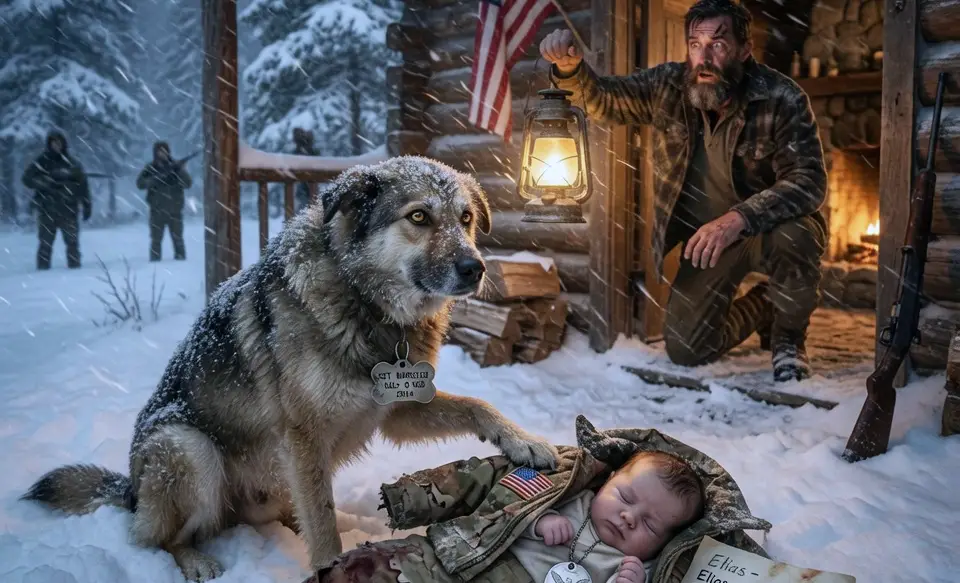
My days were built on the scaffolding of strict routine. I chopped wood until my shoulders burned, checked my snare lines, and maintained the cabin’s weatherproofing. These tasks demanded physical exertion but asked absolutely nothing of my heart. They provided structure without the dangerous requirement of feeling. I had learned the hard way—first overseas, where a compromised extraction had cost the lives of men I loved, and later on a rain-slicked highway that took my wife, Emily—that hope and attachment were liabilities.
That particular evening, the snow had been falling heavily for hours. It wasn’t a violent blizzard, just a thick, mesmerizing curtain that muted the world, making the forest feel as though it were pressing intimately against the cabin walls. I was sitting in my worn armchair near the cast-iron stove, cradling a mug of coffee that had long since gone lukewarm. My mind was drifting in that numb, familiar twilight between absolute nothingness and the crushing weight of everything I had lost. I told myself that the emptiness was a fortress. It kept me safe.
Then, the silence broke.
It was a sound so faint it barely registered over the crackle of the fire—a muted, desperate scrape of claws against the wet wood of the front porch, followed by a low, ragged whine. My body reacted before my conscious mind could process the anomaly. Shoulders rigid, breath instantly shallow, my senses sharpening into the hyper-aware state born of years in hostile territory. Out here, hesitation was a death sentence. I set the mug down silently and crossed the room, placing each footstep with deliberate care, feeling the icy draft bleeding through the floorboards. I rested my hand on the heavy iron latch. It had been an eternity since anyone had knocked on my door. An unfamiliar, tight sensation coiled in my chest as I pulled the door open.
The bitter cold rushed in immediately, a wall of pure winter carrying the sharp, clean scent of crushed pine needles and fresh powder. In the pale wash of the cabin’s lantern light, I found myself staring down at an impossibility.
Standing on the snow-swept boards of my porch was a German Shepherd. She wasn’t a stray scavenging for scraps; she possessed the lean, powerful build of a working dog, though she was perhaps four or five years old, her dark muzzle dusted with a premature frost of white hairs. Her thick coat was matted with ice, but she stood completely alert. It was her eyes that stopped my breath. They were fixed on me with a desperate, piercing intelligence, radiating an urgency that felt entirely human.
Held gently between her jaws was a small, precarious bundle wrapped in a soaked, paper-thin blanket. And from that bundle came a sound that bypassed every defensive wall I had spent years erecting—a fragile, reedy cry that cut through the Montana wind like glass.
Pressed tightly against the mother’s trembling hind leg was a second impossibility: a German Shepherd puppy, no more than a few months old. The pup’s fur was a lighter tan, and he was shaking violently from the freezing temperatures and sheer terror, his oversized paws shifting anxiously as he looked from his mother to me, waiting for a command. My tactical training screamed at me to assess the perimeter, check for threats, and maintain a safe distance. But there was no ambush here. There was only the raw, undeniable plea of survival.
Slowly, showing immense, deliberate physical control, the mother dog stepped forward. She lowered her head and placed the damp bundle directly onto the porch planks at my boots. Then, she took one calculated step backward, positioning her body to shield her puppy while maintaining absolute, unwavering eye contact with me. I had seen that exact look before. I had seen it in the eyes of my men when the radios went dead and everything hinged on a single, impossible command. She was passing the burden of life into my hands.
I dropped to my knees, ignoring the ice seeping through my denim, and reached for the bundle. I peeled back a corner of the soaked fabric, and my heart hammered against my ribs. It was a newborn. The baby was terrifyingly small, her delicate skin flushed a dangerous, mottled violet from the cold, her tiny lips quivering as another weak, breathless cry slipped out. That sound resonated deep in my marrow, waking a dormant, agonizing instinct to protect.
Without a second thought, I scooped the child into my arms. The mother dog did not flinch or growl; she merely watched me retreat into the golden warmth of the cabin. I kicked the door shut against the storm, suddenly aware that the quiet, empty existence I had so carefully curated was over.
I moved with the methodical efficiency of a medic in a combat zone. I cleared the sturdy wooden table near the stove and stripped off my heavy canvas jacket, laying it down as an insulated barrier against the wood. I placed the shivering infant onto the jacket and began peeling away the damp, freezing layers of the blanket. The child’s fingers and lips were tinged blue, her eyes sealed tightly shut against the trauma of the cold. Weakness like this demanded immediate, flawless action.
I stoked the fire with dry cedar, watching the flames roar to life, pushing back the shadows. Rummaging through my pantry shelves, my hands surprisingly steady, I found a sealed, emergency tin of powdered milk and a small aluminum pot. As the water heated over the stove, I glanced out the frost-edged window. The mother dog had taken up a sentry position directly outside the door, her broad back angled to take the brunt of the wind, her body a living shield for her puppy. She hadn’t scratched to come inside; she had surrendered the child and taken her post. The weight of her trust was staggering.
Testing the warm milk on the inside of my wrist—a forgotten echo of a life I might have had—I took a clean, soft cloth, dipped it into the liquid, and gently pressed it to the baby’s lips. For a terrifying minute, there was nothing. Then, her tiny mouth twitched. She latched onto the damp cloth, swallowing with a desperate, exhausted determination. I let out a jagged breath I didn’t know I was holding. It was the same exhalation of pure relief I used to make when a trauma dressing finally held, and the bleeding stopped.
Slowly, agonizingly, the blue tint faded from the baby’s extremities, replaced by a soft, living pink. Her breathing deepened, settling into a quiet rhythm. I sat heavily in the chair, cradling the warm bundle against my chest, staring down at the sleeping face. The cabin was utterly silent now, save for the snapping of the fire, but my mind was deafening. I thought of Emily. I remembered the way her auburn hair would escape her ponytail, the dusting of freckles across her nose that darkened in the summer sun, her warm, bell-like laugh that used to chase away the shadows of my deployments. She had always believed my instinct to protect was a gift. When I lost her on that rain-slicked asphalt, I buried that gift with her. Yet here I was, holding a fragile, beating heart in the palm of my hands.
I couldn’t call for help; the storm had likely taken down the lines, and a rescue crew would never make it through the drifts before dawn. I assessed the variables, adapted to the crisis, and held the line. I built a makeshift bed from folded wool blankets, testing the distance from the stove over and over until the ambient heat felt perfect. I laid the baby down, my body angled over her like a canopy. Opening the front door just a crack, letting the bitter wind bite my face, I met the gaze of the mother dog. I gave her a single, solemn nod. She blinked once in return…
I spent the entire night sitting upright in the armchair, fully dressed, listening to the child breathe, knowing the morning would demand a terrible toll.
When dawn finally broke, it brought a fragile, pale light that illuminated a world buried in fresh powder. The storm had blown itself out. I checked the baby—warm, breathing steadily, deeply asleep—and stepped out onto the porch. The cold was sharp, but the vicious wind had died. The mother dog stood waiting at the edge of the tree line. Her posture had shifted from defensive to expectant. She looked at me, then looked deep into the woods. She wanted me to follow.
Leaving the puppy curled in the residual warmth of the doorway, I followed the dog into the silent, suffocating density of the pines. Every crunch of my boots in the snow felt like a countdown. My mind flashed to other forests, other missions where I had arrived just minutes too late, where the smoke was still rising and the silence was heavy with the finality of death.
A mile into the woods, the dog slowed, her head dropping low. She led me to a small clearing where the pristine snow was chaotic, churned up by the unmistakable signs of a desperate struggle. My chest tightened before I fully processed the sight.
Half-buried in a drift lay a young woman. She couldn’t have been more than twenty-five. A dark knit cap had slipped back, releasing strands of dark hair that were now frozen stiff against her pale, olive-toned face. She lay curled on her side, her body curving inward around an empty space where she had clearly shielded her baby until her body simply gave out. Her worn clothes were arranged not in a panic, but with deliberate, tragic care. I knelt beside her, checking for a pulse I knew wouldn’t be there. Her features were frozen in a mask not of terror, but of an absolute, fierce resolve.
Tucked carefully beneath her stiff hands, sheltered from the moisture of the snow, was a folded scrap of paper. My fingers were numb as I opened it. The ink was faint, scratched out in shivering haste.
“Please save my baby.”
It wasn’t a plea for her own life. It was a plea for continuation. I closed my eyes, my breath pluming in the freezing air, feeling the crushing weight of her sacrifice. She had walked until her organs failed, until her blood slowed to ice, and then she had trusted her dog to carry her soul’s only priority to a stranger’s door. The dog sat beside me, letting out a low, mournful sound, mourning the family she had lost.
I took off my gloves. With bare hands, I reached out and gently closed the young mother’s eyes, honoring the sacred dignity of her final act. Then, finding a large pine where the frozen earth offered a slight reprieve, I began to dig. My muscles burned, my lungs ached in the frigid air, but the physical pain was a welcome distraction from the familiar, hollow ache of arriving too late. I lifted her with the utmost gentleness, laying her in the earth. I placed her folded note back between her hands, covering her with dirt and snow until she was embraced by the forest. I snapped two fallen branches, binding them together with a strip of leather from my boot, and drove the makeshift marker deep into the ground.
The dog stepped forward, lowering her snout to the freshly turned snow for a long moment, before turning back toward the direction of my cabin. I followed her back through the trees, a profound, unyielding resolve hardening in my chest. The isolated, silent life I had clung to was dead and buried. I had a promise to keep.
The morning had barely begun to lift the slate-grey shadows from the pines when I realized my sanctuary had been breached. It wasn’t a sound that alerted me, but a profound, unnatural absence of it. The forest birds, which typically returned to the branches the moment a storm broke, were entirely silent. The animals sensed it, too. The mother German Shepherd rose from her spot by the hearth with a sudden, rigid stiffness.
This wasn’t the relaxed stretch of a dog waking up; it was the coiled, electric posture of a guardian sensing a predator. Her ears angled sharply forward, and her body squared toward the thick wooden door. Behind her, the puppy mimicked her stance, his small frame taut against the backdrop of the cabin, trying to make himself look formidable.
I checked the baby, ensuring her breathing was steady and she was bundled warmly, before stepping soundlessly to the frosted window. To a casual observer, my posture was relaxed, but internally, every nerve was vibrating with lethal precision. Through the glass, I saw them. Fresh, deep boot prints cut an aggressive, unhesitating line through the pristine snow. These weren’t the meandering tracks of lost hikers. They were deliberate, direct, and dripping with the arrogance of men who believed they owned whatever lay at the end of their path.
When the knock came, it didn’t startle me. It was firm, heavy, and measured—a rhythmic pounding that expected immediate compliance. A familiar, glacial calm settled deep beneath my ribs. It wasn’t fear; it was the cold, calculating clarity of a soldier. Knocks like that in the middle of nowhere never brought salvation.
I unlatched the door and pulled it open just a fraction—enough to establish a line of sight without surrendering an inch of tactical ground. Standing on my porch were two men who thoroughly did not belong to the wilderness. The first was tall and heavily built, his broad shoulders wrapped in a thick, expensive black wool coat that had seen hard wear. A dark, neatly trimmed beard covered his jaw, and a dark knit cap was pulled low over pale, assessing eyes. They were the eyes of an apex predator, skimming my face and the cabin’s interior, rapidly calculating value and threat.
Slightly behind him loomed the second man. He was thinner, with a gaunt, narrow face and a jaw shadowed by days of unkempt stubble. He slouched, his hands jammed deep into his coat pockets, but his energy was chaotic, his gaze darting restlessly past my shoulder, aggressively searching for something.
“Morning,” the taller man said. His voice was smooth, practiced, and coated in a superficial warmth. “I’m Mark Evans. We’re looking for my sister’s child. She was traveling through the area, and she never made it to her destination.”
The lie was beautifully constructed, sympathetic and vague, but I had spent years interrogating men whose lies were a matter of life and death. I registered the glaring lack of genuine panic in his tone, the total absence of the soul-crushing grief I had seen on the faces of real families looking for lost loved ones. Worse, I saw the way Mark’s pale eyes flicked hungrily toward the interior of my cabin the moment the baby let out a faint, sleepy sigh. Beside him, the man named Luke tightened his jaw at the sound. Every instinct I possessed screamed the truth: these men were hunters, tracking human collateral.
Behind me, the mother dog stepped fully into the narrow wedge of open space. She planted her paws directly between me and the threshold, a living barricade. She didn’t bark. Instead, a low, sustained growl vibrated deep in her chest—a terrifying, primal frequency that filled the air. The puppy let out a high-pitched, uncertain bark, pressing tight against her flank. I watched Mark’s gaze drop to the dog, measuring her weight, calculating the risk. Men who were simply searching for a beloved niece didn’t look at an animal and calculate how much force it would take to kill it.
“I haven’t seen anyone matching that description,” I said, my voice dead flat, offering absolutely no invitation for further dialogue. “The roads are iced over. Traveling right now is unwise.”
Mark’s polite facade thinned, revealing the jagged edge of impatience underneath. “Are you sure? You didn’t hear anything during the storm? Any unusual noises?”
The tension stretched between us, a razor wire pulled to its absolute limit.
Luke shifted his weight, pulling one hand slightly out of his pocket. “It’d be a damn shame if something happened to a baby out here in this kind of weather,” he sneered, his voice rough and antagonistic. It was a clear test of my boundaries.
I didn’t argue. I didn’t raise my voice. I simply let the silence fall between us—the kind of heavy, absolute stillness that makes violent men incredibly uneasy because it gives them absolutely nothing to push against. I locked eyes with Mark, letting the mask of the polite hermit slip just enough to show him the combat veteran underneath.
“You should leave,” I said quietly. “This forest isn’t forgiving to men who linger without a good reason.”
For a split second, I saw Mark weigh the odds of forcing the door. But the tactical disadvantage was his, and he knew it. A thin, bloodless smile stretched across his face. “We’ll keep looking,” he said, the polite words dripping with a cold, lingering promise of violence.
I watched them turn and trace their path back into the dense timberline. I didn’t relax. Departures like that were merely strategic retreats. I shut the heavy door, throwing the iron deadbolt into place. As I stood in the quiet cabin, listening to the dogs slowly settle, the gravity of my situation locked into place. My refuge was compromised. It was now a target on someone else’s map, and walking away from this fight was no longer an option.
Packing was an exercise in ruthless efficiency. Extra wool blankets, high-calorie food stores, my heaviest boots—everything was compressed and secured. I checked the baby’s makeshift carrier, testing the knots and straps twice over. As I strapped the warm, sleeping weight of her to my chest, a profound shift occurred inside me. For years, my entire existence had been defined by avoidance. Now, every breath I took was defined by absolute intent.
I stepped out into the biting, crystal-clear cold. The mother dog flanked my left thigh, perfectly in sync with my stride, while the pup bounded gamely through the deeper drifts behind us. I dragged a heavy pine bough behind me for the first quarter-mile, sweeping away our tracks, leaving nothing for Mark and Luke to read but undisturbed snow.
Leaving the cabin felt like severing a limb, but it was a necessary amputation. The trail toward the nearest town was treacherous, winding through dense thickets. Several miles in, my heart leaped as a lone figure materialized on the logging road ahead. I signaled the dogs to hold.
It was a woman, walking with a measured, unhurried grace, balancing a large bundle of split firewood on her hip. She stopped when she saw me, her guard going up instantly. As we closed the distance, I took her in: early thirties, dark blonde hair woven into a thick braid beneath a knit cap, her skin weathered from harsh mountain winters. She had steady, thoughtful eyes that evaluated the world rather than judging it.
“Sarah Miller,” she introduced herself, her voice a calm, soothing presence in the frozen air. She owned a cabin a few miles down the road.
When her eyes dropped to the bundle strapped to my chest, her caution melted into pure, unguarded empathy. I gave her the absolute minimum—a child who needed warmth and safety. Sarah didn’t pry for a dramatic backstory. Instead, she offered practical salvation. She told me the main road was partially plowed and directed me straight to the town church. She possessed the quiet resilience of a woman who had survived her own devastation; she told me softly that she understood what it meant to rebuild alone after a winter accident took her husband. The mother dog walked up to her, sniffing her extended hand before retreating—an animal’s silent endorsement of a good soul.
By the time the sparse, flickering lights of the town broke through the timberline, the steel-grey dusk had settled heavily. My legs were burning, and the pup was practically dragging his paws, but we had made it. The town was small, a collection of modest buildings where life moved in visible, human rhythms.
The church stood near the center, a weathered but proud white building with a simple steeple pointing toward the darkening sky. Golden light spilled generously from its open double doors onto the snow.
Inside, the air was warm and smelled faintly of old pine and polished pews. A man stood near the altar. He was broad-shouldered with close-cropped graying hair and a neatly trimmed beard. When he turned to me, his eyes held a profound, quiet authority. He introduced himself as Pastor Thomas Reed. He didn’t bombard me with panicked questions. He looked at me, at the baby, and at the exhausted dogs, and simply gestured us further inside.
Almost immediately, a woman emerged from the back offices. She was in her late thirties, her chestnut brown hair pulled back into a practical knot. Her skin was pale, flushed from the building’s heat, but her eyes held a depth of sorrow that had clearly been transformed into grace. Her name was Mary Collins. I would later learn she was a nurse who had lost her husband and young daughter in a devastating accident—a tragedy that had hollowed her out before filling her back up with an endless capacity to heal others.
Without a word, Mary stepped into my space. Her hands were incredibly gentle but possessed a striking, clinical confidence as she checked the baby’s temperature and breathing. She hummed a soft, wordless melody that instantly lowered my heart rate. For the first time since the dog had scratched at my door, I felt the crushing weight on my shoulders ease. I surrendered the child into Mary’s arms, recognizing immediately that I had brought this little girl exactly where she needed to be.
As Mary worked, she maintained a quiet, steady stream of explanation, not demanding my input but simply offering transparency. She detailed how the baby was showing the classic signs of severe exposure, yet her core temperature was already stabilizing. She explained that consistent warmth and vigilant monitoring over the next few hours would be critical, but the child was remarkably resilient. I stood a few paces back, my arms suddenly feeling empty, absorbing every word she spoke. It was a strange, disarming sensation.
For so long, my survival—and the survival of anyone under my command—had depended entirely on my own hyper-vigilance. Trusting someone else to hold the line was a muscle I hadn’t used in years. But watching Mary, noting the way the baby’s fragile, ragged breathing began to naturally sync with the slow, rhythmic rise and fall of the nurse’s chest, I realized that true trust didn’t mean surrendering control; it meant sharing the burden.
Pastor Thomas had stepped away into a small, adjacent office to make the necessary calls. I could hear the low, measured cadence of his voice through the cracked door as he contacted the local authorities. He didn’t sound panicked; he didn’t dramatize the situation. He navigated the crisis with the calm intention of a man deeply accustomed to catching his community when it fell.
While we waited, Mary sat down in a worn wooden rocking chair, holding the baby close. She began to hum a simple, melodic tune that possessed no lyrics but carried an ocean of steadiness. I watched the tension melt from the infant’s face.
Mary finally looked up, her gaze shifting from the child to me. Her eyes were open, carrying a respectful curiosity that felt entirely free of judgment. “I’m Mary,” she said softly. “And what’s your name? How do you fit into all of this?”
“Jack,” I answered plainly, keeping my voice low so as not to startle the dogs resting nearby. “I live in a cabin a few miles up the ridge. I didn’t know her. The dog brought her to my porch.” I offered the raw facts without embellishment, expecting disbelief.
Instead, Mary simply nodded. Her acceptance was immediate and profoundly thoughtful. In that brief exchange, I felt an unfamiliar sensation wash over me. I wasn’t being looked at as a problem to solve, a suspect, or a broken veteran. I was just a man who had done what needed to be done.
The police arrived less than an hour later. The heavy wooden doors opened to admit Officer Daniel Brooks, a man in his early forties with a square, stubborn jaw and light stubble shadowing his cheeks. He carried the exhausted, heavy-lidded look of a small-town beat cop who had seen far more human tragedy than his uniform suggested. As we sat in the church pews, he explained that working a rural beat meant the lines between rigid legal duty and basic human empathy were constantly blurred.
I gave him my statement. I recounted the agonizing timeline of the storm, the tragic discovery in the woods, and, most importantly, the aggressive arrival of Mark Evans and the man named Luke. I described their posture, the expensive black coat, the calculated way they had scanned my cabin. Brooks listened with absolute intent, his pen moving swiftly across his notepad. He asked razor-sharp, precise questions, his mind clearly snapping puzzle pieces together. He admitted quietly that rumors of missing persons—vulnerable, transient women and undocumented workers—had been circulating through the neighboring counties for weeks.
As the official machinery of the law kicked into gear, the suffocating tension of the past forty-eight hours began to redistribute. When Mary briefly handed the baby back to me so she could organize a station for formula and fresh blankets, my hands instinctively curled tighter around the small weight. The bond I felt wasn’t forged by time; it was forged in the fire of necessity. The chapter of my absolute isolation was closing. As the snow continued its patient descent outside the stained-glass windows, I sat on the polished wooden bench, the child asleep against my chest, the mother dog at my feet. For the first time since Emily’s funeral, I allowed myself to believe that the world contained places built specifically to catch people stepping out of the dark.
The following morning broke with a fragile, icy clarity. The investigation moved with a quiet, devastating intensity. Officer Brooks returned to the church, this time accompanied by Detective Alan Pierce from the county unit. Pierce was a lean, sharp-featured man in his late forties, his salt-and-pepper hair cut to military precision. He possessed the kind of probing, unblinking eyes that read the truth in a man’s posture before he ever opened his mouth.
We gathered in the small office behind the sanctuary. The room smelled of old paper, floor wax, and strong, bitter coffee. I walked them through it again. Pierce took notes sparingly, preferring to let my words hang in the air. Brooks filled in the agonizing gaps, connecting Mark and Luke to an illicit operation moving vulnerable people through isolated rural routes, exploiting the vast emptiness of the Montana wilderness. Mary joined us to provide the medical timeline, her voice clinical but steeped in warmth as she testified that the baby’s exposure indicated hours in the freezing temperatures, not days.
By early afternoon, Pierce’s phone rang. When he hung up, the atmosphere in the room shifted entirely.
“We got them,” Pierce announced, his voice tight with restrained satisfaction. Mark and Luke had been taken into custody without incident at a roadblock near the state line. Evidence linking them directly to the human smuggling operation had been secured.
But the most crucial piece of the puzzle had also fallen into place. “We identified the baby,” Pierce continued, looking directly at me. “Hospital records matched a missing person report filed three weeks ago by a social worker. The mother was receiving relocation assistance. She was trying to get out.”
Hearing those words, the memory of the frozen forest rushed back, stealing the breath from my lungs. The young woman in the snow was no longer an anonymous tragedy; she was a mother who had fought a terrifying, impossible battle to save her child. The baby was officially recognized as a legal victim, shielding her from being handed over to anyone who might claim false relation. A collective, profound wave of relief washed through the office. Mary closed her eyes, pressing a hand to her chest. Pastor Thomas bowed his head in silent prayer.
Pierce waited a moment before leaning forward, resting his forearms on the desk. “The system will take over the long-term legalities, Jack. But right now, this child needs immediate stability. Given your role in her rescue, and the fact that she clearly responds to you… the court would likely approve you as a temporary emergency guardian. If you’re willing.”
The words hung in the air, heavier than any rifle I had ever carried. This wasn’t a tactical decision. It was a choice about vulnerability. It meant opening a door I had sworn to keep locked forever.
“I need a minute,” I rasped, standing up.
I walked out the back door of the church, the freezing air stinging my lungs. The dogs were waiting at the bottom of the steps. The mother German Shepherd stood up, her gaze attentive and steady, while the puppy bounded around my boots, his tail wagging frantically now that his belly was full. I crouched down, burying my bare hand into the thick, warm fur at the mother dog’s neck. I thought of the life I had built around absence. It was controlled. It was predictable. It was incredibly lonely. Then I thought of the past two days—of nights measured by a fragile heartbeat, of choices that actually mattered. I realized then that belonging wasn’t something handed to you; it was a choice you made, often terrified, often without a safety net.
I walked back inside. Mary was sitting in the sanctuary, gently rocking the baby. She looked up at me, sensing the battle in my eyes. She didn’t ask what I was going to do. She simply smiled, a sad, beautiful smile, and said, “Whatever you decide, Jack, she will always remember the feeling of being held safely. Even if her mind forgets the details, her heart won’t.”
That simple, shattering truth cut through the last of my armor.
I walked back into the office, looked Detective Pierce in the eye, and said, “Yes.”
The paperwork was outlined, the bureaucratic steps explained, but the path forward was finally defined. That evening, as the streetlamps flickered to life against the snow, I sat back down on the church bench. Pierce had called one last time to confirm that the mother’s identity was fully verified; her case would be closed with the dignity and respect she had earned with her life.
Looking down at the sleeping child against my chest, the gentle weight of her small breaths rising and falling, I didn’t feel a triumphant sense of resolution. But I felt aligned. The ghosts of my past hadn’t vanished, but they had finally stepped aside to make room for the living. I pulled the blanket tighter around her, leaning my head back against the solid oak pew, ready to answer the call.
Spring didn’t announce itself in the Montana mountains with a sudden burst of warmth; it arrived by slow, deliberate increments. The heavy, suffocating snow retreated inch by stubborn inch, revealing the dark, fragrant earth beneath. The sharp hiss of the winter wind was replaced by the low, steady murmur of meltwater rushing through the timberline, and the air softened, carrying the sweet, sharp scent of pine pitch and damp soil.
I stood on the porch of my cabin one early April morning, watching the seasonal shift with a stillness that finally felt earned rather than hollow. The months since the winter storm had completely dismantled my life and rebuilt it from the ground up, not through dramatic, sweeping gestures, but through the quiet, relentless demands of daily love.
The adoption papers had finally cleared after a grueling marathon of state bureaucracy. There had been weeks of thorough background checks, intense interviews with social workers, and scheduled home evaluations. The county handled it all with a steady, cautious patience, ensuring the child was placed safely. I had walked into the county courthouse carrying a heavy, familiar anxiety, half-expecting the system to look at a solitary, scarred veteran and decide I wasn’t enough. But when the judge finally brought the wooden gavel down and signed the official order, I didn’t feel a sudden, explosive surge of triumph. Instead, a deep, profound certainty settled into my marrow—the kind of absolute permanence that anchors you to the earth.
I officially named him Noah. It was a name that spoke not merely of surviving a flood, but of passage—of being carried safely through a devastating storm into a life that was stable and secure. Noah had grown remarkably fast, the fragile, violet-tinged infant replaced by a robust, thriving boy. His cheeks had filled out with a healthy, rosy color, and his dark, impossibly long lashes framed wide, expressive eyes that tracked every movement in the cabin with fierce fascination. I quickly learned the intricate language of his small existence. I learned the subtle differences in his cries, distinguishing hunger from fatigue. I learned the chaotic, beautiful rhythm of his sleep and wakefulness. The intense, hyper-vigilance that had once been reserved solely for anticipating ambushes and roadside threats had found a new, sacred purpose: keeping a little boy safe.
The dogs had woven themselves into the fabric of our lives as seamlessly as if they had been born under my roof. I named the mother German Shepherd “Luna,” a nod to the quiet, luminous steadiness in her gaze that had guided me through the darkest night of my life. She took up a permanent, self-appointed post—first near the heavy front door, and later, directly beneath Noah’s wooden crib. She was incredibly watchful but never intrusive, her thick coat now sleek and glossy from a steady diet and the heat of the stove. Her puppy, whom I named “Scout,” was an entirely different story.
He was growing too fast for his own good, a clumsy, joyful disaster of oversized paws and floppy ears. He learned his boundaries not through fear or shouting, but through Luna’s gentle, physical corrections. I found myself laughing out loud on a regular basis—a rusty, unfamiliar sound that startled me at first. The pristine, military-grade order of my cabin was gone, replaced by the beautiful chaos of chewed firewood, scattered blanket forts, and the undeniable evidence of a life actually being lived.
Mary Collins had continued her visits, initially arriving in her official capacity as a county nurse to monitor Noah’s weight and development. But as the snow melted and the roads cleared, the nature of her presence began to quietly shift. She stopped bringing her medical bag into the living room. Her chestnut hair, usually pulled into a strict, professional knot, was worn loose more often, strands escaping to frame her face when she laughed. She moved comfortably in the cabin’s space, possessing that rare, instinctual grace of knowing how to help without taking over. I appreciated that delicate balance more than words could say, because it perfectly mirrored my own steep learning curve. I was learning how to loosen my iron grip on control and lean into the terrifying vulnerability of trust.
Our relationship deepened without the pressure of forced urgency. It was forged in the quiet, domestic spaces of shared tasks. We spent countless evenings sitting at the scarred wooden table, nursing steaming mugs of black tea while Noah slept a few feet away. We talked about ordinary, grounding things: the changing weather patterns, the spring planting, the town council meetings. And sometimes, when the fire burned low, the heavier truths surfaced.
Mary spoke of the devastating loss of her husband and daughter, not as a raw, bleeding wound, but as a profound scar that had shaped her capacity to love. In turn, I found myself telling her about Emily, and about the brothers I had lost overseas, without the protective layer of defensive stoicism. In those late-night conversations, we found a deep, mutual respect rooted not in trauma, but in a shared, quiet resilience.
Sarah Miller, the widowed neighbor I had met on the logging road, also became a fixture in our new routine. Her visits were always practical and brief—she would pull up in her battered truck with jars of homemade preserves or advice on the muddy road conditions. Her steady, grounded demeanor never wavered. Through Sarah and Mary, I began to understand the true nature of community. It wasn’t about grand obligations; it was simply about showing up for one another, consistently, without the expectation of reward.
My cabin transformed completely. It was no longer a fortress of retreat, but a true home built for return. The walls now bore small pencil marks charting Noah’s growth, and the heavy, suffocating silence I had once desperately cultivated was replaced by sounds that vibrated with life. I noticed the physical changes in myself, too. My shoulders, chronically tense for over a decade, finally dropped. My movements lost their rigid, guarded edge. My attention expanded far beyond checking the perimeter for threats, focusing instead on the soft, vital moments: holding Noah against my chest during a restless night, or gently guiding Scout away from the hot stove with a patient hand rather than a sharp command.
On a brilliantly clear morning in late May, I stepped out onto the front porch holding Noah securely against my hip. He was bundled in a light sweater, his dark eyes wide as he took in the vast, sunlit expanse of the forest. The dogs followed us out. Luna settled gracefully over my boots, crossing her front paws, while Scout did a joyful, chaotic lap around the yard. I looked out at the distant mountain peaks. They were as massive and indifferent as ever, but I no longer felt the magnetic pull to disappear into their shadows. Everything I needed, everything that anchored me to the earth, was right here on this wooden deck.
The crunch of tires on gravel pulled my attention to the driveway as Mary’s car appeared through the tree line. She parked and walked up the steps, her smile warm and effortless. She didn’t knock; she just joined us on the porch, leaning comfortably against the railing, her shoulder brushing lightly against mine.
Together, we watched Noah reach his small, dimpled hand down toward the dogs. His fingers curled in absolute fascination as he brushed Luna’s ear. She responded with a look of calm, maternal acceptance, while Scout eagerly offered a wet, sloppy kiss to the boy’s knuckles before retreating into a play-bow.
A profound warmth spread through my chest, and it had absolutely nothing to do with the spring sun. I thought back to the agonizing promise I had made in the frozen dirt of the winter forest. I thought of the brave young woman who had poured the very last ounce of her life into trusting a dog, and a stranger, with her child. I realized then that my promise hadn’t ended with merely keeping Noah alive. It lived right here, in the continuity of our days, in the courageous willingness to build a beautiful life out of the wreckage of a tragedy.
The painful memories of my past hadn’t vanished, and the world outside the tree line would always carry risks. But those things no longer defined the perimeter of my existence. I had finally learned that true strength wasn’t measured by the emotional distance I could maintain, but by the closeness I could sustain. The iron-clad discipline that had kept me alive in combat now served a much higher calling: providing unconditional love, consistency, and care for my son.
As the morning light washed over the porch, I pulled Noah a little closer, feeling his strong, steady heartbeat against my ribs. The realization washed over me, clear and absolute. The most vital mission of my life wasn’t behind me in a faded uniform, nor was it hidden in the isolating silence of grief. It was right here, breathing in my arms, requiring not tactics or survival strategies, but absolute devotion. Mary rested her hand gently over mine, her touch grounding and familiar. I looked at her, at my son, and at the dogs resting at our feet, and I smiled—a full, genuine smile. I understood at last that true family isn’t always bound by blood or grand design. It is built by choice, upheld quietly every single day, and it is the absolute truest measure of a man’s soul.

Daniel Carter is a senior staff writer at InspireChronicle, specializing in legal conflicts, family disputes, and real-life justice stories. His work focuses on high-stakes situations involving inheritance, betrayal, and complex moral decisions. Through detailed storytelling, he explores how ordinary people navigate extraordinary challenges and the long-term consequences that follow.
His articles have gained significant traction online for their emotional depth and realism, resonating with readers across the United States.
He writes extensively about justice, personal responsibility, and the hidden dynamics within families.