
The Ashworth Country Club sprawled across forty acres of rolling, manicured hills in Westchester County, New York, an emerald canvas dotted with pristine white tents. The afternoon air carried the faint, elegant strains of a string quartet situated near the blooming rose garden. Sixty guests drifted across the lawn, their hands wrapped around crystal flutes of sparkling cider, politely nibbling on delicate finger sandwiches that cost more per plate than my entire weekly grocery budget.
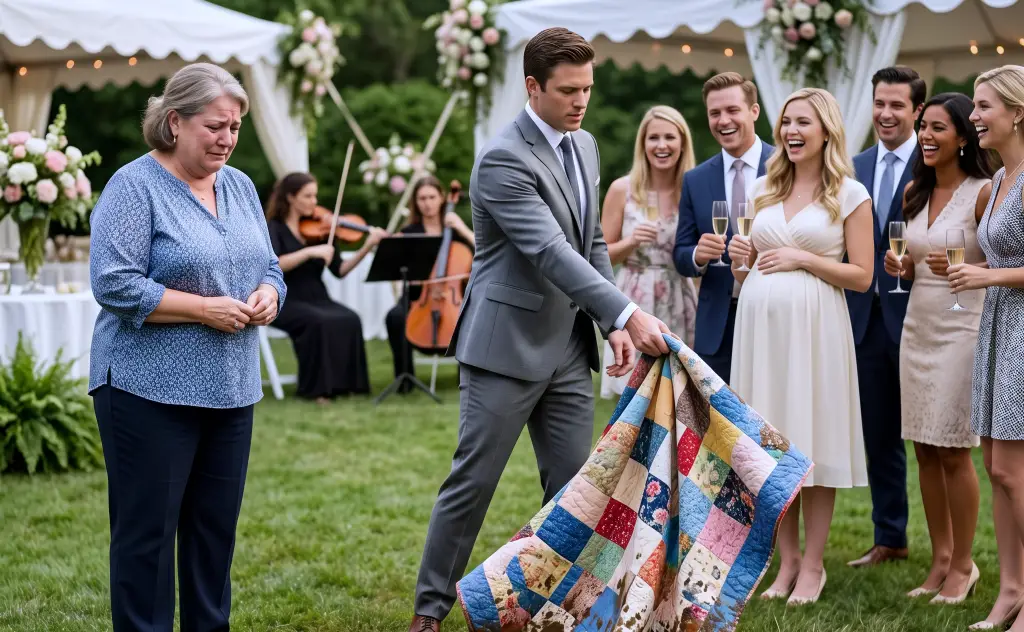
From the edge of the patio, I watched my daughter. Megan looked undeniably radiant. At seven months pregnant, she possessed a soft, ethereal glow, draped in a cream-colored maternity dress that easily ran a thousand dollars. She moved through the affluent crowd with a practiced grace, smiling and nodding as if she had been born into this glittering world of exclusive country clubs and catered weekend events.
She hadn’t been. She had been born in a cramped, two-bedroom apartment in Queens. The very first bed my daughter ever slept in was a hollowed-out dresser drawer that I had carefully lined with soft, worn blankets because a proper crib was simply out of the question.
Her husband, Bradley Ashworth, stood at her side, his large hand resting possessively on the small of her back. He was tall, with a sharp, square jaw and the kind of blindingly confident smile that made you want to hand over your life savings. He worked for his father’s insurance firm, Ashworth & Kline, managing high-value policies for outrageously wealthy clients across the tri-state area. As he reached out to shake a guest’s hand, the afternoon sun caught the face of a watch that cost substantially more than my car.
His mother, Diane Ashworth, had orchestrated the entire shower. She was the one who had selected the venue, curated the absurdly expensive menu, and aggressively gatekept the guest list. I had been allowed to attend, a gesture I was meant to understand was exceptionally generous on her part.
I stayed near the perimeter, waiting quietly until it was time for the gifts.
They seated Megan in a grand white wicker chair, practically swallowing her in a mountain of boxes wrapped in thick, designer paper and satin ribbons. She unwrapped a top-of-the-line Bugaboo stroller gifted by Bradley’s former college roommate. Next came an imported cashmere blanket set from Diane, followed by a heavy silver rattle from Tiffany’s. Every extravagant item was met with a chorus of polite, manicured applause.
Then, it was time for mine.
I had wrapped it in simple brown butcher paper because I appreciated the honest, rustic simplicity of it, securing it with a bow made of rough twine. As Megan picked it up, I caught the familiar, fleeting shadow that crossed her face. It was the exact same expression she wore whenever I showed up at an event where her new family might see me—a rapid, anxious scan of the room. Who is watching? She pulled the twine loose and let the paper fall away, unfolding the heavy fabric across her lap. It was a quilt. I had spent nine months of my life on it. Every single night, after completing my grueling shift at the Brookhaven Senior Center—where I spent hours on my feet cooking three square meals a day for eighty elderly residents—I would sit under the harsh overhead light of my tiny kitchen table and sew.
The quilt was made of thirty distinct squares, and every single one was a memory. I had painstakingly labeled each piece in tiny, precise embroidered letters. There was a patch from her first baby blanket in 1994. A vibrant piece of her Halloween butterfly costume from 1998. A swatch of the floral dress she wore on her fifth birthday in 2000. Thirty squares. Thirty pieces of our shared history, stitched together with aching love to keep her new baby warm.
Megan held it up by the corners. The chatter on the lawn abruptly died.
Diane Ashworth was the first to lean in. “Oh, my,” she murmured. She reached out, pinching a corner of the fabric between two perfectly manicured fingers as if she were testing a soiled towel for a communicable disease. “Is this… homemade?”
A hot flush of pink crept up Megan’s neck, spreading across her cheeks. She lowered the quilt, avoiding my eyes. “Mom,” she whispered, her voice tight with embarrassment. “We registered at Pottery Barn.”
I took a breath, stepping forward. I wanted to explain. I just needed her to understand the nine months of late nights, the calloused fingers, the stories woven into the very fabric she was holding.
But Bradley was faster. He snatched the quilt from her hands with a careless flick of his wrist.
“Your mother’s a lunch lady, babe,” he said. He flashed that brilliant, devastating grin at the surrounding guests, treating the moment like an inside joke they were all smart enough to get. “What did you expect? A gift card to Bergdorf’s?”
He dropped my quilt onto the gift table. It landed in a crumpled heap, right on top of a pile of discarded, torn wrapping paper, like a used napkin.
Laughter rippled through the crowd. It wasn’t loud or explosive, which somehow made it worse. It was polite. Measured. The specific, suffocating kind of laughter designed to remind you exactly where you stand, and that you do not belong among them.
Megan didn’t reach for the quilt. She didn’t attempt to fold it. She didn’t look up to find my face in the crowd. She simply turned her attention to the next silver-wrapped box—a designer diaper bag from one of Bradley’s senior colleagues—and the afternoon seamlessly moved on.
I remained in my spot for ten excruciating minutes. Not a single person met my eye or spoke to me. Across the lawn, I watched Diane lean in to whisper to another woman holding a champagne flute. The breeze carried a single word in my direction: cafeteria.
I walked quietly to the gift table. I picked up the quilt and smoothed out the wrinkles. I folded it exactly the way I fold everything—with patience, and with profound care. I placed it gently into my tote bag, turned my back on the white tents, and walked to the parking lot.
My ten-year-old Honda Civic was parked at the absolute farthest edge of the asphalt, practically touching the service entrance, dwarfed by a gleaming sea of BMWs and Mercedes-Benzes. I unlocked the door, slid into the driver’s seat, and set the quilt on the passenger side.
I sat there for a long time, staring out through the windshield. I didn’t shed a tear. I had officially stopped crying over my daughter’s desperate choices three years ago, on the rainy afternoon she called to ask me not to attend her engagement party because my presence might make Bradley’s aristocratic family feel “uncomfortable.” I had gone anyway. She had spent the entire evening introducing me to her new friends as a distant friend of the family.
Later that evening, I sat alone in my apartment in Astoria. It was the exact same apartment I had lived in for twenty-eight years. It was rent-stabilized at eleven hundred dollars a month. One bedroom, a kitchen so narrow you could barely open the oven door without hitting the opposite wall, and a single living room window that stared directly out at the elevated train tracks. Every fourteen minutes, a train roared past, and the entire building rattled in its foundation.
I brewed a cup of chamomile tea and walked out to the narrow hallway. I opened the hall closet, pushing aside the heavy winter coats. Hidden behind them was a heavy-duty, fireproof filing cabinet, permanently bolted to the floorboards. I had purchased it back in 2001, right after the towers fell, when a profound realization settled into my bones: absolutely nothing in this world is permanent except the things you have the power to secure for yourself.
I slipped a key into the lock and pulled open the top drawer.
Inside rested thirty-four thick, legal property deeds. I kept them meticulously filed alphabetically by borough: Queens, Brooklyn, the Bronx, Manhattan, and finally, three very specific properties located in Westchester County. The drawer held purchase records dating all the way back to 1997, alongside stock certificates and highly diversified municipal bond portfolios.
But tonight, my fingers bypassed the others and pulled out one specific deed. It was the only one that mattered right now.
It read: Ashworth Country Club. Forty acres. It had been quietly acquired in 2021 through an entity named RMD Holdings LLC. The initials stood for Rosemarie Delgado. The original purchase price was 3.8 million dollars. The current appraised value was 6.2 million.
I traced the raised seal on the thick paper, listening to the distant rumble of the approaching Astoria train. My daughter had just allowed her husband to humiliate me at a baby shower hosted at a venue that her lunch lady mother owned lock, stock, and barrel.
It all began out of sheer, unadulterated desperation in the winter of 1997. I was thirty-five years old, a fresh widow drowning in the terrifying reality of raising toddler Megan entirely alone. My anchor in the world, my husband Eddie, had suffered a massive, fatal heart attack at the unforgiving age of forty-one. We had no life insurance. The monthly premiums had always been a luxury we simply could not afford on my twenty-two thousand dollar a year salary, even when I picked up every extra shift the school district would allow. When the dust of the funeral finally settled, Eddie left us with a devastatingly quiet apartment and exactly four thousand, two hundred dollars in a standard savings account.
I was working the morning kitchen shift at Public School 117, elbow-deep in industrial suds and smelling permanently of institutional green beans, when I overheard two homeroom teachers gossiping by the coffee percolator. They were talking about a foreclosed, dilapidated row house down in Jamaica, Queens. The bank was desperate to offload it for sixty-two thousand dollars. Everyone in the staff lounge scoffed. They said the neighborhood was too rough, the foundation too old, the risk too high.
I didn’t see a risk. I saw a lifeboat.
I bought that decaying row house with every single dime to my name, scraping the bottom of Eddie’s meager savings and taking on a high-interest mortgage I had absolutely no business qualifying for. To this day, I firmly believe the loan officer pushed the mountain of paperwork through out of sheer, overwhelming pity. I was a grieving, exhausted cafeteria worker with a three-year-old clinging to her apron strings. I suppose he couldn’t bring himself to stamp a rejection on my file.
I spent every weekend breathing in decades-old dust, slowly bringing that property back to life. I checked out heavy, plastic-covered manuals from the local public library to teach myself the brutal mechanics of plumbing. The internet was barely a concept, let alone a resource, but there was an independent hardware store on Hillside Avenue where an old, retired contractor named Gene held court. Gene would patiently draw out pipe diagrams on scrap paper and answer my endless, frantic questions for free, provided I bought my spools of wire and buckets of joint compound directly from his registers.
I learned how to hang heavy sheets of drywall until my shoulders screamed. I learned how to wire electrical outlets and lay ceramic tile over uneven subfloors. Through it all, little Megan sat safely on a spread-out moving blanket in the corner of whatever room I was gutting, happily playing with her worn-out dolls to the rhythmic soundtrack of my hammer strikes.
When the work was finally done, I rented both units of that row house to families exactly like ours—single parents working grueling, hourly wage jobs just trying to keep the lights on. Their rent payments completely covered my heavy mortgage.
The strategy was brutally simple, and it required absolute sacrifice. Within three years, I had scraped together enough equity and savings to purchase a second property. Then came a third. Every single extra dollar that passed through my blistered hands was immediately funneled into the next deteriorating building. I never bought new clothes. I never took Megan on a vacation. We never once ate a meal at a sit-down restaurant.
By the year 2010, I quietly owned twelve properties. By 2020, that number had grown to twenty-eight.
When the global pandemic hit and the world ground to a terrifying halt, I made a silent vow. I didn’t raise a single tenant’s rent by a penny. Some of my renters, mothers and fathers who had lost their service jobs overnight, couldn’t pay me at all. I told them to lock their doors, keep their families safe, and stay. A good number of those same tenants are still living in my buildings today, faithfully paying the exact same monthly rate they paid back in 2019.
My total portfolio currently sits at thirty-four properties scattered across the boroughs of New York. The estimated market value is twenty-eight million dollars. My annual rental income, after all maintenance, taxes, and expenses are cleared, is a steady 1.4 million.
And yet, I never quit my day job. I still clock in at the Brookhaven Senior Center five days a week. My shift starts in the quiet dark at 5:30 in the morning and ends at 2:00 in the afternoon. I crack hundreds of eggs for the breakfast scramble, simmer massive vats of oatmeal, and portion out the daily lunch specials.
My hardworking co-workers call me Rosie. The elderly residents, whose faces light up when I bring them an extra cup of decaf, call me Sweetheart. Nobody in that kitchen calls me a millionaire, because absolutely nobody knows.
I kept the money a total secret from Megan by design. I desperately wanted her to deeply understand the core philosophy that Eddie and I had built our brief life upon: you earn your place in this world through grit and sweat. You do not inherit it. I honestly believed that if she grew up navigating the world without the safety net of wealth, she would naturally develop the kind of ironclad, unshakeable character that money can never buy.
I was profoundly wrong. Instead of character, my daughter developed a deep, agonizing shame. And I was learning the hard way that proximity to new money only makes that kind of deeply rooted shame infinitely worse.
The morning after the baby shower, I woke up before the sun. I didn’t drive straight to my attorney’s office. I had a crucial stop to make first.
I pulled my Civic into the customer lot of the First Metro Credit Union on Steinway Street. This was the unassuming branch where I had kept my liquid savings securely parked for the last twenty years. The account currently held exactly 4.6 million dollars—pure, untouched emergency capital completely separate from my real estate portfolio.
The branch manager, Paul Keenan, had known me personally for fifteen years. He was a discreet, observant man in a sharp suit who had quietly watched my checking balance morph from five modest figures to seven staggering ones without ever once prying or asking inappropriate questions. That was the primary reason I liked doing business with Paul. He fundamentally understood that quiet money was the only real money.
“Rose,” he said warmly, standing up from behind his heavy mahogany desk to shake my hand. He gestured for me to sit and firmly closed the frosted glass door behind us. “It is always a pleasure. What can I do for you this morning?”
I sat down, keeping my posture rigid. “I need to move everything, Paul. All of it. I need cashier’s checks made out directly to myself. Furthermore, I need you to pull and print my full, unabridged transaction history for the past five years.”
Paul leaned back in his leather chair, nodding slowly. His expression remained entirely professional, but a flicker of concern crossed his eyes. “That is a highly significant withdrawal, Rose. Is everything all right?”
“Everything is perfectly fine,” I replied smoothly, meeting his gaze. “I just find myself in immediate need of access to my own money.”
He didn’t push. He respected the boundary. Twenty minutes later, I walked out through the heavy glass doors of the credit union clutching a thick leather folio and a sealed manila envelope packed with certified financial records.
My next stop was the polished downtown office of Arthur Harmon. Arthur had been my primary attorney since 2003, the year I finally realized I needed a legal shield and hired him to establish my first LLC. He was seventy years old now, comfortably semi-retired, and spent most of his days playing golf. But he steadfastly continued to handle my complex affairs because, as he often told his partners, I was the single most fascinating client he had ever encountered in his fifty-year career.
It was his longtime secretary, Linda, who had practically sprinted to his door when she saw the stacks of documentation I was pulling from my bag. Arthur appeared in the doorway of his corner office a moment later, peering over his wire-rimmed reading glasses, a comfortable wool cardigan draped over his shoulders.
He looked down at the massive, swelling folder I had unceremoniously dropped onto Linda’s desk. “Rose,” he said, his voice laced with sudden gravity. “What exactly is going on?”
“I need a comprehensive asset review, Arthur,” I told him, my voice steady and cold. “Every single property. Every bank account. Every LLC. And I need you to set up an immediate meeting with a private investigator. Not just anyone. I need the absolute best person you have for uncovering complex financial fraud.”
Arthur’s bushy eyebrows shot up toward his receding hairline. But he didn’t argue with me. He knew better. He never did.
By two o’clock that same afternoon, I found myself sitting across a minimalist glass table from a woman named Catherine Voss. She was a former forensic accountant who had pivoted into high-stakes private investigation. She looked to be in her mid-fifties, with razor-sharp eyes and absolutely no patience for small talk. Arthur had utilized her particular set of skills on three previous cases, all of which had resulted in quiet, devastating successes.
“Mrs. Delgado,” Catherine said, opening a blank, leather-bound notebook and uncapping her pen. “Tell me exactly what you need.”
“It’s my son-in-law,” I said, folding my hands in my lap. “His name is Bradley Ashworth. He works as a high-tier broker at Ashworth & Kline Insurance. His lavish lifestyle absolutely does not match his base salary. And I intend to find out exactly why.”
Catherine didn’t blink. Her pen hovered over the paper. “What specific details make you suspicious?”
“I have been quietly watching Bradley for three long years,” I explained, letting the facts lay bare. “The luxury cars that change every season. The six-figure watches. The spontaneous, extravagant vacations to St. Barts. I know for a fact his salary at his father’s firm hovers right around ninety thousand dollars a year. His wife—my daughter—does not work. Yet, they live in a sprawling house that cost 1.2 million dollars, carrying a monthly mortgage payment that should realistically eat up more than half of his monthly take-home pay.”
I leaned forward, locking eyes with the investigator. “The math does not work, Catherine. The math never lies.”
I spent the next twenty minutes outlining everything I had observed, every disjointed financial detail, every whisper of discrepancy. She wrote it all down with chilling, mechanical efficiency, never once offering a comment or a judgment.
When I finally finished, she closed the notebook with a sharp snap. “Give me two weeks,” she said.
Catherine Voss called me exactly fourteen days later, on a quiet Tuesday evening. I was sitting alone in my narrow kitchen, the recovered quilt spread out across the scarred wooden table. I had been silently tracing the familiar, worn squares with my fingertips. There was the faded corduroy from the overalls she wore when she took her first hesitant steps.
A patch of bright yellow cotton from her kindergarten graduation. And then, there was the square I always lingered on: the pale blue fabric dotted with tiny white flowers. It was cut from the dress my five-year-old daughter had worn to her father’s funeral. I vividly remembered her tiny hand gripping mine, her voice barely a whisper as she asked me why Daddy had to sleep in a heavy wooden box.
The harsh ring of the telephone shattered the quiet.
“Mrs. Delgado,” Catherine said. Her voice was flat, professional, and entirely devoid of inflection. “I have the finalized results of the investigation. You are going to want to sit down.”
“I am already sitting,” I replied, my hand resting flat against the blue floral fabric. “Tell me.”
“Bradley Ashworth has been actively running a sophisticated premium diversion scheme for the past two years,” she stated. “He collects insurance premiums directly from his clients, intercepts the checks, and deposits them into a shadow account he controls, rather than the company’s operating fund. He then funnels that money out for his own personal expenses. The total diverted funds, as of this morning, sit at seven hundred and twenty thousand dollars.”
The kitchen suddenly felt freezing. I wasn’t entirely surprised; I had deeply suspected the foundation of Bradley’s wealth was rotten. But hearing the actual number—realizing with sickening clarity that my daughter’s lavish, arrogant lifestyle was entirely financed by stolen money—made the breath catch in my throat.
Catherine wasn’t finished. “It gets significantly worse, Mrs. Delgado. Several of his targeted clients are elderly. They are retirees living strictly on fixed incomes who genuinely believe they are paying into active life insurance and long-term care policies. They are not. Their monthly premiums went straight into Bradley’s pocket. If a single one of them were to suffer a fall or file a claim tomorrow, they would discover there is absolutely nothing there. No coverage, no safety net, no payout. Nothing.”
I squeezed my eyes shut, a wave of profound nausea washing over me. Elderly people. Vulnerable people who had spent their entire lives working, exactly like the fragile residents I cooked for every single day at Brookhaven. Good people who explicitly trusted that by dutifully paying their premiums, a reputable professional was protecting their final years.
“Does my daughter know?” I asked, my voice barely more than a ragged whisper.
“I have found absolutely no evidence that Megan is aware,” Catherine answered swiftly. “Her name does not appear on any of the shadow accounts, and she has zero access to the firm’s internal financials. From everything I can analyze, she operates under the assumption that they are living legally off Bradley’s corporate salary and generous family wealth.”
“What about his father?” I asked, gripping the edge of the table. “Edmund Ashworth?”
“That is where the timeline gets complicated,” Catherine explained. “Edmund Ashworth recently retired and formally handed the day-to-day operations of the firm over to Bradley eighteen months ago. The diversion scheme began almost immediately after the handover. I strongly believe Edmund is entirely ignorant of the fraud, but I cannot be one hundred percent certain without a federal subpoena. I need you to understand the gravity of this, Mrs. Delgado. I am going to send you an encrypted file tonight with all the documentation. What are you going to do with this information?”
“I am going to protect my daughter,” I said, opening my eyes to stare at the wall. “And then, I am going to protect the people her husband stole from.”
I spent the next three days practically chained to my kitchen table, meticulously reading through Catherine’s devastating report. Every single illegal transaction was ruthlessly documented. Every fake policy was painstakingly traced. And worst of all, every elderly client was listed by name, alongside the exact premiums they had paid and the coverage they falsely believed they possessed.
There were sixty-two clients in total. Their average age was seventy-four.
I read the file of Mrs. Patricia Hollowell, an eighty-one-year-old widow who had been diligently paying three hundred and eighty dollars every single month for long-term care insurance for four solid years. Her policy was entirely void. If she needed nursing care tomorrow, she would be left destitute. I read about Mr. and Mrs. David Chen, both seventy-six, who had paid twelve thousand dollars annually for a joint life insurance policy that had never even been processed. If either of them passed away, the surviving spouse would receive absolutely nothing to cover the burial.
I knew people exactly like Patricia and the Chens. I fed them every single day. I carefully measured out their morning oatmeal, cut their dry toast into manageable triangles, refilled their heavy ceramic coffee cups, and listened to their stories about their grandchildren. These were the very people Bradley Ashworth was bleeding dry, all so his wife could casually carry a leather handbag that cost four thousand dollars.
On Thursday afternoon, I picked up the telephone and called the New York State Department of Financial Services.
I filed a comprehensive, formal complaint. I provided the case number, the detailed banking evidence, and every shred of proof Catherine Voss had unearthed. The lead investigator assigned to my call, a seasoned man named Agent Rivera, went completely silent for a long, heavy moment after I finished detailing the scope of the fraud.
“Mrs. Delgado,” Agent Rivera finally said, his tone thick with gravity. “This is incredibly serious. We are talking about massive federal and state criminal charges.”
“I understand completely,” I told him.
“And your daughter is currently married to the primary suspect.”
“I am painfully aware of who my daughter is married to,” I replied.
There was another long pause on the line. “We will open a formal, expedited investigation immediately,” he said. “It may take several weeks before we can legally move to act. Please, under no circumstances are you to alert Mr. Ashworth.”
“I won’t,” I promised.
After I hung up the phone, I sat in the vibrating silence of my apartment, listening as the elevated train rattled past the window. I looked back down at the quilt, my eyes locking onto the square labeled Megan’s First Blanket, 1994. I thought long and hard about the hollow, materialistic woman my daughter had allowed herself to become.
Then, I picked up the receiver one more time and dialed the number for Philip Garrett, my lead property manager. Philip was a sharp, fiercely loyal man who currently managed seven of my largest commercial properties. He had been with me since 2015, and he was the kind of operator who executed complex instructions without asking unnecessary questions.
“What’s on your mind, Rose?” Philip answered, the sound of a busy Manhattan street echoing in the background.
“I need to talk to you about the Ashworth Country Club,” I said. “I want to convert it, Philip. The entire property. All forty acres. I want to build senior housing. I want a sweeping complex of affordable units specifically designed for retirees surviving on fixed incomes. We will include independent living and some assisted care wings. I want a massive community center. I want accessible green spaces. I am thinking one hundred and twenty units.”
Philip was dead quiet for ten full seconds. “Rose,” he finally said, his voice cautious. “That specific club generates eight hundred thousand dollars a year in exclusive membership fees alone.”
“I am well aware of what it generates,” I snapped.
“You want to tear down a highly profitable, legacy country club to build subsidized senior housing?”
“I want to build something that actually matters in this world,” I corrected him. “Can you get a team started on the feasibility study?”
I heard him exhale a long breath. “I will have our best architects on it by Friday morning.”
“I want the entire complex called Hollowell Commons,” I added.
“After who?”
“After a woman named Patricia Hollowell. She is eighty-one years old, and she has been sacrificing three hundred and eighty dollars a month for four years to pay for an insurance policy that does not exist.”
Philip didn’t ask another question. He simply said, “I will make it happen, Rose.”
Over the course of the following week, Megan called my cell phone fourteen times. I let every single call ring through to the automated voicemail.
I was busy at work when the majority of them came in, working the early morning shift at Brookhaven. I flipped thick slices of French toast for breakfast and stirred massive pots of homemade chicken soup for the lunch rush. Mrs. Okonkwo in room 214 asked me for an extra dash of cinnamon on her oatmeal, and Mr. Patterson in 118 told me the exact same meandering joke about a priest and a fisherman that he told me every single Tuesday. I laughed loudly, as if it were the very first time I had heard it.
Meanwhile, my cell phone sat securely in my metal locker in the staff room, buzzing relentlessly. On my fifteen-minute break, I sat on a plastic chair and listened to the mounting panic in my daughter’s voice.
Voicemail one: “Mom, I feel really bad about how the shower went. Can we please talk? I know Bradley was incredibly rude. He’s just stressed. He didn’t mean it.”
Voicemail five, two days later: “Mom, something really weird is happening. Bradley has been pacing the floor on the phone all night. He absolutely won’t tell me what’s going on. He completely snapped at me when I tried to ask. Please call me back, I’m getting worried.”
Voicemail nine: “Mom, two strange men in suits came directly to Bradley’s office today. He told me it was nothing, just a routine compliance review. But Mom, he looked absolutely terrified. I’m seven months pregnant. I really need you right now.”
Voicemail fourteen: “Mom, please pick up! I don’t know what is happening. Bradley won’t even look me in the eye. His father called the house screaming at him. I heard them arguing about missing premiums and shadow accounts. Mom, what is going on? Are you doing this? Did you do something?”
I slowly locked the phone back inside the metal cabinet, tied my apron tight around my waist, and walked back out to the industrial kitchen. The soup needed stirring.
Exactly two agonizing weeks after I filed the initial complaint, Agent Rivera finally called me back.
“Mrs. Delgado,” his voice came through the receiver, crisp and laden with official weight. “We have compiled enough evidence to move forward. The case is incredibly solid. We have successfully confirmed the existence of the shadow accounts, tracked the diverted premiums, and documented the fraudulent policies. We are preparing to make a formal arrest.”
I looked out my kitchen window at the rusted tracks. “I need you to wait exactly five more days.”
Silence stretched over the line. “Five days.”
“Next Saturday,” I clarified, my tone leaving absolutely no room for negotiation. “At the Ashworth Country Club.”
“Mrs. Delgado,” Agent Rivera sighed, a hint of paternal exasperation bleeding into his professional demeanor. “With all due respect, this is a federal investigation. This isn’t an episode of a television show.”
“No, Agent Rivera, it is not,” I replied sharply. “It is my daughter’s actual life. She is seven months pregnant. She is legally bound to a man she doesn’t even truly know. If your team arrests him at his corporate office on a random Tuesday afternoon, she will instinctively believe it is a massive bureaucratic mistake. She will fiercely defend him. She will blame me. She needs to see the absolute truth for herself, in a place that actually means something to her.”
Agent Rivera exhaled heavily. “You own the property.”
“I do.”
“And you will be present on the premises.”
“I will be,” I assured him. “So will my daughter. So will Bradley. And so will his mother.”
Another long, heavy pause. “Five days, Mrs. Delgado. We will coordinate our arrival for Saturday afternoon. But understand this: after that moment, we proceed with the arrest regardless of who is in the room.”
“Understood,” I said.
I hung up the phone, walked over to the cheap paper calendar pinned to my refrigerator, circled the upcoming Saturday in bright red ink, and went to bed. In exactly five days, my pregnant daughter was going to learn that her charming husband had been systematically stealing from the elderly. In five days, she would discover that her lunch lady mother owned the very ground she stood upon. In five days, the entire foundation of her world was going to violently shatter.
I spent those five intervening days doing exactly what I always do. I woke up in the dark. I rode the train. I went to work. I scrambled eggs and flipped pancakes for eighty fragile residents. I refilled their coffee cups, wiped down their sticky tables, and warmly said good morning to people who always remembered my name, even on the days when their minds slipped and they couldn’t remember the names of their own children.
On Wednesday afternoon, after my shift ended, I drove up to Yonkers to personally visit Patricia Hollowell.
She lived in a modest, aging brick apartment building. It was a second-floor walk-up with narrow stairs and no elevator. When I knocked, she opened the door wearing a faded floral housecoat, a steaming teacup trembling slightly in her hand. She was eighty-one years old, her snow-white hair neatly pinned up, her sharp, intelligent eyes studying me carefully from behind thick-lensed glasses.
“Mrs. Hollowell,” I said gently, keeping my hands visible and non-threatening. “My name is Rose Delgado. I promise I am not here to sell you anything. I just wanted to ask you a brief, confidential question regarding your long-term care insurance.”
She hesitated for a moment, then graciously invited me inside. Her small apartment was impeccably tidy, smelling faintly of peppermint and old paper. The walls and end tables were completely covered in framed, smiling photographs of her grandchildren. We sat down across from each other at her small kitchen table.
“Your specific long-term care policy, the one brokered through Ashworth & Kline,” I began carefully, not wanting to alarm her. “Have you ever attempted to use it or verify its standing?”
She shook her head slowly, tracing the rim of her teacup. “No, I haven’t. I pay the premium every single month like clockwork. Three hundred and eighty dollars. It is a terribly heavy burden on my pension, to be honest. But my daughter insisted we set it up. She said that if I ever suffered a fall or needed nursing help, that policy would cover absolutely everything so she wouldn’t have to worry.”
I looked at this kind, trusting grandmother, surrounded by the photographic evidence of a life well-lived, and a fierce, protective anger flared in my chest. I thought about Bradley Ashworth’s blinding, arrogant smile. I thought about the careless way he had dropped my handmade quilt onto the gift table as if it were contaminated trash.
I reached across the table and gently covered her fragile, age-spotted hand with my own. “Mrs. Hollowell,” I said, my voice thick with emotion. “I am going to make absolutely sure that you are taken care of. I cannot explain all the details to you right this moment, but I promise you, on my life, that by next week, things will be entirely different.”
She studied my face for a long time, her sharp eyes searching mine. “You aren’t from the government, are you, dear?”
“No, ma’am,” I smiled softly. “I’m a cafeteria cook.”
A warm, knowing smile spread across her wrinkled face. “The absolute best people in the world are cafeteria cooks. Do you know that?”
“I do,” I whispered.
Saturday arrived clear, bright, and deceptively beautiful.
I pulled my Civic into the Ashworth Country Club at exactly noon, a full two hours early. The sprawling grounds were completely empty, save for a small landscaping crew quietly trimming the pristine boxwood hedges in the distance. I walked slowly through the grand main building. I paced through the formal dining room, running my hand along the rich mahogany wall panels, looking up at the glittering crystal chandeliers. I walked through the massive ballroom where the elite members held their lavish, exclusive galas.
All of it was mine. Every single crystal drop, every polished wood panel, every blade of meticulously cut grass.
Philip had already begun the preliminary architectural work. Sitting safely in the glovebox of my car was a glossy, full-color rendering of Hollowell Commons. One hundred and twenty beautiful, accessible units of affordable senior housing, soon to be built directly on top of these forty acres that currently served as nothing more than a private playground for people who had never once had to worry about the agonizing price of a prescription medication.
At exactly 1:30 in the afternoon, Megan’s car slowly pulled into the sweeping circular driveway.
She climbed out of the driver’s seat with heavy, labored movements, one hand resting protectively on her swollen belly. At seven and a half months pregnant, the stress had visibly hollowed her out. She had dark, bruised-looking circles under her eyes. Her hair was pulled back into a haphazard, messy knot, and her face was entirely free of makeup.
She saw me standing rigidly by the grand double-door entrance and froze. “Mom!” her voice cracked, echoing across the empty pavement. “What is going on? You texted me to come here. You said it was a matter of life and death.”
“It is,” I told her, holding the heavy glass door open. “Come inside.”
Five minutes later, Bradley’s sleek black Range Rover practically flew into the lot, tires screeching. He threw the door open and stormed out, looking like a man who hadn’t slept in a week. His expensive designer shirt was visibly wrinkled, his tie loosened, his square jaw clenched so tightly a muscle feathered in his cheek. Diane Ashworth pulled up right behind him in her pristine Mercedes sedan. She stepped out, her sharp designer heels clicking aggressively against the pavement.
They walked up the steps together, a united front of aristocratic panic. Bradley saw me standing in the foyer, and his bloodshot eyes immediately narrowed into slits.
“What the hell is this?” he demanded, his voice echoing in the grand space. “Why are we here?”
“Sit down,” I instructed, my voice echoing with a calm, terrifying authority. “All of you.”
We moved into the center of the main dining room. The late afternoon light spilled through the soaring, floor-to-ceiling windows, catching the dust motes in the air. The vast room smelled heavily of lemon furniture polish and old, entrenched money.
Bradley aggressively crossed his arms over his chest, refusing to take a seat. “I absolutely do not have time for these games. Megan, get your coat. We are leaving right now.”
Megan didn’t move an inch. She sank into a plush, velvet-upholstered chair, her wide, terrified eyes locked onto mine. “Mom,” she pleaded, her voice trembling. “Please, just tell me what is happening.”
I took a slow, deliberate breath, squaring my shoulders. “This building,” I said, gesturing to the vaulted ceiling above us. “This entire club. I own it.”
The silence that followed was absolute. It lasted for five full, agonizing seconds.
Then, Diane Ashworth let out a sharp, incredulous laugh. “Excuse me?”
“I own the Ashworth Country Club,” I repeated, my voice entirely devoid of emotion. “I purchased it in 2021 through a private LLC. All forty acres. Every single building on the premises. Every piece of antique furniture you are currently looking at. It is mine.”
Bradley’s furious expression suddenly went completely slack. He stared at me, his mouth slightly open. “That’s impossible. You’re a damn cafeteria cook.”
“I am,” I agreed readily. “I also quietly own thirty-three other commercial and residential properties across the state of New York. The total current value of my real estate portfolio is twenty-eight million dollars. I have been aggressively investing in the market since 1997.”
Megan gripped the carved wooden armrests of her chair. Her hands were visibly shaking. The color drained entirely from her face. “Why…” she choked out, tears welling in her eyes. “Mom, why didn’t you ever tell me?”
“Because,” I said, my voice finally cracking with the immense weight of a mother’s broken heart, “I desperately wanted to know exactly who you would become without it.”
I looked at my daughter, taking in her designer maternity dress, the expensive wedding band on her finger, the terrified man she had chosen to bind herself to.
“And now I know,” I continued softly, the words tasting like ash in my mouth. “You became the kind of woman who casually lets her husband call her mother a lunch lady in front of sixty laughing strangers. You became the kind of person who throws a priceless, handmade quilt into the garbage simply because it doesn’t carry a Pottery Barn tag.”
“Mom, please, that’s not fair,” Megan sobbed, clutching her stomach.
“It is entirely accurate,” I replied coldly.
Before Megan could utter another word of defense, the heavy brass handles of the main dining room doors turned. They swung open, and Agent Rivera walked into the room, his gold badge gleaming prominently on his belt, followed closely by two stern-faced federal investigators.
Bradley’s face drained of all color, taking on the waxy pallor of a corpse. He stumbled backward, his polished leather shoes scraping awkwardly against the hardwood floor.
“Mr. Ashworth,” Agent Rivera said, his voice a calm, practiced anchor in the sudden chaos. “I am Agent Rivera with the New York State Department of Financial Services, currently operating in coordination with the FBI. We need to speak with you immediately regarding severe financial irregularities at Ashworth & Kline Insurance.”
“This is ridiculous,” Bradley stammered, his voice pitching up in panic. He threw his hands out defensively. “My father managed that firm for thirty years without a single complaint or audit. We have a pristine reputation.”
“Your father’s management was entirely clean,” Agent Rivera corrected, opening a thick manila folder. “Your management, however, was not. We have absolute, irrefutable documentation of seven hundred and twenty thousand dollars in diverted client premiums over the past two years. We have identified sixty-two individual clients—the vast majority of whom are elderly retirees—who are currently holding insurance policies that have absolutely no financial backing whatsoever.”
Diane gasped, clutching her designer handbag to her chest. She lunged forward, grabbing her son’s arm. “Bradley, what is he talking about? This is absurd!” She spun around, her eyes wild, and glared at Agent Rivera. “Who on earth filed this malicious complaint?”
She turned her furious gaze toward me. “You. You did this.”
“I provided the state with concrete evidence of criminal activity,” I said, holding my ground. “That is what any human being with a functioning conscience would do.”
The last remnants of Bradley’s polished composure completely shattered. “You don’t understand the immense pressure I was under!” he shouted, his voice cracking. “The firm was hemorrhaging legacy clients. The corporate overhead was killing us. I was going to put the money back. Every single cent of it, I swear!”
Agent Rivera simply shook his head. “Mr. Ashworth, our forensic accountants traced those diverted premiums directly to your personal expenses. You used stolen money from pensioners to fund a new Range Rover, exorbitant country club dues, and a vacation property in the Hamptons. None of that money was ever going back into the operating fund.”
“It was temporary!” Bradley yelled, practically hyperventilating now. He whipped his head toward his wife. “Megan, do something! Tell them! Tell them I am a good provider. Tell these agents that your mother is only doing this because she is a bitter, jealous woman! She’s a cafeteria lunch lady who is insanely jealous of the beautiful life we have built!”
The word hung in the vaulted air of the dining room. Jealous.
Megan slowly lifted her head. She looked at her mother-in-law. She looked at the federal agents. Then, she looked at the desperate, sweating man she had vowed to spend her life with.
“Sixty-two clients,” Megan whispered, the horror fully registering in her eyes.
“Elderly clients,” I added quietly, my voice unwavering. “Vulnerable people living on strict fixed incomes. People who genuinely believed they had a safety net. People exactly like the residents I lovingly cook for every single day.”
Megan’s hand clamped down hard over her pregnant belly. Her face crumpled, the last illusions of her perfect life dissolving into ash.
Agent Rivera stepped forward, closing the distance. “Bradley Ashworth, I am officially placing you under arrest for multiple counts of insurance fraud, grand larceny, and the financial exploitation of the elderly.”
“No!” Bradley screamed, backing toward the grand exit. “Megan, please!”
She didn’t move. She remained entirely frozen in the velvet chair, both hands cradling her unborn child, staring blankly at the stranger she had married.
The heavy steel handcuffs clicked loudly, echoing off the mahogany walls. Diane was openly sobbing now, her hands covering her face. Bradley was still frantically talking as the agents led him toward the door, still making pathetic excuses, still insisting the theft was merely a temporary loan. Agent Rivera firmly guided him out through the double doors, and the heavy glass swung shut behind them.
The dining room fell into a profound, suffocating silence.
Diane stumbled blindly past us without uttering a single word. I listened to the frantic, uneven click of her heels on the foyer tile, followed by the distant, heavy slam of her car door, and the screech of tires as she fled the property.
Megan sat motionless in that chair for twenty long minutes. I didn’t rush her. I simply walked over to the tall windows, looked out over the sprawling green lawn, and waited. I had learned a very long time ago that the most deeply important conversations of our lives usually happen in the heavy silence between the words.
Finally, she took a shuddering breath. “You knew,” she said, her voice hollow. “You knew before the baby shower.”
“Three weeks before,” I confirmed, turning to face her. “I hired a forensic investigator the moment the numbers stopped making sense.”
“Why didn’t you just tell me?”
“Would you have actually believed me?”
She flinched as if she had been physically struck. She looked down at her lap. “I don’t know.”
“Yes, you do.”
She was quiet again, fresh tears spilling over her lashes. “He promised me he loved me. He swore we were building a beautiful life together.”
“He was building a fragile lie,” I told her gently. “And you allowed yourself to live inside of it.” She let out a soft sob, and I walked over, pulling up a chair to sit directly across from her.
“Is my baby going to be okay?” she asked, her voice trembling with raw maternal terror.
“Your baby is going to be perfectly fine,” I promised, reaching out to wipe a tear from her cheek. “Your baby has a grandmother who legally owns thirty-four buildings and currently has 4.6 million dollars sitting securely in the bank. Your baby is going to be more than fine.”
Megan looked at me, her mascara streaked and ruined. “Why, Mom? Why did you choose to live like that? The cramped apartment in Astoria. The exhausting cafeteria job. If you had all of this incredible wealth… why?”
“Because your father and I deeply believed that honest work gives a person dignity,” I explained. “Any kind of work. It grounds you.” I gestured around the opulent dining room. “I bought my very first dilapidated property with the meager money I saved from cooking public school lunches. I built everything I have with my own two hands. Just like I painstakingly built that baby quilt. Stitch by deliberate stitch. Dollar by hard-earned dollar. I hid the money because I desperately wanted you to understand that specific kind of value.”
“But I didn’t,” she whispered, her shoulders shaking. “I never did.”
Then, she broke down. She really broke down. It was the agonizing, guttural kind of crying that comes from somewhere infinitely deeper than simple sadness. It was pure, unfiltered shame. It was the crushing weight of total recognition. She finally understood exactly what she had so callously thrown away.
“I am so sorry, Mom,” she wept, leaning forward to bury her face in her hands. “I am so incredibly sorry for everything.”
“I know, sweetheart.”
“Can you ever forgive me?”
“I already have,” I told her softly, resting my hand on her trembling shoulder. “But you need to understand that my forgiveness is not the hard part. The truly hard part is what comes next.”
She sniffled, looking up at me with bloodshot eyes. “What comes next?”
I reached into my bag, pulled out the thick, glossy architect’s rendering, and laid it flat on the table between us.
“Hollowell Commons,” I said, tapping the paper. “One hundred and twenty accessible units of affordable, subsidized senior housing. Right here. Built directly on top of these forty acres.”
She stared at the beautiful, sprawling design. “You’re actually tearing down the country club?”
“I am tearing it down to build something infinitely better,” I said. “It will be named after an eighty-one-year-old woman named Patricia Hollowell. She has been surviving on a meager pension, faithfully paying your husband three hundred and eighty dollars a month for an insurance policy that simply does not exist.”
Megan’s pale face went entirely white.
“Every single stolen dollar that Bradley used to buy your designer bags and fund your country club lunches came directly from someone’s vulnerable grandmother,” I said, making sure she felt the full weight of the truth. “Someone’s mother. Someone who worked their entire life and implicitly trusted that the system would protect them in their final years.”
I paused, letting the reality settle into her bones. “I am going to make it right, Megan. I am going to shelter them.”
Megan packed her bags and moved back to Queens the very following week. She settled into a modest, two-bedroom unit in my building on 31st Avenue that I had intentionally kept vacant. She filed the official divorce papers before the month was out.
Bradley’s father, Edmund Ashworth, upon learning the full, devastating scope of what his own son had orchestrated, fully cooperated with federal investigators. He immediately liquidated his own assets and began the grueling process of fully reimbursing every single defrauded client from the firm’s remaining reserves.
Megan started working directly for Philip, my property manager. It was strictly an entry-level position. She answered the ringing phones, filed mountains of heavy paperwork, coordinated with demanding contractors, and learned the gritty reality of the real estate business from the absolute ground up. She did not complain. Not a single time.
Her beautiful baby girl was born in late November. She named her Rose.
Eight months later, I stood on the sprawling grounds where the Ashworth Country Club used to be. The opulent clubhouse and the manicured golf greens were entirely gone. In their place stood beautiful, modern rows of newly constructed apartments. They were bright, clean, and specifically designed for seniors who had spent their entire lives being casually told that they simply could not afford to live their final years with basic dignity.
It was Hollowell Commons. One hundred and twenty units. It featured a sprawling community garden, a fully staffed on-site medical clinic, and a massive, sunlit cafeteria where the residents could gather and eat together—exactly the way I had always fiercely believed meals were meant to be shared.
Patricia Hollowell was the one who proudly cut the thick red ribbon. She cried. Her daughter, standing beside her, cried. Half of the gathered crowd wiped away tears.
I stood quietly in the very back of the crowd, right next to Megan. She was holding baby Rose securely on her hip. Megan was wearing faded denim jeans, scuffed steel-toed work boots, and a navy blue Hollowell Commons staff jacket. The expensive designer bags and the perfectly manicured acrylic nails were long gone. She looked thoroughly exhausted, remarkably real, and finally, like someone I deeply recognized.
“You built all of this,” Megan said quietly, watching the overjoyed families walk through the front doors of their permanent new homes. “You built every bit of this from cooking school lunches and fixing broken pipes.”
“I built it from simply showing up every single day,” I corrected her gently. “That is all building truly is, Megan. Just showing up.”
An elderly man in his seventies walked past us, his arms wrapped around a heavy cardboard box labeled Bedroom. He stopped, caught my eye, and offered a respectful nod. I smiled and nodded back. He was moving into Unit 47. He was a retired city bus driver.
“Mom?” Megan’s voice was small, almost hesitant.
“Yeah?”
“I keep thinking about the quilt,” she admitted, looking down at her boots. “The one I let Bradley throw on the gift table.”
“I know.”
“Do you still have it?”
“It is in my apartment,” I said. “Hanging safely on the wall.”
Megan’s eyes immediately filled with fresh tears. “Can I… can I have it? For Rosie?”
I looked long and hard at my daughter. I looked at the woman who had once been so deeply ashamed of my existence. The woman who had cowardly allowed her arrogant husband to mock the very hands that fed her. The woman who had eagerly traded her core values for a country club membership.
And then, I looked at the incredible woman standing beside me now. Eight grueling months into the hardest, most humbling work of her entire life, securely holding a beautiful baby named after a cafeteria cook.
“When you’re ready,” I told her.
She nodded, wiping a tear from her cheek. “How will I know when I’m truly ready?”
“When you finally stop asking,” I smiled.
That evening, I took the train home to my small apartment in Astoria. It was the exact same apartment. The exact same rent. The exact same rattling view of the elevated train tracks.
I could have easily lived absolutely anywhere in the world. I actively chose to stay in this place because it constantly reminded me of exactly where I came from, and more importantly, what truly mattered.
On the faded wall above my small kitchen table hung two precious things. First, the handmade quilt. All thirty squares of our history were meticulously preserved behind custom framing glass. Beside it hung a framed photograph of Eddie, my late husband. He was standing proudly outside P.S. 117 on my very first day of work. He had driven me there in our rusting, beat-up Dodge, kissed me softly on the cheek, and said, “Rosie, you’re gonna feed a lot of kids today.”
He was right. I fed thousands of kids for thirty years. Then, I fed seniors. And then, I built permanent homes for one hundred and twenty families who had been cruelly told they couldn’t afford to live with dignity.
My cell phone buzzed on the counter. It was a text message from Megan.
Good night, Mom. Thank you for never giving up on me. I will see you at the Commons tomorrow morning. Philip says I might actually be ready to manage a building completely on my own by the spring.
I smiled, typing back: Good night, sweetheart. I will be there.
I put the phone down and looked around my tiny, cramped apartment. One bedroom. One narrow kitchen. One window that violently shook every fourteen minutes when the heavy train roared by. I could easily afford to buy a sprawling Manhattan penthouse. I could afford ten of them. But this small space held absolutely everything I would ever need. Not because it was just enough, but because it constantly reminded me that enough is a deliberate choice.
For thirty long years, people looked at me and only saw a simple lunch lady. A woman in a stained apron and a hairnet, serving scoops of oatmeal and wiping down sticky counters. They assumed I was poor. They assumed I was uneducated. They incorrectly assumed that just because my hands permanently smelled of industrial dish soap, I had absolutely nothing of value to offer the world.
My own daughter had believed that lie, too. Until she finally didn’t.
The handmade quilt was never truly the gift. The towering apartment buildings were not the gift. The twenty-eight million dollars sitting in the bank was certainly not the gift.
The gift was the agonizing lesson.
I learned that your worth as a human being is never, ever determined by your corporate job title. It is strictly determined by exactly what you choose to do with the fleeting hours you are given on this earth. When I was standing in a commercial kitchen stirring vats of oatmeal at 5:30 in the morning, exhausted and feeling entirely invisible to the world, I didn’t realize that a greater purpose was quietly building something monumental through my calloused hands. Every single honest hour of labor, every crumpled dollar saved, every dilapidated property purchased and restored—it was all leading to a moment where I could provide absolute shelter for people who had nowhere else to turn.
Life tests us. Not to brutally break us down, but to strip away the absolute nonsense and forcefully reveal who we really are. When my daughter dropped that quilt on the table, the universe was revealing exactly what her heart valued at the time. When she humbly came back to me eight months later, wearing work boots and willing to start over from the absolute bottom, it showed me the breathtaking beauty of her transformation.
I almost lost my only child because I foolishly chose silence over the difficult truth. But in the end, we found each other again in the quiet dignity of hard work.
It was never just a raggedy blanket. It was a legacy.

Daniel Carter is a senior staff writer at InspireChronicle, specializing in legal conflicts, family disputes, and real-life justice stories. His work focuses on high-stakes situations involving inheritance, betrayal, and complex moral decisions. Through detailed storytelling, he explores how ordinary people navigate extraordinary challenges and the long-term consequences that follow.
His articles have gained significant traction online for their emotional depth and realism, resonating with readers across the United States.
He writes extensively about justice, personal responsibility, and the hidden dynamics within families.