
The thud came first—wood cracking against bone like a wet branch snapping in a storm.
I didn’t scream. The air left my lungs in a rush that tasted like copper and dust. Grandma’s braided rug pressed against my cheek. It still smelled faintly of her lilac lotion, even after all these months.
“You think that uniform makes you untouchable?”
Dad’s voice cut through the ringing in my ears. His work boots planted themselves inches from my face. The same boots that used to kick a soccer ball in the backyard. The same man who taught me to ride a bike without training wheels.
— Sell the house, Naomi. Your sister is drowning. You can live on base. You don’t need this place.
I tried to push up. Pain lanced through my left side like someone twisting a knife between my ribs. I collapsed back onto the floor, gasping.
— Please don’t do this.
Mom’s voice fluttered from somewhere near the kitchen doorway. I could barely see her through the blur of tears. She was wringing her hands the way she always did during arguments—helpless, caught between us.
— She’s being selfish, Mom. Grandma would want the family taken care of. Not some Navy brat hoarding a house she visits twice a year.
That was my sister. Always the victim. Always the one who needed saving.
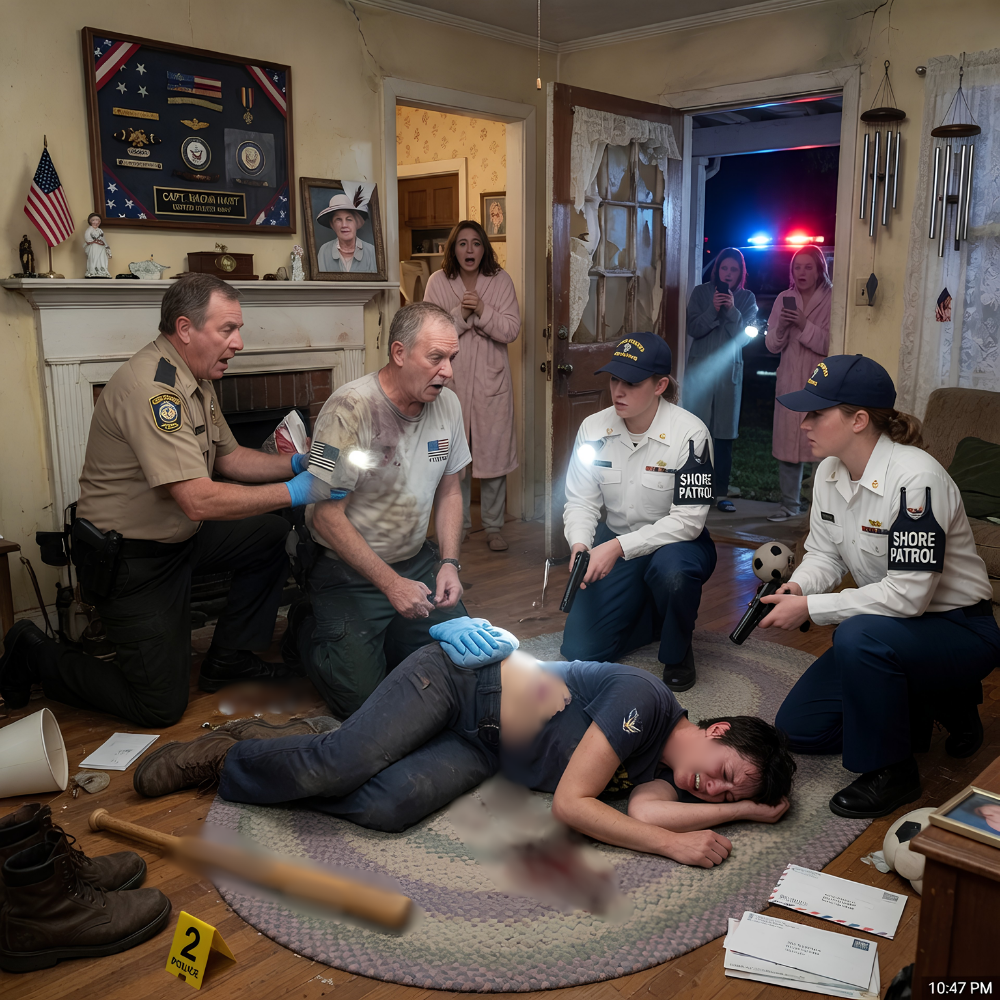
The bat scraped against the hardwood as Dad shifted his grip. Through the cracked window behind him, I could hear Mrs. Patterson’s wind chimes from next door—bright, cheerful notes that made the violence in this room feel surreal.
— I’m not selling, I managed to whisper.
The words came out thin. Pathetic. But they were mine.
Dad’s knuckles whitened around the handle.
— Then I’ll make you.
He raised the bat above his head.
I squeezed my eyes shut.
And that’s when the front door exploded inward.
— POLICE! DROP THE WEAPON! DROP IT NOW!
Three uniforms filled the frame—one county deputy and two sailors in crisp shore patrol dress. Their weapons were drawn. Their faces were stone.
The bat clattered to the floor. Dad’s hands shot up.
— She’s my daughter! This is family business!
The deputy ignored him. He was already cuffing Dad’s wrists, reading rights in a monotone voice that bounced off the walls like a radio broadcast.
But one of the sailors—young, maybe twenty-three, with freckles across his nose—he looked past my father. He squinted at me through the dim lamplight.
His posture changed instantly. Shoulders back. Spine straight.
— Captain Hart. Ma’am, are you injured?
The room went silent.
Mom’s hand flew to her mouth. My sister’s jaw dropped. Dad stopped struggling against the cuffs and stared at the sailor, then at me, then at the shadow box above Grandma’s mantle—the one with my ribbons and insignia pinned neatly inside.
— Captain? Dad’s voice cracked. What the h*ll is he talking about?
The sailor—Ellison, his nametag read—ignored him completely. He crouched beside me, careful not to touch my ribs.
— Ma’am, an ambulance is three minutes out. Try not to move.
I wanted to answer. I wanted to stand up and show them I was fine. But when I tried, the left side of my body lit up with white-hot agony, and all I could do was press my forehead back against Grandma’s rug and breathe through clenched teeth.
— She’s a captain? My sister’s voice was small now. Since when?
— Nine years, Ellison answered flatly. United States Navy. Commissioned officer. And you just committed aggravated assault against her.
Dad’s face drained of color. He looked old suddenly—older than I’d ever seen him. The anger that had burned behind his eyes moments ago flickered and died, replaced by something I couldn’t name.
Confusion. Shame. Fear.
Maybe all three.
The paramedics arrived in a blur of gloves and gurney straps. Someone cut my shirt open. Someone else pressed ice against my ribs. They asked my name three times, and each time I said “Captain Naomi Hart” like it was a shield I’d forgotten I was carrying.
As they wheeled me past the mantle, I caught Grandma’s photograph in her Sunday hat—the one with the little feather tucked in the band. Her eyes were soft, amused, like she knew exactly how this night would end before it even began.
— Naomi.
Dad’s voice stopped me at the doorway.
He was standing in cuffs now, the deputy guiding him toward the porch. His eyes were wet. His hands were trembling.
— I didn’t know.
The paramedic pushed the gurney forward. Cold night air hit my face. Neighbors stood frozen on their lawns, phones raised like tiny witnesses.
I didn’t answer him.
What was there to say?
He didn’t know because he’d never bothered to ask. Nine years of silence. Nine years of choosing pride over curiosity. Nine years of assuming I was still the rebellious teenager who’d walked out his door with a duffel bag and a grudge.
The ambulance doors closed.
The sirens started.
And somewhere behind me, in the house Grandma left me to keep safe, the wind chimes kept singing their bright, oblivious song.
Part 2: The ambulance rocked gently as we pulled away from Maple Lane. Through the small rear window, I watched my childhood home shrink into a blur of red and blue lights, the porch where Grandma used to shell peas now crawling with deputies and crime scene tape.
“Ma’am, I need you to stay still.”
The paramedic—a young woman with tired eyes and a name badge that read “Martinez”—pressed an ice pack against my ribs. The cold bit through the shock, sharp and clarifying.
“Can you tell me your full name again?”
“Naomi Hart,” I said through clenched teeth. “Captain. United States Navy.”
She nodded, scribbling notes while her partner adjusted the IV line snaking into my arm.
“You’re doing great, Captain. We’re about eight minutes from County General.”
Eight minutes. I counted them in my head like I used to count down drills on the bridge. One Mississippi. Two Mississippi. Each breath came with a price—a stabbing reminder that the man who’d taught me to swing a bat had just used one to break me.
The siren wailed above us, a sound I’d heard a hundred times from the other side of the world. In Djibouti, in the South China Sea, in ports where danger wore different faces. But never like this. Never in the house where I’d learned to walk.
Martinez’s partner—older, grayer, name tag reading “Daniels”—leaned over me.

Daniel Carter is a senior staff writer at InspireChronicle, specializing in legal conflicts, family disputes, and real-life justice stories. His work focuses on high-stakes situations involving inheritance, betrayal, and complex moral decisions. Through detailed storytelling, he explores how ordinary people navigate extraordinary challenges and the long-term consequences that follow.
His articles have gained significant traction online for their emotional depth and realism, resonating with readers across the United States.
He writes extensively about justice, personal responsibility, and the hidden dynamics within families.