
A twelve-hour rotation on an ambulance has a peculiar way of sinking into your marrow. Seasoned EMTs like me usually pray for the kind of quiet I had just experienced—no horrific interstate pile-ups, no frantic cardiac arrests, no desperate calls shattering the uneasy silence of the rig. Yet, that kind of stillness carries its own heavy, creeping exhaustion. By the time I finally clocked out, the last bruised hues of twilight were surrendering to the night sky, and I felt hollowed out, running purely on fumes and muscle memory.
I pulled into the parking lot of a tired local strip mall, desperate for a few simple groceries before retreating to the absolute sanctuary of my apartment. My hair was a losing battle; the ponytail I had tied back at dawn was unraveling, stray strands clinging to the sweat on my neck. My scrubs bore the faint, innocuous stains of a long, gritty day—nothing hazardous, just the collateral damage of moving patients and navigating cramped spaces. I was entirely too exhausted to care about my appearance. Fatigue wasn’t just sitting on my shoulders; it had settled deep into my bones. All my body craved was the comfort of a hot, mindless meal and the heavy oblivion of sleep.
I stepped out of the small market, the automatic glass doors sliding shut behind me with a quiet thud. I was clutching a brown paper grocery bag in one hand and my phone in the other, my thumb hovering over a text I was simply too tired to send. I scanned the dim expanse of the parking lot, mentally mapping the shortest route to my car. That was the exact moment my eyes caught the erratic movement near the buzzing neon glow of a taco shop just a few yards away.
A man was stumbling. His gait was broken, uneven. My initial instinct, forged by years of cynical city nights, was entirely dismissive. I let out a soft sigh, assuming he was just another careless tourist who had celebrated happy hour a little too aggressively. But the harsh, unforgiving glare of the municipal streetlamp quickly stripped away that illusion. The dark liquid soaking through the fabric at his side wasn’t a spilled margarita. It was a heavy, saturated stain. It was blood.
My professional brain instantly overrode my exhaustion. As I moved closer, the details snapped into sharp, terrifying focus. He was young, impossibly young—couldn’t have been more than his mid-twenties. He was wearing a torn, dirt-smudged Marine uniform. He dragged his right leg with agonizing effort, his entire upper body leaning heavily to one side as if trying to fold in on the source of the bleeding across his ribcage. His face was turned toward the light, and his complexion was ashen, a ghostly, translucent pallor that screamed of severe hypovolemic shock.
And yet, by some sheer miracle of willpower, he kept moving. His trembling fingers were white-knuckled, pressing desperately into his own side. Around him, the evening crowd drifted like ghosts. People walked past him with their eyes glued firmly to the glowing screens of their smartphones, or their attention wrapped up in the greasy warmth of their takeout bags. They were completely, willfully oblivious to the catastrophic emergency unraveling right in their midst. I didn’t have the luxury of hesitation. The exhaustion vanished, replaced by a sudden, electric surge of adrenaline.
I dropped my grocery bag onto the unforgiving pavement. Apples and canned goods spilled out, rolling into the shadows, entirely forgotten. I sprinted toward him, my sneakers slapping hard against the asphalt.
“Hey, hey, it’s okay, you need to sit down. You’re severely hurt,” I called out. My voice had lost its fatigue, shifting effortlessly into the firm, commanding tone I used on the worst calls.
“I’m an EMT,” I promised him, catching him just as his trembling knees finally gave way. I braced my stance, supporting his dead weight against my own, and guided him as gently as I could down to the concrete curb. He didn’t have the breath left to speak. He simply offered a weak, desperate nod as his chest heaved, fighting for air.
A rapid visual sweep told me a grim story. His left shoulder was severely battered, purple bruising already blooming under the torn fabric, but his ribcage looked as though it had absorbed a devastating, crushing impact. Without a second thought, I tore open a sterile gauze pack from the utility belt I always wore until the moment I walked through my front door. I pressed the thick pad against the worst of the wound, applying firm, two-handed pressure to stem the bleeding.
My hands worked with practiced, automated precision—fast, competent, hyper-focused. I was mentally calculating his respiratory rate when the very atmosphere of the parking lot seemed to curdle. The fine hairs on the back of my neck stood at absolute attention. It was the kind of primal warning you only get when a scene turns hostile. I glanced up. Two men were closing the distance between us, moving not with the hesitant curiosity of bystanders, but with predatory, locked-in speed.
The first man was towering, his features completely swallowed by the shadows of a black hoodie pulled low over his brow. His companion was shorter but built like a concrete block, his head shaved clean, with dark, jagged tattoos creeping up from his collar to curl around his jawline. These weren’t random passersby. Their trajectory was a straight, uncompromising line, and their eyes were dead-set on the injured young man bleeding out under my hands.
“Back off,” the taller one growled, his voice a low, gravelly threat that barely carried over the distant traffic. His gaze never left the Marine.
I scrambled to my feet, positioning my body squarely between the aggressors and my patient. I was profoundly confused, but my system was absolutely flooded with a fierce, protective fury.
“He needs immediate medical help,” I stated firmly, locking my knees to hold my ground. I lied through my teeth to buy time. “I’ve already called for an ambulance. They are minutes away.”
“No one asked you to step in, lady,” the tattooed man snapped, his voice dripping with a cold, terrifying malice. “Walk away. Right now.”
My stomach plummeted into a bottomless abyss. The reality of the situation washed over me like ice water. This wasn’t a mugging gone awry. This was an execution.
“Doc…” the Marine rasped from the pavement behind me. He was struggling violently to form the words, his breath hitching. “They… they followed me.”
The pieces snapped together with horrifying clarity. These men had hunted this boy. They had targeted him, brought him to the brink, and now they had followed his blood trail to finish the job while he was utterly defenseless. My heart hammered wildly against my ribs, a frantic bird trapped in my chest, but I refused to flinch.
“You are not touching him,” I declared, planting my feet wider, forming a human barricade. “Back. Away. Now.”
The man in the hoodie didn’t offer another word. Instead, his hand slipped into his pocket. The sickly yellow streetlight caught the jagged glint of metal, and the tense, suspended stillness of the parking lot suddenly shattered into absolute violence. He lunged forward with terrifying momentum, thrusting the weapon directly toward the Marine’s exposed chest.
I threw my entire body weight sideways, intercepting the downward arc. The weapon struck my upper arm. A raw, piercing scream tore violently from my own throat, but I forced my legs to hold. I twisted, frantically trying to block his advance, when a second, crushing blow struck my lower back from the tattooed man.
I grappled blindly with the first attacker’s wrist, my fingers digging in, desperately trying to force the weapon away from us. In response, the second man delivered a brutal, breathless kick to my ribs. I stumbled hard, gasping for a breath that wouldn’t come, the pain radiating through my torso in hot, electric waves. Still, I scrambled back into their path, remaining the sole physical barrier between the monsters and the soldier.
Through the haze, I felt the Marine trying to push himself upward. He was fighting through the thick fog of near-unconsciousness, desperately trying to shield me. But his battered body finally failed him completely, and he collapsed heavily back onto the cold concrete. My vision began to swim, the edges blurring into dark static. I had been struck again, this time near my collarbone.
The massive spike of adrenaline was the only thing masking the true extent of the agony. I had entirely lost count of how many times I had been hit. My palms were slick with sweat, making it impossibly hard to maintain a grip on the attacker’s wrist. My legs were turning to absolute jelly, threatening to give out with every frantic movement.
“Help!” I screamed, my voice cracking, desperate and raw. “Somebody please call 911!”
The handful of bystanders lingering near the shops seemed paralyzed by the sudden eruption of violence. A few stood frozen like statues, their phones raised high to record the horror, stunned into an absolutely shameful inaction. I was losing my grip. I was going to fail.
And then, a single voice shattered the trance.
“Leave her alone!” a young man’s voice roared from the periphery. He was charging forward at a dead sprint.
The attackers, completely startled by the sudden intervention and the rapidly growing commotion from the storefronts, froze. They exchanged a single, calculated glance, realizing they had lost their window. They turned and vanished instantly into the pitch-black shadows of a nearby alleyway.
The moment the threat evaporated, so did my strength. My knees buckled, and I dropped hard onto the pavement. The Marine was lying completely flat, his eyes rolling back in his head.
I forced my shaking hands back onto his side, putting every ounce of my remaining, failing body weight into compressing his wounds.
“I’ve got you,” I whispered, my voice barely a breath as the entire world began to tilt violently on its axis. “Stay with me. Please stay with me.”
In the distance, the beautiful, piercing wail of approaching sirens began to cut through the night. Someone rushed to my side, dropping to their knees beside me. I recognized him vaguely—another off-duty EMT who must have stopped his car when he saw the crowd. Warm, fresh hands firmly replaced my trembling ones on the Marine’s chest.
“You’re hurt bad,” his voice echoed, sounding warped and distorted, as if I were listening to him from deep underwater. “Hang on. Just hang on.”
I felt myself being lowered incredibly gently backward onto the unyielding pavement. Someone was carefully cradling the back of my head, a gentle voice repeatedly urging me to just keep breathing. I stared straight up at the vast expanse of the night sky. The distant stars began to smear into long, dizzying streaks of pure white light. And then, mercifully, everything faded to black.
The very first sensation that registered as my mind clawed its way back from the heavy, suffocating void was a dreadful, sticky warmth pooling along my side. My hands were trembling uncontrollably, small, erratic spasms that I couldn’t stop. Every limb felt as though it had been poured full of lead. Through the thick fog of shock, a single, desperate mantra began to loop in my head: Don’t die. Not here. Not now.
My terrifying anxiety wasn’t for myself. My thoughts were entirely consumed by the young man in the uniform. I forced my heavy eyelids open, fighting the overwhelming urge to just let go. My field of vision had narrowed into a chaotic, terrifying tunnel of flashes. Flash: the swirling, aggressive red of emergency lights bouncing off aluminum walls. Flash: frantic, disembodied voices shouting sharp medical commands over the wail of a siren. Flash: the acrid, metallic smell of antiseptic clashing with the scent of burnt rubber from the tires tearing across the asphalt.
I couldn’t string the noises into coherent sentences, but I could feel the agonizing, deliberate pressure of sterile gauze being packed tightly into my wounds. My entire body had become a localized map of absolute agony. Time turned completely elastic inside that rig, stretching out into eternities and then snapping back into sudden, sharp reality. When I finally managed to grasp a fleeting second of focus, I realized an oxygen mask was strapped tightly over my nose and mouth. A paramedic, a guy I recognized vaguely from the station, was hovering directly above me. He was repeating my name with a rhythmic, terrified urgency.
“Emily, Emily, you need to stay with me. We’re almost there. Keep your eyes open.”
I tried to speak, but my mouth was like dry sandpaper, and my throat felt completely raw. I desperately wanted to ask him about the soldier. Was he still breathing? Had those monsters come back? But my lungs couldn’t push the air past my vocal cords. All I could manage was a soft, ragged groan before the darkness rushed back in, pulling me under once more.
While I was lost in that void, the strip mall parking lot had transformed into a scene of highly controlled chaos. I would later learn from police reports and colleagues that officers had immediately taped off the entire perimeter, systematically pulling statements from the handful of witnesses who were still visibly shaking from the shock of the violence. The manager of the taco shop quietly handed over his security tapes, providing the grainy, crucial footage of the attack.
Most of the bystanders had scattered into the night, desperate to distance themselves from the blood on the pavement. But one young man, a college student named Luis, had refused to leave. He was the one whose shout had broken the attackers’ focus. The responding officers noted that his eyes were wide with disbelief as he gave his statement. “She jumped right in front of him,” he kept repeating to the detectives. “She didn’t even hesitate. She just took it.”
In a second ambulance rushing toward the same trauma center, Corporal James Rivas was fighting his own desperate battle. He was only semi-conscious, his vitals dangerously erratic, but his hands were locked in a vice grip around a torn, bloodied scrub jacket that belonged to me. He had sustained severely cracked ribs and massive internal trauma, but because of the immediate, aggressive compression I had applied to his side, his blood pressure was finally beginning to stabilize. One of the paramedics working on him murmured quietly to his partner, a quote that would later make its way back to my station: “If she hadn’t stepped in when she did, he wouldn’t be here. There is absolutely no question.”
I was wheeled through the bright, sliding doors of the emergency room first, red-tagged and prioritized as a critical trauma. The first responders had grossly underestimated the damage. Once the trauma shears cut away my ruined clothes, the surgical team faced a grim reality. I had taken multiple deep, plunging wounds: to my lower back, my shoulder, and my side, along with a brutal, jagged laceration straight across my upper arm where I had tried to block the weapon.
One of my lungs had fully collapsed under the trauma. Two of my ribs were fractured from the sheer force of the kicks. By some profound, inexplicable miracle, the blade had missed every major artery. The surgical team worked relentlessly for hours beneath the glaring operating lights to repair the devastation. They systematically stopped the internal bleeding, re-inflated my lung, and sutured the labyrinth of wounds.
It took several blood transfusions to replace what I had left on the asphalt. I spent two incredibly precarious hours floating in the intensive care unit before the doctors finally allowed themselves to exhale. As the morning sun began to breach the horizon, painting the sterile hospital walls in a pale, forgiving light, James was stabilizing in the room right next to mine. Between ragged gasps of pain, he only had one question for the nurses checking his lines.
“The girl,” he wheezed, his voice utterly exhausted. “The EMT. Is she okay?”
No one was allowed to give him an answer just yet.
Miles away, back at the police precinct, detectives were already putting names to the blurry faces on the security tape. Thanks to that footage and Luis’s rock-solid eyewitness testimony, the department had enough actionable evidence to issue a sweeping, city-wide alert. The attackers weren’t random thugs; they were quickly identified as known members of a local criminal syndicate, a group notorious for targeting off-duty service members. James, despite his youth, had been targeted with absolute precision. Weeks prior, he had accidentally stumbled upon an illicit transaction near the perimeter of his base and had dutifully reported it to his superiors. The retaliation had been planned, swift, and designed to be fatal. But those men simply hadn’t calculated for an exhausted, stubborn paramedic buying groceries.
At that exact same hour, my mother, Corinne, answered her ringing phone and received the sentence that permanently stops a parent’s heart.
“Your daughter has been injured. She is alive, but she is in surgery.”
My mother dropped the receiver entirely. It clattered against the kitchen counter. Her hands began to shake so violently she couldn’t pick it back up. My father snatched the phone, his usually booming voice trembling as he demanded the details. “Where is she? What exactly happened?”
Within the hour, they were pacing the gleaming white tiles of the ICU waiting area, entirely consumed by dread. Finally, the lead surgeon pushed through the double doors. He looked profoundly exhausted, pulling down his surgical mask, but his eyes were calm.
“She’s stable,” he announced to my parents. “She lost a very significant amount of blood, but the wounds were clean. We managed to avoid any permanent organ damage. Your daughter is incredibly lucky, and she is incredibly brave.”
My mother pressed a trembling hand tight against her mouth to stifle a heavy sob, the tears finally spilling over her lashes. “When can we see her?”
“As soon as she wakes up.”
It was hours later when I finally stirred. I felt groggy, heavily medicated, and utterly disoriented. The acoustic ceiling tiles blurred overhead. I felt the uncomfortable, restrictive tug of IV tubes taped to the backs of my hands and the suffocating tightness of heavy, thick bandaging wrapped tightly across my chest and abdomen. A sharp spike of panic flared in my chest, a residual echo of the parking lot, until a nurse with warm, kind eyes leaned over the metal bed rail.
“You’re safe,” she said gently, her voice an anchor in the confusion. “You’re in the hospital. You made it.”
My throat was desperately dry. My first question came out as nothing more than a raspy, broken whisper. “The Marine… is he okay?”
The nurse offered a soft, deeply genuine smile. “He is alive. And it is because of you.”
Hot tears immediately leaked from the corners of my eyes, sliding backward into my hairline. I let out a long, shuddering exhale. A sharp ripple of pain traveled aggressively through my broken ribs, but I honestly didn’t care. A tidal wave of absolute relief washed over my bruised body. The very last thing I remembered was the terrifying chaos and the cold, encroaching darkness.
“I thought he was going to die,” I whispered to the ceiling.
“You saved his life,” the nurse replied with firm conviction. “It’s all anyone in this building is talking about.”
Much later that night, the heavy door to my room slowly pushed open. A man stepped into the dim light. He was dressed in a pristine, perfectly crisp military uniform. He was tall, clean-cut, and carried an undeniable, quiet aura of absolute authority.
“Emily Carter?” he asked softly, respecting the quiet of the ICU.
I offered a slow, careful nod against my pillow.
“I am Captain Ramirez, representing the United States Marine Corps. Corporal James Rivas asked me to come here to personally thank you on his behalf, and on behalf of every Marine serving.”
He reached carefully into his dark dress coat. He stepped to the side of my bed and gently placed a small, incredibly heavy bronze coin onto my plastic tray table. I could see it was intricately, beautifully engraved with the Marine Corps emblem.
“This is a challenge coin,” the Captain explained quietly. “It is not something given lightly. James insisted that you receive it.”
I stared at the heavy bronze, feeling a sudden, overwhelming wave of emotion. “I… I just helped. I didn’t think about it. That’s my job.”
Captain Ramirez smiled, and there was a look of profound, unwavering respect in his dark eyes. “You didn’t just help, ma’am. You stood between a warrior and death. That makes you one of us.”
When I fully surfaced the next time, the harsh edges of the ICU had softened into a steady, rhythmic cadence of beeping monitors and the slow, mechanical drip of intravenous fluids beside my bed. My eyelids fluttered open, greeted by a dull, comprehensive ache that had settled into every muscle and joint. For a fleeting second, the heavy fog of medication kept me entirely ignorant of why I was there. Then, I tried to shift my weight against the mattress. A sharp, breathless bite of pain ripped through my side, and the memories came rushing back with terrifying velocity—the desperate struggle, the flash of the weapon, the young soldier collapsing on the concrete.
My mouth was impossibly parched, my lips cracked and dry. A nurse materialized almost instantly, her rubber-soled shoes silent on the linoleum.
“You’re awake,” she noted, her eyes quickly scanning the digital readouts above my head. “Try not to make any sudden movements. You are still in the intensive care unit. You made it through a very long surgery.”
I blinked slowly, willing the room to stop spinning. “The Marine,” I whispered again, needing to hear the absolute confirmation out loud.
“He’s perfectly stable,” the nurse reassured me, her voice a soothing balm. “He is alive. You truly saved his life.”
Hearing those words a second time felt like drawing in pure, unfiltered oxygen. My body hurt in ways I had never imagined possible, a deep, radiating trauma that made even breathing a chore, but a massive knot deep within my chest finally unraveled. I didn’t cry—not in that exact moment—but my uninjured hand weakly squeezed the stark white bedsheets. That boy, whoever he was, hadn’t died on the asphalt. My pain had purchased his tomorrow.
The nurse gently fed me small chips of ice from a plastic cup, explaining the timeline I had lost. I had been completely unconscious for nearly eighteen hours post-surgery. Multiple penetrating wounds, a collapsed lung, fractured ribs—yet my body had fought back with an aggressive tenacity.
“Most people would have simply blacked out much sooner,” the nurse observed quietly, adjusting my blanket. “Very few would have remained standing long enough to physically shield someone else. The attending doctors have been calling you a walking miracle.”
I just shook my head slowly against the pillow. “I wasn’t thinking. I just reacted.”
Later that evening, the hospital staff finally lifted the strict restriction on visitors. My mother rushed into the room and immediately burst into fresh tears, clutching my one uninjured hand like it was the only lifeline she had left in the world. My dad, a stoic man who rarely allowed his emotions to show, leaned over and pressed a long, silent kiss to my forehead. He stood rigid beside the bed, his jaw tight, his eyes glassy and rimmed with exhausted red.
“I really thought we lost you,” my mother whispered, her voice fracturing.
I managed a faint, incredibly tired smile. “I’m still here, Mom.”
My younger sister entered next, carrying a massive stack of envelopes. They were “Get Well Soon” cards from hospital staff, my EMT colleagues at the station, and even from people in the building I had never spoken to. One card near the top immediately caught my eye. The handwriting was sharp and disciplined. It simply read: You saved one of ours. Thank you.
I didn’t truly grasp the staggering magnitude of that sentiment until the following afternoon. Captain Ramirez, the man who had brought the challenge coin the night before, returned. He stood tall and formal beside the doorway, but this time, he wasn’t alone. Standing just behind his shoulder was Corporal James Rivas, the very Marine I had barricaded with my own body.
He moved with agonizing slowness, visibly weak, leaning heavily on a metal cane to support his steps. His face bore angry, red scratches and deep, blossoming purple bruising along his cheekbone, but his eyes were sharp. They burned with an intense, overwhelming mixture of grit and absolute gratitude.
“Miss Carter,” he said quietly, offering a deep, respectful nod as he approached the foot of my bed.
I tried to sit up, instantly wincing as my ribs protested. “You’re really okay.”
“I am, entirely thanks to you,” James replied, his voice thick with emotion. “I owe you my life, and I know that no words will ever be enough to cover that debt.”
He carefully reached into the pocket of his trousers and pulled out a small, folded piece of olive-drab fabric. It was his official unit patch. “This was mine,” he said, reaching out to place it gently into the center of my palm. “Now it’s yours.”
I stared down at the embroidered fabric, my eyes widening as the weight of the gesture settled over me. “I don’t understand,” I said, feeling suddenly breathless.
Ramirez spoke up from the doorway, his tone carrying that same quiet reverence. “It is exceptionally rare for a civilian to be awarded a Marine unit patch. But what you did out there wasn’t ordinary, Emily. You intentionally put yourself between a soldier and a lethal threat. That kind of courage doesn’t come from basic training. It comes from pure instinct.”
“Honor,” James added, leaning slightly on his cane. “In combat, we call what you did a ‘guardian moment.’ And you, Emily, are a guardian.”
The conversation was deeply emotional but necessarily brief; James was still in the very early, fragile stages of his own recovery, and my monitors were already beginning to beep a warning about my elevated heart rate. But just before he turned to leave, James looked back, his expression entirely solemn. “You didn’t just save me that night. You reminded every Marine on this base exactly what we fight for. People like you.”
When they finally left the room, I lay in silence, staring at the textured fabric of the patch in my hand. I was utterly stunned. All of this reverence, all of these honors, for what I still firmly believed was just a basic, fundamental human reflex. I couldn’t comprehend it.
Meanwhile, entirely outside the protective walls of my hospital room, the world was catching fire with my story.
Grainy footage of the attack had surfaced online. The manager’s security camera, combined with the shaky cell phone video captured by a bystander, didn’t show every gruesome detail, but it perfectly captured the vital, indisputable moment: me, an exhausted woman in scrubs, stepping directly in front of the injured Marine. It showed me shoving back a masked attacker, and it showed me taking several vicious, debilitating hits without ever stepping aside. The footage was raw. It was terrifyingly brutal. And it was completely undeniable.
The video went viral practically overnight. Military veterans across the country began reposting it with captions like That’s real courage. Civilians flooded the comments calling me a hero. Within hours, hashtags were trending globally across every platform: #ShieldOfHonor, #HeroEMT, #EmilyStrong. National news anchors spoke my name across the glossy morning shows. Major editorial columns dubbed me “The Spine of America.”
But I didn’t know any of it yet. I was still recovering in the ICU, blissfully shielded from the absolute media circus erupting outside.
Back at the police department, actionable leads were flooding the phone lines. The two men had been positively identified, both confirmed as active members of the local criminal group linked to a string of previous, cowardly attacks. Arrest warrants were issued with extreme prejudice. One suspect was apprehended that exact same day, cornered while hiding out in a cheap, rundown motel on the far outskirts of the city. The other was still temporarily at large, but the District Attorney was already preparing a heavy, uncompromising slate of charges, including attempted murder and assault with a deadly weapon. Amid the brewing legal storm, what gripped the city wasn’t a sense of fear—it was a profound sense of pride. Pride in a young woman who refused to run away. Pride in someone who stood her ground when absolutely no one else did.
Back in the sterile quiet of my hospital bed, the sheer weight of reality finally crushed my defenses. I broke down—not from the agonizing physical pain, but from something much deeper and harder to name. I felt completely overwhelmed. The constant attention, the intense gratitude, the terrifying realization of how close I had actually come to dying on that pavement.
“I just wanted to help him,” I whispered to my mom, tears finally spilling hot and fast down my cheeks. “That’s all I was trying to do.”
She sat on the edge of the mattress and kissed my forehead gently, stroking my tangled hair. “And you did, sweetheart. You did more than you will ever know.”
I turned my head away, looking out the large window. The sky outside was a deep, dusky blue, signaling the end of another day. In the faint reflection of the glass, I could see myself—bruised, heavily bandaged, looking fragile and small. But directly behind my reflection, out in the hallway, something entirely unexpected caught my eye.
A group of uniformed Marines was standing in the hospital corridor. They were completely silent, their posture perfect, just waiting. They weren’t waiting for medical news, and they weren’t waiting for orders. They were simply standing guard for me. I couldn’t wrap my head around how fast things had escalated. One day, I was fighting to simply stay conscious in an ambulance, and the next, I was surrounded by the United States military.
When I finally gained enough strength to sit up on my own a few hours later, my favorite day nurse walked in. She was smiling, holding a digital tablet in her hands. “You might want to see this,” she said gently, passing it to me.
I tapped the illuminated screen. A video instantly began playing. It was the shaky, zoomed-in cell phone recording from the night of the incident. It was short, only thirty seconds long, but it captured absolutely everything that mattered. I saw myself standing directly in front of the injured Marine, my arms outstretched in a desperate plea. I saw the attacker lunge. I watched myself physically push the Marine backward and take the initial blow. Then another. And another. I could hear the panicked, distant screams of the bystanders in the background. I stayed standing. My stomach dropped into my shoes watching it. Against those men, I looked incredibly small. Yet, something in my posture, something in my eyes during that chaotic moment, looked completely unbreakable.
I handed the tablet back to the nurse, my hands visibly shaking. “I don’t want to see any more of that,” I whispered, feeling sick to my stomach.
But the rest of the world had already seen enough. By the very next morning, the video had racked up over two million views, and within hours it jumped to five, then ten million. It wasn’t just circulating in tight military circles anymore; it had gone completely global. Strangers on the internet were calling me “The Shield,” “The EMT Guardian,” and “America’s Bravest.”
Pundits on cable news networks were actually debating whether I should be awarded the Presidential Medal of Freedom. Late-night television hosts abandoned their comedy monologues to honor me with earnest tribute segments. A prominent veteran advocacy group began printing my image onto shirts with the bold caption: She stood so he could live.
I desperately didn’t want any of it. I demanded the TV in my room be turned off, I shut down my cell phone completely, and I strictly asked the nursing staff to block any and all media interview requests. I hadn’t stepped in for fame. In fact, the blinding spotlight made my skin crawl. But my discomfort did absolutely nothing to stop the rising wave.
The hospital administration was forced to install a dedicated security detail outside the doors of my ward. People were showing up in the lobby trying to bring massive bouquets of flowers, thousands of letters, gifts—even total strangers begging just to shake my hand. One man, a complete stranger, drove two hundred miles across the state just to leave a handwritten note with the front desk. The nurse brought it up to me. It read: I served two tours overseas. I lost good men. What you did out there was what we all pray someone would do for us if we fell. You are one of us now. Semper Fi.
That handwritten message on standard hospital stationery hit me significantly harder than the cold metal of the weapon ever could. It stripped away my stubborn reluctance and forced me to confront the profound reality of what we had survived. Meanwhile, Corporal James Rivas was fighting his own quiet battles just two doors down the corridor. We hadn’t spoken a single word since that emotionally charged moment when he pressed his unit patch into my palm, but the ICU nurses had happily become our daily messengers. Every time they checked my vitals, I asked about his pain levels. Every time they changed his dressings, he asked if I was finally getting some sleep.
On the third day of my recovery, there was a soft, hesitant knock at my open door. James stepped into the room. His posture was still incredibly stiff, and his body was clearly focused on the grueling work of healing, but his presence felt entirely steady. He leaned heavily on his cane, navigating the space between the medical equipment with careful precision.
“Are you okay with having visitors?” he asked softly, hovering near the threshold.
I managed a genuine smile, gesturing weakly to the vinyl chair beside my bed. “You’re honestly the only visitor that makes any sense right now.”
He lowered himself into the chair with a suppressed wince, and we sat together for a very long time in complete silence. Words simply didn’t come easy for either of us. There is no existing social script for talking to someone you nearly died to protect, just as there is no manual for speaking to someone who bled on the pavement so you could breathe. We just existed in that shared, quiet space. Finally, I gathered the breath to ask the question that had been keeping me awake.
“Why were they after you?”
James hesitated, dropping his gaze to study his bruised hands resting in his lap. “I got in their way. I stopped something I definitely wasn’t supposed to see near the base. They had been tracking me, just waiting for the right moment to catch me off guard.”
“And you were out there entirely alone?” I asked, my heart aching for the sheer terror he must have felt.
“Yeah,” he nodded slowly, lifting his eyes to meet mine. “Until you weren’t.”
Those heavy words hung suspended in the sterile hospital air like a sacred promise neither of us had ever expected to make. Outside our quiet sanctuary, the United States Marine Corps was already moving with formidable speed. High-ranking military officials had taken serious note of the viral story, but more importantly, they recognized the undeniable symbol I had accidentally become. They saw those chaotic thirty seconds of footage as a living, breathing embodiment of their deepest values—uncompromising courage, willing sacrifice, and fierce honor.
Even though I had never worn a uniform or signed a contract, I had lived out their creed in the most terrifying moment of my life. The very next afternoon, a formal letter from the Commandant of the Marine Corps was hand-delivered to the nurses’ station and brought to my bed. The heavy, cream-colored parchment bore an official seal.
The letter read that my act of selfless bravery reflected the highest traditions of duty, even without obligation. It stated that I had defended one of their own with a courage they held sacred, and that I would forever be recognized as a true friend to the Corps. It ended with their legendary motto, Semper Fidelis.
I sat alone in my hospital bed and cried reading those perfectly chosen words. Still, I desperately stayed away from the blinding media spotlight. When cable news stations practically begged for live interviews from my room, I firmly declined. When daytime talk shows offered to fly me out and compensate me handsomely for my trauma, I said absolutely not. I wasn’t doing this for a moment of fleeting television fame. I just wanted people to remember the young Marine, the actual reason I had ever stepped off the curb in the first place.
But quietly, entirely behind the scenes, I began receiving hundreds of private messages. They flooded my social media from young EMTs, exhausted medical students, and the wives and mothers of deployed veterans. People from across the country told me that my story had inspired them to keep going, moved them to tears, or even healed a broken part of their spirit.
One beautifully written message came from a mother who said her teenage daughter now desperately wanted to become a paramedic. Another message simply said that the writer had completely given up on humanity until they saw what I did, thanking me for reminding them that good still fundamentally exists in the world. I read those specific messages every single night when the hospital grew quiet.
One morning, my mother entered the room with a tearful, radiant smile lighting up her exhausted face. “There’s someone outside the doors asking to see you.”
I let out a long, weary sigh, gently rubbing my aching temples. “Mom, please tell me it isn’t more press.”
“No,” she said softly, walking over to hand me a small, velvet jewelry box.
I opened it carefully. Resting inside on a bed of satin was a stunning silver pendant, deeply engraved with the Marine Corps emblem. Tucked behind the delicate chain was a small, handwritten note. It said that I wasn’t just the shield, but that I was the heart, signed affectionately from all of the men in M-Co, 2nd Battalion.
Hot tears immediately welled in my eyes, blurring the silver. I clutched the cool metal pendant in my palm, my chest tightening with overwhelming emotion. In that incredibly profound moment, I finally realized something vital. This relentless attention wasn’t actually about me anymore. It probably never was. It was about all the everyday people who had ever stood up when they were explicitly told to sit down. The ordinary people who stepped into the fray, completely unarmed and untrained, simply because it was the right thing to do. I had survived, yes. But more than that, I had willingly become a symbol for them.
Exactly four days after being officially discharged from the hospital, I finally returned to my quiet, unremarkable neighborhood in suburban San Diego. My small, single-story house sat at the dead end of a heavily tree-lined street. It was the kind of peaceful place where the loudest noises most mornings came from the rumble of municipal garbage trucks or the distant barking of golden retrievers. I was still healing at an agonizingly slow pace. I moved carefully, my thick stitches pulling tight against my skin with every step, my breath still shallow from the fractured ribs, but the absolute peace of my own home was a welcome blessing.
I hadn’t told many people I was finally coming home. Only my closest friends, my immediate family, and my shift supervisor at the station knew the actual date. The hospital administration had generously offered to arrange a private security detail for my house, but I had politely declined. I just desperately wanted to go home and be Emily again, not feel like a high-profile patient living under constant guard.
That first night in my own bed, I barely slept a wink. It wasn’t from the physical pain, though the deep ache was certainly still present, but from the sheer, crushing weight of everything my brain was finally trying to process. Every single time I closed my eyes, the terrifying flashes came rushing back. The sudden violence of the attack. The chaotic noise of the parking lot. The raw sound of my own scream. And through it all, James’s ashen face looking up at me from the concrete.
I hadn’t heard directly from Corporal James Rivas since our quiet conversation in the hospital room. He was navigating his own difficult recovery, transitioning to an outpatient facility. The final word from the nursing staff said he was doing remarkably well—getting stronger every day. I kept desperately hoping he was finding his own peace. I had felt something fundamental shift in the atmosphere of that hospital room with him, a deep, silent bond forged under intense fire that I couldn’t quite explain to anyone else.
At exactly 6:02 AM the next morning, there was a firm, rhythmic knock at my front door. I was awake, standing in my small kitchen, moving with careful deliberation while trying to pour myself a hot cup of chamomile tea. My mom, who was staying with me temporarily to help with the heavy lifting, shuffled down the hallway to answer it.
I heard the deadbolt click, the door creak open, and then my mother let out a loud, stunned gasp.
I left my mug on the counter and practically dragged myself down the short hallway, my heart suddenly hammering against my bruised ribs. I peeked over my mother’s trembling shoulder, and the breath caught violently in my throat.
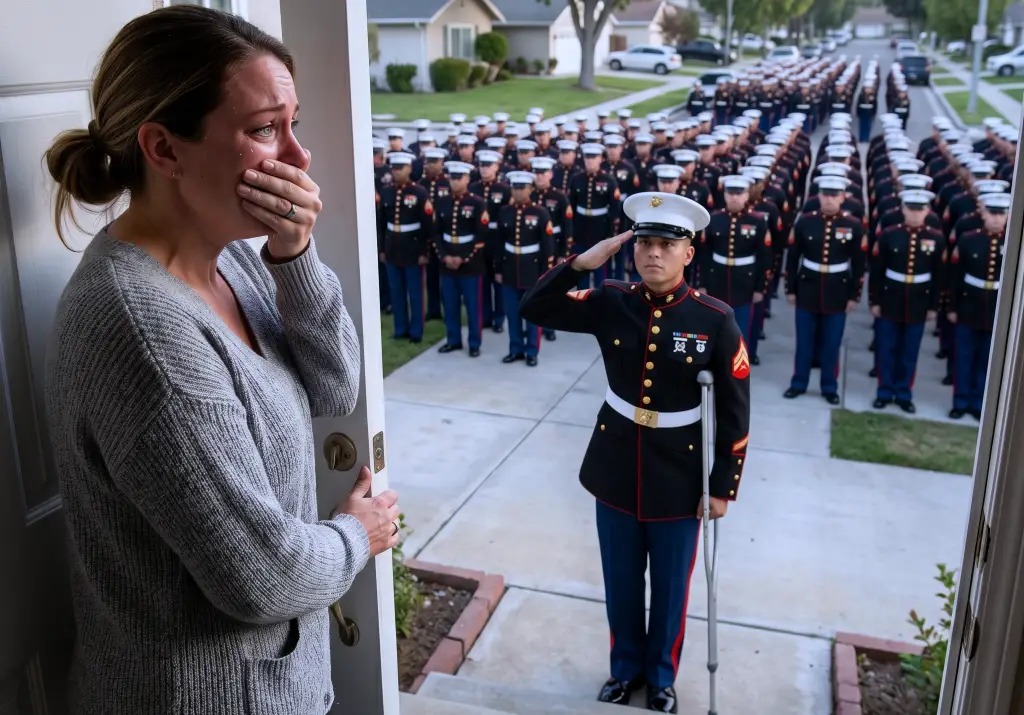
Out across the dewy expanse of my small front lawn, standing shoulder to shoulder in absolute, uncompromising silence, were over one hundred United States Marines. They were in full dress blues, forming a perfect, immovable block that stretched across the quiet suburban street. Their polished boots were aligned with mathematical precision, their posture as straight as arrows, their faces stoic and deeply respectful.
At the very center of the formation stood Corporal James Rivas. He was supported heavily by a single metal crutch, but he stood completely upright, proud, and beautifully composed. He wore no cover on his head. Just the sharp lines of his uniform and the gleaming medals resting against his chest.
I stepped forward slowly, my body still incredibly weak. I pushed the screen door open fully, stepping out onto the small wooden porch with the heavy reliance of the handrail. My bare feet touched the cool, damp concrete. The morning air was crisp, holding the faint scent of eucalyptus and ocean marine layer. I didn’t know what to say. I didn’t know how to breathe. The Marines said absolutely nothing. Then, on a silent, imperceptible cue, they raised their white-gloved hands and saluted. All at once.
The sudden, sharp snap of hundreds of arms moving in perfect unison echoed across the quiet street like a crack of thunder.
I froze completely. My eyes welled with thick tears instantly, blurring the sea of blue and white. My mouth trembled, and my heart raced in utter disbelief.
Corporal Rivas stepped forward, moving slowly but deliberately away from the safety of the formation. He stopped at the exact edge of my lawn, raised a hand in a crisp salute, and then lowered it to his side as he projected his voice into the morning air.
“You stood between death and one of ours,” he declared, his voice carrying the deep, resonant weight of absolute conviction, loud enough for every single neighbor to hear. “Today, we stand for you.”
I covered my mouth with both hands, the tears finally spilling hot and fast down my cheeks. Up and down the block, front doors cautiously cracked open. Neighbors stepped out onto their porches. Some silently raised their cell phones to film the incredible sight. Some clapped quietly, reverently. Older men in the neighborhood, veterans themselves, stood at strict attention in their own driveways.
Rivas continued, his gaze locked entirely on mine. “We do not forget those who protect our own, whether they are in uniform or out.”
He stepped aside, allowing two high-ranking Marines to walk up the sloping concrete of my driveway. One carried a perfectly folded American flag; the other held a deeply polished, heavy wooden box. They stopped at the base of my porch steps, straightened their posture, and presented both items.
The Marine holding the flag spoke first, his tone gentle but formal. “On behalf of the United States Marine Corps, we present you with this flag, as a lasting symbol of courage and sacrifice.”
The second Marine slowly opened the brass latch of the wooden box. Resting inside on dark velvet was a custom-forged challenge coin, significantly larger and heavier than the one Ramirez had brought to the hospital. One side bore the classic Marine Corps emblem. The other side featured a meticulous, hand-carved engraving: To The Shield, From Those You Stood For.
I accepted both items with violently shaking hands, holding the folded flag against my chest. “I don’t deserve this,” I whispered, the words catching on a sob.
Rivas took a tentative step closer to the porch, his voice dropping into a softer, much more intimate register. “You earned far more than this, Emily. You gave everything you had without a single question. That’s exactly what makes a warrior.”
My mother was standing right behind me now, crying softly into her hands. She placed a warm, grounding hand on my shoulder as the entire company of Marines, still locked in perfect formation, held their salute.
Suddenly, a voice from somewhere in the neighborhood crowd shouted into the quiet air, “Three cheers for EMT Carter!”
The Marines responded with a deafening, chest-rattling roar that shook the leaves in the trees: “Hurrah! Hurrah! Hurrah!”
That overwhelming sound completely broke my final emotional barrier. I wept openly, entirely unable to process the staggering magnitude of what was happening on my lawn. Rivas reached out over the railing, placing his hand firmly over mine.
“You didn’t just save me that night,” he said quietly, ensuring only I could hear. “You changed us.”
The Marines stood in silent vigil for a few minutes longer before quietly dispersing, row by disciplined row. Their boots tapped the pavement in rhythmic, synchronized steps. Some tipped their hats to me as they marched past. Others offered a slow, profound nod of respect. There were no flashing media cameras. There were no grand political speeches. There was just presence. There was just pure honor.
Rivas remained behind as the street slowly emptied. We sat together on the front concrete steps, sipping lukewarm coffee and watching the brilliant California sunrise peak over the neighborhood rooftops.
“I really didn’t know what to expect when I opened that door,” I admitted finally, my voice raw and hoarse.
“You deserve to feel exactly what we feel every single time someone proves they have our back,” Rivas replied, staring out at the horizon.
We let a long, comfortable silence stretch between us. The neighborhood was slowly waking up, sprinklers hissing to life on the lawns.
Then he turned to me, a sudden, nervous vulnerability in his eyes. “Would it be okay if I came to visit you again? Not just today?”
I smiled through my lingering tears. “I would really like that.”
As the sun climbed higher into the sky, chasing away the morning chill, I looked down at the heavy folded flag resting in my lap and the brass coin in my palm. It felt like a surreal dream. But the weight of the objects grounded me. I hadn’t just survived and come home. I had inadvertently stepped into something so much greater—a deep, permanent respect earned not from rank or a signed enlistment contract, but from sheer, stubborn courage. The kind of courage that stands its ground when everyone else is content to just watch.
Days bled into challenging weeks. The extraordinary story of that morning salute inevitably leaked, spreading far beyond my quiet street. A neighbor’s video went wildly viral, and a fresh wave of headlines dominated the internet: Civilian EMT Risks Life to Save Marine, Receives Hero’s Salute.
I remained entirely uninterested in the sudden celebrity. I ignored the relentless interview requests, declined every single morning talk show, and immediately deleted the dozens of frantic emails from producers begging for the exclusive rights to my story. I hadn’t stepped in for validation. I had done it because a young man was bleeding to death. That was my job. That was fundamentally who I was.
Still, the private reality of healing was significantly harder than I had ever anticipated. The wounds had left deep, agonizing muscle damage. My ribs were a constant, tender reminder of the violence. My right hand, the one that had desperately tried to block the weapon from striking James, was struggling to regain full motor function. I was forced to undergo grueling, painful physical therapy twice a week, working tirelessly on simple gripping, lifting, and rebuilding the basic strength in my arms.
The specialists warned me it could take a year or more to feel normal again. Some days, the pain was absolutely unbearable. And it wasn’t just physical. The mental toll was a heavy, suffocating blanket. The worst part was the involuntary mental replay. Over and over again. The exact moment I realized I might actually die on that pavement. The crushing, paralyzing helplessness. The terrifying realization that if I had hesitated for even a fraction of a second, Corporal Rivas would not have survived.
But I quickly learned I wasn’t fighting the dark thoughts alone. James kept his promise. He visited my house every single week. At first, he came bearing formal updates about his own medical progress; his leg was gaining strength, and his internal injuries were miraculously healing faster than the base doctors had projected. But very quickly, those structured visits evolved into something entirely different.
We would sit out on my back porch for hours, drinking endless cups of coffee and watching the neighborhood kids ride their bikes down the alley. We talked about absolutely everything. We traded stories about our childhood dreams, debated the merits of our favorite classic rock bands, and shared our worst fears. He told me raw, unfiltered stories from his grueling last deployment overseas. I countered with the most bizarre, chaotic 911 calls I had ever responded to.
There was a massive, unspoken weight between us. It was a bond that hadn’t just been forged in the white-hot trauma of the attack, but in the slow, shared resilience of our recoveries. Rivas helped me believe in my own fundamental strength again.
One terrible afternoon, after a particularly brutal physical therapy session, I came home absolutely furious. I was trying to make dinner and realized I couldn’t even manage the grip strength to twist the lid off a simple jar of pasta sauce. My hand trembled violently, my stitches throbbed with a dull, sickening ache, and my patience completely evaporated. I threw the jar into the sink and leaned against the counter, crying out of pure, unadulterated frustration.
When I finally pulled myself together and walked to the front door to check the mail, Rivas was already sitting on my porch steps, holding two massive plastic shopping bags.
“What in the world is that?” I asked, wiping my eyes, annoyed that he had caught me looking so defeated.
He offered a wide, boyish grin. “Today, Carter, we are going to fight your absolute worst enemy.”
He reached into the bag and pulled out two enormous, incredibly complex Lego sets.
“What the hell?” I let out a surprised, wet laugh despite my lingering anger.
“Fine motor skills,” he said confidently, tapping the colorful cardboard box. “This is officially Marine-approved physical rehab.”
That entire evening, we sat cross-legged on my living room rug for hours, painstakingly building a massive, intricate miniature battleship. It took me twenty agonizing minutes just to align and snap one tiny, stubborn gray piece properly into place, but I eventually finished my section. I broke down crying when I clicked the final piece in—not because of the plastic toy, but because the frustrating, tedious process reminded me of a harsh truth I had been trying to ignore. Healing is never a clean, linear path. But it is still progress.
As the quiet months passed, I finally felt strong enough to return to the fire station. I wasn’t cleared as a full-time, active responder just yet, but I took on a vital light-duty capacity. I trained the nervous new EMT recruits, led intensive medical workshops, and gave community safety talks. My shift team welcomed me back with open arms and immense relief, but more than that, something entirely new began taking shape in my professional life.
My name had slowly, inadvertently become a quiet legend within local military and first responder circles. The formal invitations began to arrive in my mailbox, asking me not just to attend somber ceremonies, but to stand at a podium and speak. They wanted me to talk about the anatomy of courage. They wanted to hear a civilian’s perspective on stepping up, on what it truly means to face catastrophic danger with absolutely no armor other than a clear sense of purpose.
One particular evening in late autumn, I was asked to deliver the keynote address at a massive, joint Army-Marine charity fundraiser. I stood nervously backstage, smoothing the fabric of a simple, elegant black dress, terrified of the massive crowd waiting beyond the velvet curtains. When I finally stepped out into the blinding spotlights, I stood before hundreds of highly decorated people—uniformed men and women, high-ranking government officials, trauma surgeons, and civilian leaders. I didn’t frame my story as the tale of a victim, nor did I try to paint myself as a fearless superhero. I spoke simply as an ordinary human being who had been forced to make a split-second choice on a dark sidewalk.
“I didn’t have the luxury of time to think about what I might lose that night,” I said, my voice echoing clearly through the grand ballroom. “I only focused on what I might be able to save.”
The entire room rose to their feet in a thunderous, sustained standing ovation. It was overwhelmingly humbling. After the event finally wound down, James walked me out to the valet stand. He looked incredibly striking in his formal dress blues, the crisp fabric highlighting his broad shoulders. The cool night air felt wonderfully grounding after the heat of the ballroom.
“Do you ever think about it?” he asked quietly, the valet fetching my car in the distance. “How entirely different everything would have been if you just hadn’t stopped your car that day?”
“All the time,” I admitted, my voice barely above a whisper.
We stood there in the comfortable shadows, the low hum of the city traffic washing over us. Then, James did something he hadn’t dared to do in all those long, vulnerable weeks of recovery. He reached out and gently took my hand—the exact same right hand that had desperately tried to shield him from the blade—and held it firmly in his. Neither of us said a single word. But the atmosphere shifted permanently. Something profound and beautifully undeniable had taken root between us.
Later that same month, I received an astonishing phone call inviting me to Washington, D.C. The United States Marine Corps had officially nominated me for the Distinguished Public Service Award, which I quickly learned was the absolute highest honor they could legally bestow upon a civilian. I was completely floored. I hadn’t even known such a prestigious commendation existed.
The ceremony was incredibly formal but surprisingly intimate, held in a polished, historic hall at the Marine Corps headquarters. As I stood on the deep crimson carpet before the Commandant himself, bowing my head to receive the heavy, golden medal, my heart pounded against my ribs even harder than it had the night of the attack. In that surreal moment, surrounded by intimidating military brass and a flurry of national media attention, I still just felt like a tired paramedic who had simply done the right thing. But when I looked out into the front row, I saw James sitting there, beaming with an unrestrained, fiercely proud smile. That was all the validation I needed.
Back home in California, things weren’t exactly “back to normal,” because I realized my old normal was gone forever. But in many beautiful, quiet ways, my life was significantly better.
My injured hand had finally regained almost all of its normal movement, thanks to the grueling physical therapy and the endless hours of building Lego sets on my living room floor. The angry, raised scars across my torso had faded into pale, pink trails—permanent road maps of my survival. I could finally sleep through the night without jolting awake in a cold sweat. My neighbors greeted me with much more than just polite suburban nods; there was a deep, genuine warmth and a protective respect in their eyes.
One mundane Tuesday afternoon, I was walking out of a local pharmacy, clutching a paper bag of vitamins, when I saw a young boy lose control of his bicycle across the busy street. He hit the pavement hard, scraping his knees and elbows. Without a single second of hesitation, I dropped my bag and sprinted to him. I checked his small limbs for serious injuries, calmed his frantic crying with a soft voice, and helped him back to his feet. Just like before. Because underneath the medals, the viral videos, and the news headlines, I was still just Emily. I was still the woman who ran straight into the fray when everyone else stood frozen.
I had never truly imagined how far the ripples of my single act of stubborn courage would travel. While I happily returned to a much quieter daily rhythm—balancing my ongoing physical therapy, my light EMT duties at the station, and my occasional community speaking engagements—the rest of the country clearly hadn’t forgotten me. In fact, the story of that night in the parking lot was actively inspiring other ordinary people to step up.
A news story broke about a civilian woman in Arizona who had bravely pulled an unconscious driver from the wreckage of a burning car. When a reporter interviewed her on the local news, she looked directly into the camera and said, “I thought of that EMT girl in California who shielded a Marine with her own body. I figured if she could risk absolutely everything for a stranger, then so could I.”
I sat on my couch watching that broadcast, completely stunned. I had never wanted to be a symbol for anyone. But the more I tried to humbly shrink away from the glowing spotlight, the more the world stubbornly insisted on holding me up to the light. The letters continued to pour into the fire station by the hundreds. They came from aging veterans, grieving widows, young kids enrolled in local ROTC programs, and teenage girls studying late into the night to pass their paramedic exams.
One particular letter arrived written on lined notebook paper, penned by a twelve-year-old girl named Harper. Her handwriting was careful and deliberate. You made me feel like girls can be strong too, she wrote. When I finally grow up, I want to be brave and help people exactly like you do.
I sat in absolute silence at my kitchen table after reading Harper’s words, hot tears slowly filling my eyes. I had never wanted fame. I loathed the cameras. But maybe, just maybe, this specific kind of spotlight was the exact tool needed to help change the world, even just a little bit.
Meanwhile, Corporal James Rivas was navigating a critical mission of his own. He was officially back on limited duty at the base, handling administrative work while his leg finished healing. But every single weekend, without fail, he drove out to visit me. We would walk for miles together down by the ocean pier, sample terrible food from local beachside food trucks, or just drag a blanket up to the flat roof of my building to watch the commercial planes disappear into the thick, coastal clouds.
Yet, he carried a heavy tension in his shoulders. I knew there was one vital piece of the puzzle he hadn’t shared with me yet. It was the missing context that clearly kept him awake at night. Recently, military intelligence had finally declassified the grim reality of the situation: the true reason why he had been so violently attacked that night. He had unknowingly become the primary target of a massive, highly organized criminal ring that was actively smuggling stolen, high-grade military equipment through the local civilian shipping ports.
During his last weekend of leave, he had noticed highly suspicious, unauthorized activity near a restricted shipping facility and dutifully reported it up the chain of command. It turned out, the wrong people had intercepted that report. The attack in the strip mall wasn’t a random mugging gone wrong. It was a calculated, deliberate assassination attempt. He was absolutely never supposed to survive that night. But he did. Because I had parked my car to buy apples.
One breezy afternoon, we were sitting close together in a quiet, secluded corner of the beach, watching the tide roll in. Rivas finally decided to speak the truth out loud.
“They genuinely wanted me dead, Em,” he said, staring out at the crashing waves. “That wasn’t a robbery. It was a sanctioned hit.”
I didn’t say anything for a very long time. I just let the cold reality of his words wash over me. Then I turned my head to look at his profile. “And if I hadn’t stepped in front of that blade, I wouldn’t be sitting here either.”
I took a deep breath, inhaling the salt air. “So, what happens now? Are you actually safe?”
He nodded, finally turning to meet my eyes. “They arrested the main organizers. The entire ring is being dismantled. But yeah, the brass has assigned me a permanent protection detail until the federal case is officially closed and the trials are over.”
I leaned back against the cool, damp sand, letting out a heavy sigh. “So I inadvertently saved a military whistleblower. That’s just great. Now I’m actually living in a ridiculous action movie.”
He let out a loud, genuine laugh, and I quickly joined in. Despite the heavy, terrifying gravity of absolutely everything we had been through, we had miraculously found a deep, abiding peace in the quiet moments between the chaos. James started exclusively calling me “Em.” I playfully started calling him “Trouble.” It wasn’t just casual flirtation; it was a profound coping mechanism. It was survival. It was the beautiful realization that after facing down the very real specter of death together, we finally had permission to just laugh and be alive.
Then, out of absolutely nowhere, came the ultimate surprise. The White House officially reached out to the fire station. The President of the United States had personally heard the story of the parking lot attack and the subsequent viral salute, and he wanted to meet me. My jaw literally dropped when my shift supervisor forwarded the official email to my phone. At first, I was entirely convinced it was an elaborate, cruel spam message. But exactly two days later, a massive, heavily tinted black government SUV pulled silently up to my curb, flanked by two serious-looking official escorts in dark suits.
When I arrived at the White House, I was ushered into a grand, historic room. I was being honored in a quiet, incredibly private ceremony, recognized not just for an isolated act of bravery, but for representing the extraordinary, resilient spirit of everyday American civilians—the people who don’t wear a uniform, who don’t carry a weapon, but who step up to serve their communities just the same. I stood awkwardly on the plush carpet, wearing my favorite navy dress, standing shoulder-to-shoulder with decorated four-star generals, serious cabinet members, and even a living Medal of Honor recipient.
But as the cameras flashed and the applause echoed off the painted ceiling, I only frantically scanned the back of the crowded room for one specific face. When I finally found James standing near the heavy wooden doors, he offered a slow, incredibly proud nod. I held my heavy gold medal, utterly stunned by the trajectory of my life. I was still just a girl from San Diego who stepped off a curb because she couldn’t look away.
That evening, after the adrenaline of the ceremony had finally faded, we flew back to California and returned to the quiet sanctuary of my apartment. I carefully placed the velvet box containing the presidential award on my bookshelf, setting it right beside a framed photo of my smiling parents and the incredibly fragile, tiny Lego battleship we had built together. James stood near the kitchen counter, his demeanor suddenly shifting from celebratory to deeply serious.
“I don’t want to waste any more time, Em,” he said softly, his voice carrying a weight that made me stop what I was doing.
I tilted my head, genuinely confused. “What do you mean by that?”
“I don’t want to just be the guy who comes to visit you on the weekends,” he explained, stepping closer to me. “I don’t want to just be the soldier who keeps thanking you for saving his life. I want to be here with you. I want to be for you.”
My heart pounded furiously against my ribcage. He wasn’t just offering another profound thank you. He was saying I love you without needing to use the exact words. I looked up at him, my expression softening entirely.
“I was really hoping you were going to say that,” I whispered.
The very next morning, I woke up to the rich, comforting smell of brewing coffee filtering into the bedroom. James had beaten me to the kitchen. I padded down the hallway and found him standing by the stove. He was casually wearing one of my oversized, faded college hoodies, quietly humming a truly terrible rendition of a classic country song. I stood silently in the doorway and just smiled. I had bled out on this exact floor. I had screamed in agony here. I had cried countless tears of frustration in this space.
But looking at him now, I felt entirely, profoundly safe. Not because my physical wounds were perfectly healed, but because I finally had real hope for the future. He turned around, spotted me in the doorway, and offered a steaming mug.
“Good morning, hero,” he teased, his eyes crinkling at the corners.
I rolled my eyes dramatically, taking the hot mug. “I am still not a hero, Trouble.”
He leaned in and pressed a warm kiss to my forehead. “I am still going to politely disagree with you on that.”
Later that afternoon, I had agreed to sit for one final interview, this time with a major, highly respected national magazine. I was finally getting much better at articulating my story without breaking down. When the seasoned journalist asked me the inevitable question, “Exactly what was going through your mind in those crucial seconds that night?” I took a long pause and gave her the absolute truth.
“Nothing,” I said firmly. “There was absolutely no time to think. There was simply a young man in terrifying danger. And I had two feet, two hands, and a beating heart. That is all I really needed.”
And just like that, I inadvertently gave the world another powerful quote they would never forget.
Six full months after the brutal attack in the strip mall parking lot, the world had finally settled into a manageable, new rhythm for Emily Carter. The exhausting chaos of the media circus had finally quieted down. The voracious 24-hour news cycle had moved on to chase other breaking stories. But my personal life had been fundamentally changed in absolutely every way—publicly, privately, and permanently.
I had officially returned to part-time EMT work on the ambulance, very slowly easing myself back into the intense pressure of emergency calls. At first, my body fiercely resisted the physical demands. The deep tissue scars ached terribly under the weight of the heavy medical bags. Sudden, terrifying flashbacks would unexpectedly trigger during high-stress moments, especially when a chaotic call came in over the radio about an assault or a victim bleeding out in the street.
But I slowly learned how to breathe my way through the rising tide of fear. I didn’t try to erase the trauma; I learned to actively work alongside it. The experience ultimately made me a significantly stronger, more deeply empathetic paramedic. And back at the station, James never once left my side. Our bond had deepened far beyond the initial trauma, far beyond the heavy debt of gratitude. We were so much more than just two survivors tied together by a violent night. We had genuinely become each other’s primary reason to keep moving forward into the light.
One crisp, quiet Tuesday morning, I received another letter in the mail. This wasn’t an email or a printed flyer; it was a heavy, formal envelope securely sealed with dark red wax. It was from the Office of the Secretary of Defense. I was formally being invited to speak at a massive national memorial service for Armed Forces Day, to be held on the hallowed grounds of Arlington National Cemetery.
I wasn’t a soldier. I had never laced up combat boots or worn a camouflage uniform. But my actions in that parking lot had powerfully reminded the entire nation of what it meant to live with active courage. The beautiful letter explicitly described me as “a civilian who possesses the true heart of a warrior.” I sat at my kitchen table, staring blankly at the embossed envelope for over an hour before I spoke a single word. James walked in from the living room, saw the broken wax seal resting on the wood, and smiled gently.
“Are you going to go?” he asked, leaning against the doorframe.
I nodded slowly, tracing the edge of the paper. “If I can stand up there and speak for all of the ordinary people who never enlisted but still showed up when it mattered most, then yes. I will.”
When we finally arrived in Washington D.C., the sheer scale of the event was significantly grander than I had ever anticipated. Thousands of perfectly aligned white folding chairs lined the incredibly green, manicured cemetery grounds. Countless American flags rippled loudly in the stiff breeze. The haunting, mournful sound of bagpipes hung low and heavy in the distance. I was wearing a simple navy blue dress, specifically choosing to pin the small silver emblem I’d received from the Marines directly onto my collar.
In the massive crowd sat high-ranking generals, powerful politicians, grieving Gold Star families, and thousands of active-duty service members representing every single branch of the military. Scattered among them were quiet survivors just like me—ordinary civilians who had instinctively stepped up during terrifying emergencies. As I slowly approached the heavy wooden podium, my legs trembled slightly under the intense scrutiny. But then I looked down and saw a very familiar, incredibly comforting sight occupying the entire third row.
One hundred United States Marines in full dress uniform. They were the exact same men who had stood silently on my dewy lawn that transformative morning in California. The men who had held their rigid salute without ever speaking a word. The men who had carried the heavy weight of my story when I was too broken to walk. They were here again today. Not as a coordinated publicity stunt for the cameras, but as my family.
I adjusted the microphone, took a deep breath, and began to speak.
“I am not a soldier,” my voice echoed across the quiet rows of white headstones. “I have never been to boot camp. I do not know what it feels like to take complex orders in the terrifying heat of battle. But I do know this one fundamental truth: Courage does not always wear a uniform. Sometimes, courage is just bleeding on a cold sidewalk, stubbornly refusing to step aside. Sometimes, courage is desperately dragging someone behind a dirty dumpster because you know in your soul they will die if you do not move. Sometimes, courage is actively choosing to care, even when it would be infinitely easier to just walk away.”
I paused, gripping the edges of the podium to keep my hands steady, fighting back the tears threatening to blur my vision.
“I did not act that night because I was inherently brave. I acted simply because I could.”
I looked out at the massive sea of faces, making eye contact with as many people as possible.
“I share this profound moment today with every exhausted nurse who stayed hours past her shift. With every terrified teacher who locked a door and shielded her students. With every ordinary bystander who saw violence and said ‘not on my watch.’ You do not need stripes on your sleeve to stand for something important. You just need a beating heart.”
The entire crowd rose to their feet in unison. Men and women openly cried. Hundreds of hands snapped up in crisp salutes. And down in the front row, a young, wide-eyed cadet leaned over and whispered to his friend, “She is the exact reason I finally decided to join.”
After the massive ceremony concluded, James and I walked very slowly through the quiet paths of the cemetery, walking hand in hand. The endless rows of perfectly aligned white headstones stood silently all around us, a sacred, overwhelming sea of ultimate sacrifice. At one specific grave near an oak tree, James gently pulled me to a stop. It belonged to a young Marine who had bravely saved his life during a terrifying ambush on a previous deployment overseas.
I stood back quietly, respecting the heavy silence, letting him have his private moment. James knelt down, his knee pressing into the damp grass, placed a small brass coin gently on top of the cold marble headstone, and whispered, “We are definitely not done paying it forward, brother.”
As he stood back up, brushing the grass from his trousers, he looked deeply into my eyes.
“You know the brass really wants me to help train the next generation of recruits? Teaching resilience and leadership at the school?” he asked. “I told them I would only agree to do it on one very specific condition.”
I raised a skeptical eyebrow. “And what condition is that?”
“You have to come with me.”
I let out a loud laugh. “I am definitely not joining the Marine Corps, Rivas.”
He smirked, that familiar, playful glint returning to his eyes. “Not as a soldier, Em. As a civilian speaker. As a true partner. As a mentor. They need someone who can show them that real bravery isn’t always about combat strategy. Sometimes, it’s just about profound compassion.”
I smiled, looking out at the endless rows of fallen heroes, and then back at the incredible man standing right in front of me. “Then yeah. I am absolutely in.”
Months passed, turning into a productive, meaningful year. My story eventually evolved from a viral sensation into a standard curriculum case study used in advanced training courses for emergency first responders and military field medics across the country. I traveled extensively, touring massive military base camps and quiet community schools, delivering my talks. I held the trembling hands of young widows and hugged terrified kids growing up in military families. I learned to laugh genuinely on late-night television sets and wept openly in small, quiet local churches.
But through absolutely all of it, I never once lost my core identity. I was still just the stubborn EMT who refused to run away. The ordinary woman who physically stood between a jagged blade and a total stranger. The civilian with the faded pink scars and a thousand incredible reasons to keep moving forward.
On the exact one-year anniversary of the parking lot attack, I quietly returned to that exact same taco shop in San Diego. James waited patiently across the street, leaning against the hood of my car, giving me the space I needed. I knelt down, placed a single, vibrant red flower on the cold concrete curb, and whispered to the empty air, “Thank you for letting me be needed that night.”
As I stood back up, wiping a stray tear from my cheek, a small girl tugged gently at the denim of my jeans. “Excuse me, are you the hero lady?” she asked, her eyes wide.
I knelt back down until I was exactly at her eye level. “I am just someone who helped a friend,” I told her gently.
The little girl smiled, revealing a wonderful, gap-toothed grin. “I want to be big and help people too.”
I hugged her tight, breathing in the scent of strawberry shampoo. “That means you already are a hero.”
As I walked back across the busy street, James reached out and firmly took my hand. The California sun was beginning to set, casting long, golden shadows across the pavement, but my story wasn’t over. It wasn’t even close.

Daniel Carter is a senior staff writer at InspireChronicle, specializing in legal conflicts, family disputes, and real-life justice stories. His work focuses on high-stakes situations involving inheritance, betrayal, and complex moral decisions. Through detailed storytelling, he explores how ordinary people navigate extraordinary challenges and the long-term consequences that follow.
His articles have gained significant traction online for their emotional depth and realism, resonating with readers across the United States.
He writes extensively about justice, personal responsibility, and the hidden dynamics within families.