
The screen door hung at a weary, crooked angle on its rusted hinges, swaying with a rhythmic, mournful creak in the hot Arizona wind. It was the kind of dry, heavy gale that swept down off the Kaibab Plateau and tasted of red dust and impending rain. Margaret Pearson stood motionless on her weathered front porch, raising one thin, blue-veined hand to shade her eyes against the fierce afternoon glare. At seventy-three years old, her body had become a living barometer.
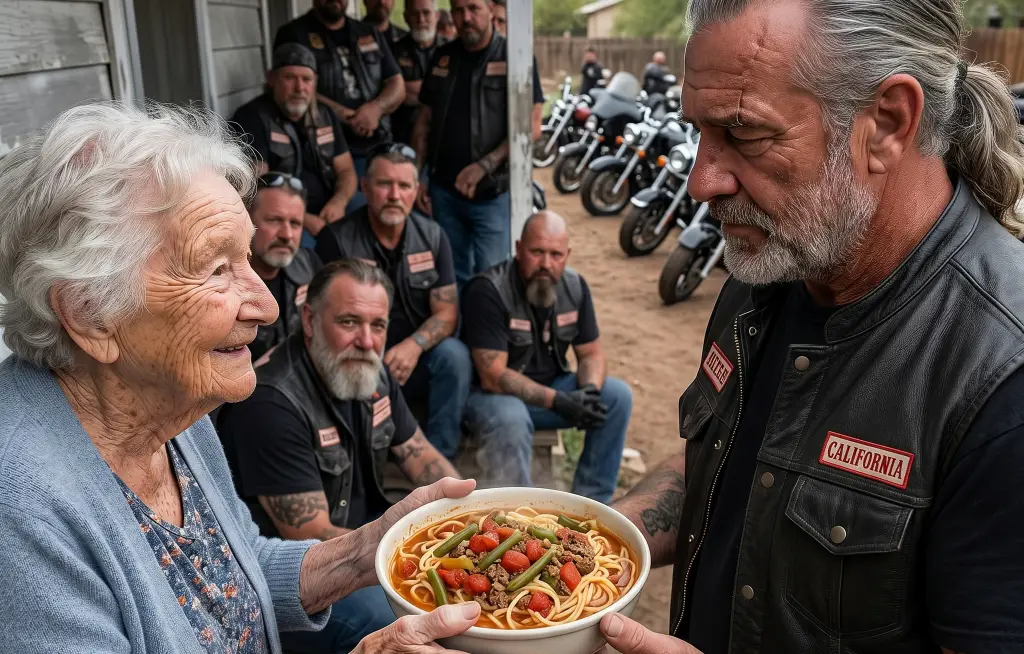
She had learned to read the vast desert sky with the same fluency that other people read their morning newspapers, and the bruised, purplish clouds gathering violently over the San Francisco peaks in the distance told a grim story. A summer monsoon was barreling toward them, and the deep, persistent ache in her joints promised it was going to be a brutal one.
Her home sat quietly on the forgotten eastern edge of Williams. Here, the historic stretch of Route 66 curved sharply away from the modern, bustling interstate, surrendering to a lonely ribbon of cracked asphalt bordered by wild juniper and towering ponderosa pines. The house itself bore the heavy scars of time and neglect. Its exterior paint had surrendered to the elements decades ago, peeling away to reveal bare wood that the sun had bleached to an ashen gray. Overhead, the roof sagged dangerously in the center, a permanent casualty of water damage that had steadily rotted through the foundational supports.
Two windows on the upper floor were completely boarded up with rough sheets of plywood, simply because Margaret could not scrape together the funds for replacement glass. Even the porch steps beneath her feet groaned in protest under her slight, fragile weight. The third step down was broken clean through, a jagged hole she had to consciously step over every single day. Margaret pulled the collar of her faded knit cardigan tighter around her neck, seeking comfort despite the stifling desert heat.
This house had been a thing of beauty once. That was back when Harold was still alive, breathing life and energy into these walls. His local contractor business had kept them comfortable, safe, and secure. She could still clearly picture him climbing up onto that very roof every spring, his tool belt jingling, meticulously checking for winter damage. She remembered when their daughter, Rebecca, would visit with the grandchildren, filling the now-hollow rooms with chaotic, joyful laughter.
But time is a thief. That was fifteen years ago. It was before the sudden, massive heart attack that took Harold from her in the middle of the night. It was before Rebecca moved away to California, her phone calls gradually thinning out to nothing. And it was before the suffocating avalanche of medical bills and relentless property taxes had entirely consumed whatever small nest egg Margaret had managed to save.
Now, her survival was a quiet, daily mathematics. She lived strictly on a meager Social Security check and whatever produce she could coax from the small, stubborn vegetable garden she tended behind the house. The tomatoes, at least, were having a spectacular year. It was a small mercy, but at her age, you learned to count the small mercies.
The wind suddenly picked up velocity, whipping her silver hair across her face. It carried the undeniable, metallic scent of ozone and rain, but beneath that, there was something else. She smelled burning engine oil and hot, exhaust-baked metal.
Margaret squinted down the lonely stretch of road. Emerging from the heat waves rippling off the asphalt, she saw them coming. Motorcycles. Thirty of them, perhaps more, riding in a tight, disciplined formation. The deep, guttural rumble of their heavy engines echoed off the surrounding hills, a sound that vibrated right through the soles of her orthopedic shoes. Even from a distance, she instantly recognized the heavy leather vests, the intricate patches, the winged skull insignia emblazoned on their backs.
Hells Angels.
Her heart did not leap into her throat with panic. Had her neighbor, Patricia Walsh, been standing on this porch, the woman would have already been dialing the authorities in hysterics. But Margaret had simply seen too much of the world to measure a man by his wardrobe. She had known bikers in her younger days. They were generally good, hardworking men who simply preferred the absolute freedom of two wheels over the confinement of four.
Still, Margaret was acutely aware of how the rest of the town viewed them. She knew how the local shop owners on Main Street would hurriedly flip their signs to ‘Closed’ and lock their doors whenever a motorcycle convoy rolled through. She knew how Sheriff Calvin Murphy would tail them closely in his cruiser, shadowing them all the way to the county line just to ensure they didn’t linger.
The lead motorcycle throttled down, its engine shifting to a low, throaty purr as it approached her property line. Margaret looked past the rider and saw the approaching storm wall. It was a terrifying, magnificent curtain of solid gray rain marching relentlessly across the desert floor, swallowing the landscape behind the riders. They had fifteen minutes, at most, before the sky completely fell. Out here on this exposed stretch of highway, with absolutely no cover for miles in any direction, they were about to be caught in the violent teeth of the monsoon.
The lead rider swung his heavy bike into her dirt driveway, the thick tires kicking up a cloud of amber dust. He cut the engine. He was a large, imposing man, likely in his mid-fifties, with thick iron-gray hair pulled back into a tight ponytail. A pale, jagged scar cut a stark line straight through his left eyebrow. His leather vest identified him as Vincent Hawk Blackwell, and the array of patches across his chest marked him as a man of significant importance within the club’s hierarchy.
The rest of the riders followed his lead, pulling into the yard and parking their massive machines in perfectly neat, orderly rows along the edge of the road.
“Ma’am,” Vincent called out, his deep voice carrying over the wind. He pulled off his dark riding glasses. His eyes, Margaret noted with mild surprise, were remarkably kind, framed by deep crow’s feet etched from years of squinting into the highway sun. “Sorry to bother you, but that storm’s coming in fast and hard. Is there a garage or shelter nearby where we could wait it out? We really don’t want to get caught out on the road when the lightning starts.”
Margaret looked past his broad shoulders at the churning black sky. Vicious sheet lightning was already flickering deep inside the bruised clouds, followed by the low, ominous growl of distant thunder. She shifted her gaze back to the thirty men sitting on their motorcycles. Despite their tough exteriors, their weathered faces showed varying degrees of genuine concern and physical discomfort as the first heavy, cold drops of rain began to smack against the dry dirt. They were incredibly far from home. She could read the Flagstaff chapter markings on their vests; they had clearly miscalculated the sheer speed of an Arizona monsoon.
“There’s no shelter for miles,” Margaret said, her voice clear and steady over the rising wind. “But you can bring those bikes around back and come inside. I’ll put on coffee.”
Vincent’s thick eyebrows shot up toward his hairline. “Ma’am, that’s incredibly kind of you, but there’s thirty of us. We can’t impose on you like that.”
“You can and you will,” Margaret said, locking her eyes with his. She possessed the unyielding authority of a woman who had raised a child and buried a husband. “I’ve got four walls and a roof, and it’s about to come down hard. Now move those bikes before you all get soaked.”
Another rider pulled his bike up alongside Vincent’s. He was younger, with a leaner build, but he carried the same road-weary exhaustion. His vest bore the name Russell Forge Carver. “Hawk, we really should—”
“I heard the lady,” Vincent interrupted smoothly, cutting off the younger man’s protest. He looked back at Margaret, his expression carefully guarded, studying her face as if searching for a trap. “You absolutely sure about this, ma’am?”
“I’m sure. Now hurry up.”
The bikers moved with a sudden, astonishing military efficiency. They guided their heavy motorcycles around the side of the house to the backyard, carefully tucking them beneath an old, rusted carport that offered minimal, but desperately needed, cover….

Daniel Carter is a senior staff writer at InspireChronicle, specializing in legal conflicts, family disputes, and real-life justice stories. His work focuses on high-stakes situations involving inheritance, betrayal, and complex moral decisions. Through detailed storytelling, he explores how ordinary people navigate extraordinary challenges and the long-term consequences that follow.
His articles have gained significant traction online for their emotional depth and realism, resonating with readers across the United States.
He writes extensively about justice, personal responsibility, and the hidden dynamics within families.