
The late afternoon light filtered through the frosted safety glass of Little Lanterns Daycare, casting long, fractured shadows across the linoleum floor. Tessa Whitlock walked down the brightly decorated hallway, the familiar scent of industrial disinfectant and crushed graham crackers washing over her. Beside her, Bishop—a German Shepherd mix with intelligent amber eyes and a coat the color of burnt oak—padded quietly at her left hip. The rhythmic clicking of his nails against the floor was a grounding sound, a steady metronome that usually helped Tessa transition from the exhaustion of her workday to the demands of single motherhood.
The hallway walls were plastered with finger paintings and crookedly cut construction paper shapes, bursting with the chaotic joy of childhood. Today, however, Tessa barely registered the artwork. Her mind was already cataloging the evening ahead: pick up Hollis, navigate the rush-hour traffic, start the bathwater, and maybe, just maybe, steal a quiet moment on the porch after he went to sleep.
Miss Jenny, a college-aged assistant with a perpetually cheerful demeanor, met them at the threshold of the infant room. “Hi, Mrs. Whitlock,” she whispered, offering a warm, slightly tired smile. “Hollis had such a great nap today. He went down without a fuss.”
She gestured toward the dimly lit room, where a small speaker tucked onto a high shelf played a synthesized, lullaby rendition of a classical sonata.
The shift in Bishop was instantaneous.
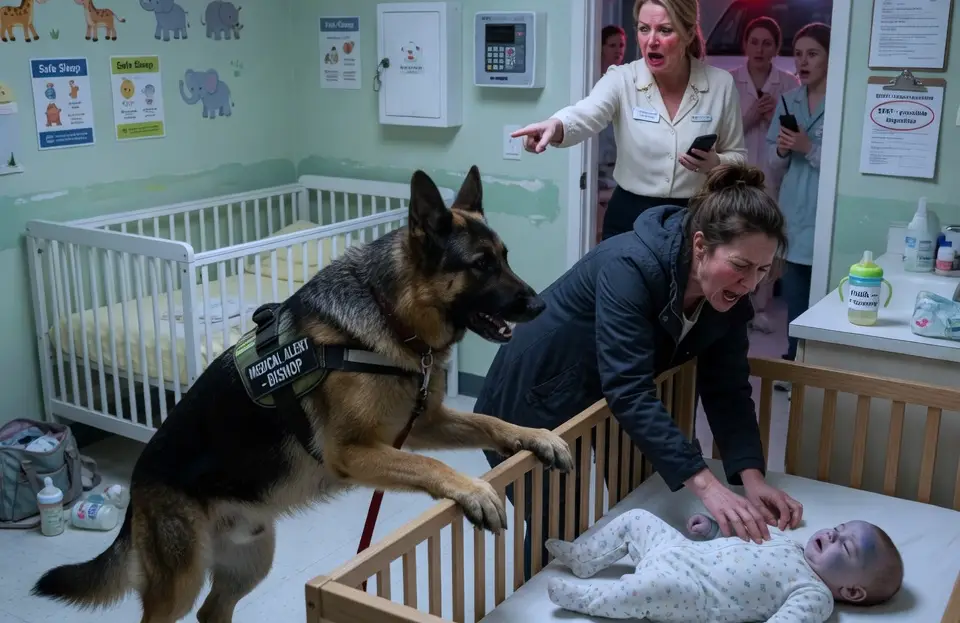
The moment they crossed the doorway, the relaxed drape of the dog’s posture vanished. The muscles beneath his dark coat coiled tight. His ears, usually pinned back in easy submission, snapped sharply forward. Tessa felt the sudden, rigid tension travel straight up the leather leash. Before she could process the change, Bishop surged forward, pulling her toward the back corner of the room.
“Bishop, wait!” Tessa hissed, instinctively tightening her grip.
Her command died in her throat. The heavy-set Shepherd planted his front paws firmly against the base of Hollis’s crib, his body a solid, immovable wall. A low, vibrating growl rumbled deep in his chest—a sound that sent a cold spike of adrenaline straight down Tessa’s spine. It was a sound she hadn’t heard since those long, grueling months in the backyard, when her late husband, Grant, had painstakingly put Bishop through his rescue and alert training.
“Hey, get that dog away from there!” a senior staff member snapped from across the room, abandoning a stack of folded blankets and rushing forward.
Bishop ignored the woman entirely. He didn’t bare his teeth. He didn’t snap. Instead, he lifted a heavy paw and struck the side of the wooden crib, the movement deliberate and frantic. He hit it again, harder this time.
Tessa’s heart hammered a frantic rhythm against her ribs. Bishop was a certified, extensively trained medical alert dog. Grant had poured his remaining months into that training, treating it like a sacred duty. Bishop did not break protocol. He did not act out. He only acted when the world was falling apart.
“Bishop, show me,” Tessa commanded. Her voice was terrifyingly steady, a leftover reflex from a past life.
The dog’s paw moved immediately, hovering deliberately over Hollis’s small chest, before his amber eyes locked onto Tessa’s face. The gaze was piercing. Absolute. It was the exact signal he had used to alert Grant that his oxygen levels were crashing in the weeks following the warehouse fire.
Moving blindly past the protesting daycare worker, Tessa reached over the wooden railing. The moment her fingers brushed her son’s cheek, the mother vanished, and the former EMT took over.
Hollis’s skin was unnervingly cool to the touch. Worse was his color. A subtle, grayish-blue tint bloomed around his tiny, parted lips. It was a color Tessa had seen in the backs of speeding ambulances, a color that made the blood roar in her ears.
“Something’s wrong,” Tessa announced. Her tone left absolutely no room for debate as she scooped the limp, eight-month-old infant from the mattress. Hollis’s head lolled against her collarbone. His breathing wasn’t just shallow; it was a fragile, thready flutter. “Call 911. Right now.”
“Mrs. Whitlock, please.”
Pamela Voss, the daycare director, materialized in the doorway, cutting through the rising panic of the room. Her blonde hair was perfectly lacquered, her tailored suit immaculate. She looked less like a caregiver and more like a corporate litigator, and her eyes were sharp, darting between Tessa and the dog. “That animal needs to be removed from the premises immediately. He is creating a severe disturbance.”
Tessa cradled her baby tightly against her chest, her free hand already fishing her phone from her pocket. “My dog just alerted me that my infant is in respiratory distress,” she said, her thumb sliding across the screen. “I am calling emergency services.”
Her fingers trembled violently, but years of emergency response training kept her voice locked into a clinical, detached cadence as the dispatcher picked up. “This is Tessa Whitlock. I am at Little Lanterns Daycare on Elm. I need an immediate bus for an eight-month-old male. He is in acute respiratory distress, presenting with cyanosis around the mouth, cold skin, and shallow respirations.”
The infant room erupted. Miss Jenny stood frozen by the rocking chair, her hands clamped over her mouth in horror, while the senior staff scrambled to herd the waking, crying toddlers into the adjacent hallway. Through the chaos, Pamela Voss stepped closer, her voice dropping to a harsh, demanding hiss.
“Mrs. Whitlock, I must insist. That animal is frightening the other children. Take him outside.”
“He stays,” Tessa fired back, dropping her phone to her pocket and resting her hand on the thick fur between Bishop’s ears. The dog hadn’t moved an inch from her leg, his eyes glued to the baby in her arms. “He’s a trained medical alert dog. He just did his job.”
She ignored the director, turning all her focus to Hollis. She counted the seconds between his frail, hitching breaths, pressing two fingers to the inside of his tiny wrist to find a pulse. It was there, but it was sluggish. Every agonizing second stretched into an eternity until the distant wail of sirens finally cut through the autumn air.
They burst through the heavy front doors of the facility with practiced, kinetic energy. Heavy boots squeaked on the linoleum, trauma bags swinging. Tessa recognized the lead paramedic instantly. It was a face from a lifetime ago.
“Tessa?” Mike Patterson paused for a fraction of a second, his professional mask slipping as he registered the woman standing amidst the chaos. “What have we got?”
She rattled off the vitals with the staccato precision of a veteran. “Infant male, eight months. Respiratory depression. Peripheral and perioral cyanosis. Skin is cool and clammy. No prior medical conditions, no history of asthma.” She swallowed hard, forcing the next words out. “My medical alert dog signaled the distress. I found him unresponsive in the crib.”
Mike nodded sharply, already snapping on purple nitrile gloves and moving in to assess the baby. Bishop shifted backward to give the men room, sitting squarely on his haunches, watching their every move with intense scrutiny.
“Sat levels are bottoming out,” Mike announced, ripping open a plastic package and pulling out a pediatric oxygen mask. It looked impossibly huge against Hollis’s pale face. “We need to transport. Now.”
“The dog can’t ride in the rig,” Mike’s partner stated flatly, grabbing the straps of the stretcher.
“He has to,” Tessa pleaded, the clinical wall finally cracking, letting a sliver of the terrified mother bleed through. “Please. He knew something was wrong before anyone else. He’s trained for this. I need him.”
Mike looked from Tessa’s desperate face to the German Shepherd, who was sitting perfectly still, radiating disciplined focus. “He rides up front with you, Jamie,” Mike ordered, waving off his partner’s objection. “We’ve run with service animals before. The dog stays with the family.”
As they transferred Hollis onto the gurney, securing the straps over his small body, Pamela Voss reappeared at Tessa’s elbow. The director’s composure seemed incredibly forced, a tight smile plastered over her face. “Mrs. Whitlock, I am certain this is just a misunderstanding. The change in weather… he’s likely just coming down with a severe bug.”
Tessa stopped dead. She turned slowly, her eyes locking onto Pamela’s. The air between them dropped twenty degrees. “My dog does not make mistakes about breathing patterns,” Tessa said, her voice dropping to a venomous whisper. “This isn’t a cold. And I think you know that.”
She didn’t wait for a response. She turned on her heel and followed the stretcher out the double doors. Bishop trotted right beside the wheels, hopping up into the front of the ambulance the moment the doors opened, settling onto the floorboards only after he saw Hollis safely loaded into the back.
Tessa climbed in, sitting on the bench and gripping her son’s tiny, limp hand. The heavy rear doors slammed shut, enclosing them in the harsh, fluorescent glow of the rig. As the ambulance lurched forward, the siren screaming into the evening, Tessa stared at the rise and fall of Hollis’s chest beneath the oxygen mask.
Bishop had bought them time. Precious, irreplaceable minutes. But as she watched Mike adjust the oxygen flow, a dark, heavy realization began to settle in her gut. Bishop’s alert hadn’t been random. He had smelled something. He had sensed a specific, dangerous shift. A healthy eight-month-old boy didn’t just stop breathing during an afternoon nap.
Something had happened in that room. And looking back at the facade of Little Lanterns fading into the distance, Tessa knew with bone-deep certainty that this was no accident.
The blindingly bright emergency room bay buzzed with a controlled, kinetic chaos the moment the automatic doors parted. Mike wheeled the gurney through the entrance at a sprint, his heavy boots squeaking against the polished floors. Bishop trotted flawlessly in sync with the stretcher, a dark shadow moving through the harsh fluorescent glare, his eyes locked entirely on the fragile form of the infant.
“Pediatric respiratory distress!” Mike shouted over the din, projecting his voice toward the waiting trauma team. “Oxygen saturation remains critically low despite supplemental flow!”
Dr. Sarah Chen, the attending ER physician, pushed off the nurses’ station counter and immediately took the lead. She was a woman of sharp, decisive movements. “Let’s get him into Room Three, right now,” she ordered, her eyes sweeping over Hollis before landing squarely on the massive German Shepherd keeping pace. “Is this a service animal?”
“Medical alert,” Tessa choked out, jogging to keep up. Her throat felt raw, as if she had swallowed ground glass. “He’s the one who detected the drop. He is specifically trained for respiratory emergencies.”
Dr. Chen didn’t waste a single second arguing protocol. She gave a brisk, single nod. “He can stay in the room, but he needs to maintain a strict perimeter away from the sterile fields and the crash cart.”
Bishop didn’t need to be told twice. As they rushed Hollis into Trauma Room Three and transferred his small body to the oversized hospital bed, the dog found the furthest corner of the room. He sat squarely on his haunches, positioning himself where he had an unobstructed line of sight to the bed without interfering with the half-dozen medical professionals swarming the room.
The next sixty minutes blurred into an agonizing montage of clinical efficiency. Nurses established IV lines with practiced precision, drawing vials of blood while Dr. Chen barked orders for a battery of rapid toxicology and pediatric panels. Through the whirlwind of movement, Bishop remained a statue of vigilance. He didn’t pace. He didn’t seek comfort. But suddenly, the Shepherd lifted a heavy paw, swiping it anxiously at the empty air—his secondary trained signal for an impending respiratory dip.
“His pressure is bottoming out again,” a nurse called out, her eyes fixed on the telemetry monitor.
Simultaneously, Bishop let out a low, urgent whine, stepping out of his corner.
Dr. Chen glanced sharply between the plummeting numbers on the digital display and the dog standing at attention. “Fascinating timing,” she muttered, reaching for a pre-filled syringe. “Let’s push the stabilizing meds, stat. Bolus dose.”
Under Dr. Chen’s swift intervention, the violent dipping of Hollis’s vitals finally began to level out. The frantic, high-pitched alarms settled back into a steady, rhythmic, and beautiful beeping. Tessa stood pressed against the far wall, her arms wrapped tightly around her own torso. Her knuckles were bone-white. Every rise and fall of her son’s small chest was a monumental victory, a terrifying reminder of the razor-thin line they had just walked.
The fragile quiet of the trauma room was violently shattered by the hiss of the sliding glass doors.
Pamela Voss stepped into the sterile space. Her appearance was jarringly out of place among the scrubs and stainless steel. She was flanked by two uniformed city police officers and a burly county animal control officer, the latter gripping a heavy aluminum restraint pole.
“There,” Pamela announced. Her voice carried the polished, theatrical projection of a woman used to holding an audience. She raised a manicured finger, pointing directly at Bishop. “That is the animal that attacked our facility. We need him removed and impounded immediately.”
The animal control officer took a heavy step forward, unspooling the wire loop at the end of his pole.
Tessa moved faster than she could think. She threw herself between the officer and the dog, her arms spread wide. “Do not touch him!” she warned, her voice trembling with a fierce, maternal rage. “He didn’t attack anyone. He was alerting me to my son’s medical crisis. He is a certified, fully trained medical alert dog!”
“We have multiple staff witnesses who observed the dog acting highly aggressively, trapping a child in a crib,” Pamela countered, her tone dripping with manufactured civic duty. “As the director of Little Lanterns, I am legally obligated to report any incident involving a direct threat to the children under my care.”
The older of the two police officers pulled a small, spiral-bound notepad from his breast pocket, looking deeply uncomfortable in the cramped medical space. “Ma’am, we have to document the incident. The facility’s management has filed a formal criminal complaint.”
“Excuse me,” Dr. Chen interrupted. She stepped away from the bed, pulling her stethoscope from her ears, her authority absolute. “This dog has been in my trauma bay for the past hour demonstrating textbook medical alert behavior. As a matter of fact, he has been accurately predicting micro-fluctuations in this infant’s respiratory condition seconds before my hospital-grade monitors can catch them.”
Pamela’s perfect posture didn’t waver. She smoothly produced her smartphone, tapping the screen before turning it toward the officers. “We have the security footage of the dog’s hostile behavior. Furthermore,” Pamela turned her chilling gaze to Tessa, “I have already contacted Child Protective Services regarding Mrs. Whitlock’s reckless decision to bring a dangerous, aggressive animal into an infant care facility.”
The fluorescent lights seemed to flicker. The floor dropped out from beneath Tessa’s feet, leaving her free-falling in a sudden, breathless panic. “You… you did what?”
“It is standard county procedure,” Pamela said, her voice laced with a synthetic, cloying pity. “When a parent’s judgment puts vulnerable children at risk, mandated reporters are required to make the call.”
The animal control officer cleared his throat, tapping the metal pole against his thigh. “Regardless, ma’am, we’re going to need to take the dog in for a behavioral evaluation. It’s standard mandatory quarantine procedure after a reported aggression incident.”
“No!” Tessa’s voice cracked, the edges of her composure finally splintering. “Bishop is all I have left. He saved my son’s life today. You cannot take him.”
Dr. Chen physically inserted herself between the authorities and Tessa. “My patient is still in critical, unstable condition. Removing this medical alert animal right now could actively compromise our ability to monitor sudden, life-threatening changes. As the attending physician of record, I am formally requesting—no, requiring—that the dog be allowed to remain until the patient is transferred to the pediatric ICU.”
The officers exchanged a loaded, frustrated glance. They were out of their depth, caught between conflicting institutional powers.
“Alright, Doc,” the senior officer finally conceded, snapping his notepad shut. He looked at Tessa, his expression hardening. “We will hold off on the physical removal for tonight. But the dog must be surrendered to county control for the mandatory evaluation within twenty-four hours. And ma’am? You should expect a knock on your door from CPS by tomorrow. They do not take these facility reports lightly.”
Pamela Voss offered a microscopic, satisfied tightening of her lips. “We are only thinking of the children’s absolute safety, Tessa. I am sure, when you calm down, you’ll understand.”
With a final, lingering look at the monitors, Pamela turned and swept out of the room, her entourage trailing behind her.
The heavy glass doors slid shut, sealing the quiet back in. Tessa’s knees buckled. She sank heavily into the plastic visitor’s chair beside the bed, burying her face in her hands. Bishop immediately closed the distance, pressing his solid, warm shoulder against her shin, resting his heavy chin directly on her knee. She tangled her trembling fingers deep into his thick ruff, desperate for an anchor.
“I don’t understand,” she whispered to the empty air, the tears finally spilling over her lashes. “How did this happen? How did everything go so wrong, so fast?”
Dr. Chen paused from charting Hollis’s vitals, her pen hovering over the tablet. “Your dog’s predictive behavior has been invaluable, Mrs. Whitlock. I am documenting everything I have witnessed in his official medical file.” She offered a look of deep, empathetic sorrow. “But you need to brace yourself. When a system like this gets set in motion, it is an absolute avalanche to fight.”
Through the narrow slit of the hospital window, the sky had bruised into a deep, unforgiving purple. Tessa looked down at Bishop. She thought of Grant. She remembered the gruff, unyielding patience her husband had shown while training this dog, building a lifeline that would ultimately sustain her after he was gone. And now, the very instincts that made Bishop a hero were being twisted into a weapon against her. The institutions designed to protect families were preparing to tear hers apart.
She was completely, utterly alone.
Then, the quiet hum of the machinery was broken by the heavy, measured sound of boots in the hallway.
Tessa looked up. Standing in the doorway, framed by the harsh hallway light, was a tall man in a faded, fleece-lined denim jacket. Wes Holt’s weathered, handsome face carried the exact same quiet strength she remembered from years ago, back when he and Grant would sit on the back porch after a grueling day of canine training.
Bishop’s tail gave a heavy, rhythmic thump against the linoleum, recognizing an old friend, though he refused to abandon his post beside Hollis’s bed.
“Heard what happened over at Little Lanterns,” Wes said, his voice a low, steady rumble that seemed to instantly ground the frantic energy of the room. He stepped over the threshold, his eyes taking in the monitors, the pale baby, and finally, the exhausted mother. “Figured you might need some backup.”
The sight of Wes Holt standing in the doorway of the trauma bay nearly undid whatever fragile composure Tessa had left.
Tears prickled hot and fast behind her eyes, threatening to spill over. Just looking at him brought a tidal wave of memories crashing down on her. She saw humid summer evenings in her backyard, the smell of charcoal smoke and cut grass hanging in the air. She saw Grant and Wes, both younger and unburdened, leaning against the porch railing with cold beers in their hands, their faces animated as they debated canine training tactics while their dogs wrestled in the lawn.
“They’re saying he attacked Hollis,” Tessa managed to whisper, her voice rough and hollow. “But Wes, you should have seen him. He knew something was terribly wrong before any of us even realized it.”
Wes stepped fully into the room, his boots making no sound. He didn’t offer empty platitudes. Instead, he moved closer to the hospital bed, his sharp eyes immediately falling into the analytical cadence of a seasoned K-9 handler. He studied Bishop’s positioning, the angle of his body, the focus in his gaze. The massive Shepherd acknowledged Wes with a brief, intelligent flick of his eyes, but his heavy head never turned away from the sleeping infant.
“That is not aggression,” Wes said. His voice was a firm, undeniable anchor in the swirling chaos of the room. “Look at his physical mechanics, Tess. Ears are pinned forward, not flattened back. His weight is distributed evenly, not coiled to strike, and his tail is in a relaxed, neutral hang. He is actively monitoring. There isn’t a single aggressive micro-expression on that animal.”
“Try explaining that to the county animal control officer,” Tessa replied, a bitter edge bleeding into her tone. “Or Child Protective Services.”
Wes’s head snapped up, his jaw locking tight. “They called CPS on you?”
“The daycare director did. She told them that bringing Bishop into the facility demonstrated a severe lack of parental judgment.” Tessa ran a trembling hand through her hair, fighting a wave of profound exhaustion. “They are coming to take him for a mandatory behavioral evaluation tomorrow.”
“Not on my watch, they aren’t.” Wes pulled up a plastic visitor’s chair, spinning it around to sit with his arms crossed over the backrest. His expression was pure granite. “This is textbook medical alert behavior. Grant trained him for exactly this scenario after that massive warehouse fire. Do you remember?”
The memory hit Tessa with the physical force of a blow. Grant, returning from the hospital with lungs permanently scarred by chemical smoke. The agonizing weeks of recovery where he couldn’t walk up the stairs without wheezing. But Grant had never been one to surrender to vulnerability. He had channeled his frustration into Bishop, spending hours on the living room floor, teaching the young dog to recognize the minute changes in human respiratory patterns. She remembered the fierce, proud smile on Grant’s face the first time Bishop had successfully nudged his chest just before a coughing fit began. This dog has a gift, Tess, he had told her, out of breath but beaming. He’s going to save lives someday.
She hadn’t allowed herself to think about those intimate training sessions in years. It simply hurt too much. Remembering Grant’s gentle persistence, his unyielding patience, and the way he had believed in Bishop’s capabilities when everyone else saw just another anxious rescue dog felt like pressing on a deep, unhealed bruise.
“I remember,” she whispered, looking down at her hands. “But I never thought… I mean, that was years ago.”
“Good training sticks,” Wes said, his tone softening. “And Grant was the best handler I ever had the privilege of working with. He was better than half the professionals in the state program.” Wes leaned forward, resting his elbows on the back of the chair. “Listen to me, Tess. I have twenty years of canine handling experience under my belt. I know exactly what a dangerous dog looks like, and this isn’t it. Bishop is doing precisely what he was conditioned to do.”
As if understanding the conversation, Bishop chose that exact moment to shift. He stood up from his haunches, taking one deliberate step closer to Hollis’s bedside, and gently lifted his paw to tap the metal bed rail.
Almost instantaneously, the digital telemetry monitor above the bed began to beep with a slightly more rapid, urgent tempo.
A nurse in floral scrubs hurried into the room, her eyes darting straight to the readouts. She checked the digital display, then reached down to adjust a valve on Hollis’s IV line. “His blood pressure is spiking just a little,” she explained calmly to Tessa. “We are correcting the flow rate now.”
As she stepped back, the nurse paused, looking down at the German Shepherd with an expression of profound, newfound respect. “That is the third time he has alerted us to a microscopic change before the telemetry caught it.”
After the nurse slipped back out into the hallway, Wes gave Tessa a deeply pointed look. “You see? That is not random, chaotic behavior. That is a highly specific, conditioned response to a biological change. It is exactly what Grant built him to do.”
Tessa watched as Bishop circled once before settling back into his vigilant sphinx pose. “But how do we prove that to a judge? Pamela has security footage of him blocking the staff’s access to the crib, growling at anyone who came near. On tape, it’s going to look terrible.”
“Then we will force them to let the experts review that tape,” Wes said, pulling his cell phone from his jacket pocket. “I still have deep connections in the working-dog community. We can get independent, professional assessments of his body language. We have Dr. Chen’s medical documentation of his alert patterns right here in the hospital.”
He reached across the space between them, his large, calloused hand covering her small, trembling one. He squeezed gently. “You are not in this alone, Tess.”
The simple, grounding touch of his hand brought another devastating wave of memories crashing over her. She remembered Wes standing like a sentinel at Grant’s funeral, steady and solid in his dress uniform. She remembered the endless weeks that followed, how Wes had quietly let himself into her house to leave foil-covered meals on her counter, how he had taken Bishop for miles-long runs when she physically could not pull herself out from under the covers. He had been her lifeline, but as the months wore on, she had slowly withdrawn, retreating into the dark, solitary cave of her grief, and Wes had gracefully stepped back to give her space.
But now, here he was. The moment her world caught fire again, he had walked right back into the smoke, ready to fight for her.
“I cannot lose him, Wes,” she said softly, her eyes locked on Bishop’s dark coat. “After Grant… Bishop became my anchor. He is the only reason I found the strength to keep breathing, to keep being a mother to Hollis. And now they are telling the world I am a negligent mother for trusting him.”
“We are not going to let that happen.” Wes’s voice held an absolute, unbreakable conviction. “Grant knew exactly what he was doing when he shaped this dog. Bishop has more functional medical training than half the certified service animals I’ve evaluated. We just need to legally prove it.”
He unlocked his phone, his thumb flying across the screen as he began scrolling through his contacts. “I know a premier veterinary behaviorist who specializes in high-drive working dogs. I’m also going to call my old shift supervisor from the K-9 division. He works as an expert witness in complex behavioral cases now. Between their testimony and the medical logs from this ER…”
Tessa watched him work, struck by the quiet, methodical efficiency he was bringing to her nightmare. The tight, suffocating knot of panic in her chest finally began to loosen, just a fraction.
“Why are you doing all of this?” she asked, her voice barely above a whisper when he paused between sending texts.
Wes looked up. His eyes met hers, and the raw, unguarded intensity in his gaze made her breath catch in her throat.
“Because Grant would never forgive me if I let a broken system take his dog,” Wes said, his voice dropping an octave. “Because Bishop is a hero, not a liability.” He hesitated, the silence stretching taut between them, before he finished softly. “And because you and Hollis matter to me, Tess. You always have.”
The words hung heavy in the sterile hospital air, thick with a decade of unspoken meaning and shared history. Tessa felt a sudden, terrifying flutter in her chest. She quickly looked away, forcing her attention back to the rhythmic rise and fall of her baby’s chest. She couldn’t afford to navigate the complicated, beautiful emotions Wes’s presence was stirring up. Not right now. Not with her son in a hospital bed and her dog in the crosshairs of the state.
“Thank you,” she managed to say, her eyes fixed blindly on the blankets. “For believing in him. For being here.”
“Always,” Wes replied simply. He turned his attention back to his phone, granting her the quiet space she desperately needed to pull her armor back on.
Tessa reached down, burying her fingers in Bishop’s thick fur. She focused entirely on the present moment, on protecting her child and clearing her dog. Everything else—the political nightmare Pamela Voss was orchestrating, and the undeniable way her pulse jumped when Wes smiled—would simply have to wait.
The heavy glass doors slid open once more, breaking the quiet. Dr. Lyle Fenwick, Hollis’s veteran pediatrician, stood at the foot of the bed. He was a tall, imposing man, his white coat crisp, but a deep, troubling frown creased his forehead as he stared down at the metal clipboard in his hands. He adjusted his wire-rimmed glasses, looking up at Tessa, then at Wes, before his gaze settled on the dog.
“Mrs. Whitlock,” Dr. Fenwick began, his voice meticulously controlled. He tapped a silver pen against the paper. “The comprehensive bloodwork results have just come back from the lab. And I am afraid they are deeply concerning.” He stepped closer to the bed, lowering his voice so it wouldn’t carry into the hallway. “We have isolated traces of a chemical depressant in your son’s system. A powerful sedative that is absolutely not part of any medical treatment we have administered here.”
Tessa’s hand froze entirely where she had been rhythmically stroking Bishop’s neck. The hum of the hospital room suddenly felt deafening.
“What kind of sedative?” she asked. Her voice didn’t sound like her own; it was thin, stripped of all its previous emergency-mode armor.
“A relatively common class of chemical depressant, but undeniably powerful,” Dr. Fenwick explained, his brow furrowed as he scanned the tablet. “Especially for an infant. Mrs. Whitlock, I have to ask you this directly, for the sake of the medical record. Has Hollis been administered any medication, over-the-counter or otherwise, outside of what I have explicitly prescribed?”
“No,” Tessa said, the word punching out of her lungs. She stood up, the chair scraping harshly against the linoleum. “Absolutely not. The only medicine he has had in his entire life was the liquid antibiotic you gave us for his ear infection last month. That is it.”
Dr. Fenwick nodded slowly, his pen flying across the digital screen to log her response. “I treated your husband, Grant, during his pulmonary recovery,” the doctor said quietly, glancing down at the dog. “I remember the extensive training Bishop went through. The specific alert behaviors you described at the daycare today—the physical blocking, the chest-pawing—they are perfectly consistent with what I observed when he was learning to detect Grant’s sudden oxygen drops.”
At the sound of Grant’s name, Bishop’s ears perked up. The massive dog rose smoothly to his feet and moved directly to Hollis’s bedside, carefully placing one heavy paw on the lower rung of the metal rail. He froze there, staring intently at the baby’s chest.
“See that?” Dr. Fenwick pointed with the end of his pen. “That is a highly conditioned, trained response. There is zero predatory or aggressive intent there.” He stepped past the dog and checked the digital readout above the bed. “And sure enough, there is a micro-fluctuation in his oxygen saturation. A slight dip. Nothing dangerous right now, but Bishop caught the atmospheric change before our monitors triggered an alarm.”
Before Tessa could even process the profound relief of having a medical professional validate her dog, a sharp, authoritative voice pierced the quiet of the hallway.
“I have every right to check on the child’s condition,” Pamela Voss’s perfectly modulated, icy tone carried clearly through the cracked door. “As the director of Little Lanterns, I am contractually and legally responsible for documenting this unfortunate incident. And that dog should never have been allowed past the lobby.”
Wes, who had been leaning quietly against the windowsill, moved with startling speed. His broad shoulders completely filled the doorframe just as Pamela appeared, flanked by two nervous-looking daycare assistants.
“This is a restricted pediatric trauma area,” Wes said. His voice wasn’t raised, but it carried the unyielding density of a brick wall. “Family only.”
Pamela’s professionally pleasant expression tightened, the corners of her mouth pinching into a hard line. She looked Wes up and down, clearly unused to being told no. “I am simply doing my administrative due diligence, sir. We have the internal security footage showing that animal acting aggressively—”
“You mean the footage showing a certified medical alert dog performing exactly as he was trained to do?” Wes countered smoothly, not giving her an inch. “Because that is exactly what the state canine training experts are going to see when my K-9 unit contacts subpoena it for review.”
Pamela blinked, thrown off balance by the legal terminology.
Dr. Fenwick stepped forward, moving to stand shoulder-to-shoulder with Wes. “Ms. Voss, I am Dr. Fenwick, Hollis’s attending pediatrician. I am afraid I am going to have to ask you to leave my ward immediately. We are in the middle of reviewing some highly concerning bloodwork results.”
Pamela’s eyes narrowed to tiny, glittering slits. “Concerning how?”
“That is strictly confidential medical information,” Dr. Fenwick replied, his tone chillingly professional. “But I assure you, I will be documenting everything thoroughly for the upcoming investigation.”
Something ugly flickered across Pamela’s manicured face. It happened so quickly that Tessa almost missed it—a sharp, sudden flash of genuine panic, rapidly swallowed by a mask of cold fury.
“Of course,” Pamela said smoothly, recovering her poise. She adjusted the strap of her leather tote bag. “I will follow up with administration later. But I do want to remind everyone in this room that there will be severe county consequences for bringing a dangerous, unmuzzled animal into a licensed childcare facility.”
With a sharp pivot on her designer heels, Pamela marched down the hallway, her assistants scurrying in her wake.
Wes closed the heavy door until it clicked shut, sealing the room. Tessa let out a long, violently shaky breath, pressing the heels of her hands into her eyes. “She is really going to try to have Bishop declared a dangerous animal and destroyed, isn’t she?”
“Let her try,” Wes said grimly, rolling his shoulders. He turned his attention back to the pediatrician. “Doc, about those lab results. Could the specific chemical depressant you isolated have caused Hollis’s respiratory failure?”
“Absolutely,” Dr. Fenwick replied without hesitation. “In fact, profound respiratory depression is the primary, most dangerous side effect of this particular medication, especially in a pediatric patient. The dose we found in his system was relatively low, but for a baby of Hollis’s size and weight…” He shook his head, a grim shadow crossing his features. “If Bishop hadn’t alerted the staff when he did, this would have been a catastrophic event.”
Tessa felt a paralyzing cold seep into her marrow, chilling her despite the warm, stuffy hospital room. She looked at the doctor, then at Wes, her mind struggling to bridge the horrifying gap between the facts. “Are you saying someone deliberately gave my baby a sedative?”
“I am saying we need to aggressively investigate exactly how this unauthorized substance entered his bloodstream,” Dr. Fenwick said carefully, choosing his words with deliberate weight. “As a physician, I am legally required to report suspicious circumstances like this, especially when it involves a non-verbal infant.”
Wes was already pulling his phone back out, his jaw muscles working. “I have a contact in the Special Victims division at the police department. Someone who won’t brush this under the rug. We need to document everything right now, while the timeline is fresh.”
Bishop let out a soft, low whine, pressing his heavy body flush against Tessa’s legs. She sank back into the chair, burying her fingers deep in his thick ruff, desperately drawing strength from his solid, unwavering presence.
“The timing of Pamela’s visit just now is remarkably interesting,” Dr. Fenwick mused aloud, making more rapid notes on his tablet. “She was incredibly invested in knowing what those test results showed.”
“And she is incredibly invested in legally discrediting Bishop,” Wes added, the pieces clicking together in his mind. He looked at Tessa, his eyes dark with realization. “Think about it, Tess. A highly trained medical alert dog—an animal that can literally smell biological changes—would be a massive, uncontrollable threat to anyone trying to hide medical tampering.”
Tessa’s mind spun dizzily. The betrayal was so profound, so monstrous, that her brain actively tried to reject it. “But why? Why would a high-end daycare… why would anyone there drug an infant?” She couldn’t even finish the thought without bile rising in her throat.
“That is exactly what we are going to find out,” Wes said. He pulled his chair closer to Tessa, dropping his voice to a focused, grounding register. “Tess, look at me. I need you to think back. Tell me everything you remember about Bishop’s behavior during pickup times over the last month. Any deviations? Any patterns? Were there other kids he seemed overly focused on?”
Tessa closed her eyes, forcing herself to rewind her memories, searching past her own exhaustion. “He was always restless when we pulled into the parking lot,” she murmured. “He would pace in the back of the SUV. I thought he was just excited to see Hollis, but…” She opened her eyes, a new, sickening clarity washing over her. “Last Thursday. When I picked Hollis up, Bishop kept pulling against the leash. He was trying to drag me back down the hallway toward the infant room, even though I already had Hollis in my arms. He kept whining and sniffing the bottom of the door. Like he wanted to check on the other cribs.”
Dr. Fenwick looked up sharply from his tablet. “I need to review county hospital admission records immediately. I need to see if we have had any other cases of unexplained respiratory issues or severe lethargy originating from Little Lanterns.”
“Document every single detail, Tess,” Wes emphasized, leaning forward. “Dates, times, which staff members were present, and Bishop’s exact physical behaviors. The more empirical evidence we gather, the harder it will be for Pamela Voss to spin this to a judge as an unprovoked dog attack.”
Right on cue, Bishop’s heavy head suddenly snapped up. He moved deliberately from Tessa’s side back to Hollis’s bedside, his amber eyes locking onto the infant. The monitors chimed a second later, showing another slight dip in oxygen levels—small, manageable, but caught by the dog a full three seconds before the machines registered the change.
“Good boy,” Tessa whispered, a fresh wave of tears burning her eyes as she watched the nurse adjust the flow of the pediatric oxygen mask.
Every single alert reinforced what she had known deep in her bones. Bishop wasn’t a threat. He was a guardian. He was doing exactly what Grant had meticulously trained him to do: protecting human life in the dark.
Dr. Fenwick finished his notes, tucking the digital tablet under his arm. “I am ordering a full, expedited toxicology panel,” the doctor announced, his tone leaving no room for argument. “And I am going to discreetly contact some colleagues at the other pediatric clinics in town. Let’s see if there is a wider pattern we have been missing. Whatever is happening inside that facility, your dog may have just uncovered something far bigger than a single, isolated incident.”
After the doctor left the room, Tessa slumped forward in her plastic chair, the adrenaline finally crashing and leaving her hollowed out and trembling. Wes shifted closer, his large, warm hand finding her shoulder and giving it a firm, grounding squeeze.
“We are going to figure this out,” he promised, his thumb brushing lightly against her collarbone. “Bishop isn’t the problem here, Tess. He’s the solution. And now we finally know what he’s been desperately trying to tell us.”
Tessa looked at her son’s peaceful, sleeping face, then down at the fiercely loyal dog who had saved him. The scattered, chaotic pieces of the afternoon were beginning to form a picture that was both utterly terrifying and violently infuriating. Someone had intentionally put her baby at risk, and then tried to legally destroy the very creature who had exposed them.
“Bishop knew,” she said softly, her hand resting on the dog’s broad head. “He knew something evil was happening in that room, and he didn’t back down. Not even when the entire staff was screaming at him.”
She straightened in her chair. The crippling fear that had been suffocating her all afternoon began to recede, replaced by a slow-burning, white-hot resolve. It was the same fierce, unyielding strength that had gotten her through the darkest days of losing Grant.
“Well,” Tessa said, her voice dropping into a register of pure steel, “neither will I.”
Wes’s phone buzzed sharply in his hand. He glanced at the screen, a grim smile touching the corners of his mouth. “My contact just replied. They are dispatching a detective from the Special Victims Unit to take our official statements tonight. And I have three certified canine behavioral experts lined up to legally dissect that security footage.”
Bishop settled heavily onto the floor, assuming a perfect, rigid guard position, his eyes fixed permanently on Hollis. Whatever dark, twisted secret was festering behind the brightly painted walls of Little Lanterns, the dog had successfully pulled the first thread.
Now, Tessa realized with icy clarity, they just had to keep pulling until the whole corrupt tapestry unraveled.
Wes leaned back in his plastic chair, his eyes going distant, tracing a memory etched somewhere in the fading daylight beyond the hospital window. Outside, evening had fully settled, washing the room in a heavy, twilight blue that contrasted sharply with the harsh glow of the telemetry monitors. The rhythmic, steady beep of Hollis’s heart rate filled the quiet space, a fragile lullaby.
At the foot of the bed, Bishop remained at his post. His amber eyes were fixed with unwavering intensity on the crib rails.
“You know,” Wes said softly, his voice dropping to a gravelly murmur that barely disturbed the quiet, “I remember the exact week Grant started conditioning Bishop for this.”
Tessa’s breath caught. The sudden mention of her late husband’s name in the sterile room felt like a physical ache. The memories were still so raw, carefully compartmentalized just to survive the daily grind of single motherhood. But something in the gentle, grounded cadence of Wes’s tone made her lean in, desperate for the connection.
“It was right after that massive five-alarm fire down in the warehouse district,” Wes continued, folding his hands together. “Grant was so incredibly frustrated, being sidelined and stuck at home on medical leave. The chemical smoke inhalation had really done a number on his lung capacity. But instead of just lying around feeling defeated, he turned that agonizing recovery into something productive. He started actively working with Bishop.”
“I remember,” Tessa said quietly, staring down at her intertwined fingers. “He would spend hours out in the backyard with him, running drills. I just thought… I thought it was to keep himself busy. To stop from going crazy while the rest of his crew was out on calls.”
Wes slowly shook his head. “It was a lot more than that, Tess. Grant knew he needed help monitoring his own respiratory dips. You know exactly how stubborn that man was about admitting when his body was failing him. He hated making you worry. So, instead of complaining, he methodically trained Bishop to alert to atmospheric pressure changes and irregular human breathing patterns. He essentially built a living, breathing pulse oximeter. That dog became more reliable than any piece of hospital equipment they sent him home with.”
Tessa sat up straighter, the cold dread in her stomach suddenly replaced by a sharp, illuminating jolt of understanding. The chaotic pieces of the afternoon abruptly snapped together into a perfect, undeniable whole.
“The pawing,” she breathed, her eyes widening as she looked at the Shepherd. “The heavy paw straight to the chest. That is exactly what Bishop used to do to Grant when his oxygen levels would unexpectedly drop in the middle of the night.”
“Exactly,” Wes confirmed, leaning over to gently scratch the thick fur behind Bishop’s right ear. The dog leaned into the touch for a microsecond before returning his focus to the infant. “Grant taught him how to isolate the physical signs of respiratory distress and signal them with absolute clarity. Bishop is not just some random, anxious rescue dog. He is a highly specialized, operational medical alert animal. Those deeply ingrained instincts don’t just fade away with time.”
Hot tears welled in Tessa’s eyes, blurring her vision. All this time, she had been terrified that Bishop was becoming unpredictable. But he had been utilizing the exact, painstaking skills Grant had taught him. The same alerting behavior that had safeguarded her husband in his darkest moments was now being deployed to shield their child.
“When Grant…” Tessa started, her voice wavering dangerously before she forced herself to swallow the lump in her throat. “When he passed away, Bishop seemed so profoundly lost. For months, he just wandered the house like a ghost. But when I brought Hollis home from the maternity ward, it was like a switch flipped. He found his purpose again.” She fiercely wiped a tear from her cheek. “He wasn’t attacking anyone at the daycare today, Wes. He was doing precisely what Grant conditioned him to do. He was screaming at us that there was a dangerous breathing problem in that crib.”
Wes nodded in firm agreement. “And doing it flawlessly, from an operational standpoint. The timing of his physical alerts matched perfectly with Hollis’s oxygen crashes. Any judge in the county will see that this isn’t aggression. This is specialized, high-level training executing in a live environment.”
At the sound of his name, Bishop’s heavy head lifted. He offered a soft, rumbling whine in the back of his throat, seeking Tessa’s eyes for a moment before snapping his attention back to Hollis. The baby was sleeping peacefully now, the terrifying bluish tint completely gone, his cheeks flushed with a healthy, warm pink.
“We need to formally document all of this,” Tessa said, wiping her face. The crushing weight of her grief was rapidly crystallizing into a razor-sharp determination. “Grant’s original training logs, Bishop’s behavioral certification process, the departmental sign-offs. There has to be a paper trail somewhere.”
“Already miles ahead of you,” Wes replied, tapping his cell phone on his knee. “I reached out to our old captain from the K-9 unit while you were talking to the doctor. They remember Grant logging those specific hours with Bishop. We can easily secure sworn affidavits about the entire training methodology. We will legally prove this was an established, conditioned behavior long before today.”
Tessa stood up, unable to sit still any longer. A fierce, protective energy coursed through her veins as she began to pace the narrow strip of linoleum beside the bed. “All this time, I have been playing defense,” she said, the words spilling out rapidly. “I’ve been apologizing for Bishop, trying to convince people he isn’t a threat. But we need to completely flip the narrative. He’s not just ‘not dangerous.’ He’s a hero. He executed his job exactly the way Grant trained him to do it.”
“And that,” Wes pointed out, his eyes gleaming with strategic satisfaction, “is exactly what makes Pamela Voss’s fabricated story crumble. A certified medical alert dog does not suddenly turn feral and aggressive for no reason. If anything, Bishop’s documented behavior proves beyond a shadow of a doubt that something was catastrophically wrong with Hollis’s breathing while in her facility. Wrong enough to trigger an emergency response.”
Tessa stopped pacing at the window. She stared out at the city skyline, watching the last remnants of the sunset bleed into a bruised purple night. Grant had always sworn Bishop was a once-in-a-lifetime animal, a dog with an intrinsic instinct for protecting the vulnerable that went far beyond basic obedience.
She turned slowly back to face Wes, a chilling new thought taking root. “Wes… what if that is the real reason he was so persistent at the daycare all month?” Her voice dropped to an awed whisper. “What if he sensed something wrong with the other babies, too?”
Wes didn’t say a word. He simply reached into the inside pocket of his denim jacket, pulling out a small, battered leather notebook and a pen. “Let’s start from the very beginning,” he instructed, flipping to a blank page. “I want you to tell me every single time Bishop seemed unusually focused on that building. Any prolonged sniffing, any agitation at the door, any behavior that you dismissed as weird at the time, but makes terrifying sense now.”
For the next hour, the hospital room became an impromptu war room. They meticulously built a chronological timeline. Tessa recalled Bishop’s escalating anxiety during the evening pickups. She remembered his physical attempts to jam his body through the door of the infant room, the way he would stubbornly plant his paws near specific cribs on the rare occasions Pamela allowed him past the lobby. Behaviors that Tessa had previously written off as separation anxiety or mere overprotectiveness now formed a horrifying, undeniable pattern of systemic medical alerts.
“We need to formally subpoena his training records from the fire department archives,” Wes muttered, his pen flying across the lined paper. “Grant was a perfectionist. He would have documented every single hour. Those files will establish that Bishop is a specially trained asset using precise skills to mitigate a threat.”
Suddenly, Bishop stood up. His posture was rigid but entirely calm.
Moments later, the digital oxygen monitor above Hollis’s bed showed a fractional dip—nowhere near enough to trigger the loud hospital alarms, but a change in the atmospheric pressure nonetheless. Wes and Tessa fell silent, watching in awe as the massive Shepherd padded silently to the crib, lifted his right paw, and gently, deliberately scraped it against the metal railing until a floor nurse popped her head in to check the readouts.
“Do you see that?” Wes whispered, pointing his pen at the dog. “Calm. Controlled. Clinically precise. Anyone who knows a damn thing about working dogs will see the massive difference between that and a hostile attack.”
Tessa felt tears threatening again, but this time, the suffocating sorrow was gone. “Grant knew,” she whispered, her hand covering her mouth. “Somehow, he knew we were going to need Bishop to be exactly this. That is why he pushed through the pain to spend all those exhausting hours training him, even when the doctors told him to stay in bed.”
“Grant always played the long game, Tess,” Wes agreed, his voice growing thick with an emotion he rarely showed. “He believed in being relentlessly prepared. In building something strong enough to last.” Wes stood up, closing the distance between them, and reached over to gently squeeze her shoulder. “Bishop isn’t just protecting Hollis. He is actively carrying on Grant’s legacy of saving lives.”
The profound truth of that statement hit Tessa with the force of a freight train.
For nearly a year, she had been viewing Bishop’s actions through a distorted, suffocating lens of fear. Fear of the dog being taken away. Fear of being judged by the other polished mothers at the daycare. Fear of failing at the impossible task of doing this all alone.
But standing in the quiet hum of the ER, that lens completely shattered. Bishop wasn’t a liability she had to desperately defend. He was a highly trained guardian, executing a flawless mission.
The grief that had sat like lead in Tessa’s chest since the day of Grant’s funeral suddenly metamorphosed into something entirely different. It became pure, unadulterated determination. Determination to fiercely honor Grant’s foresight. Determination to protect the family she had left. And most importantly, determination to violently tear away the pristine facade of Little Lanterns and expose whatever darkness had nearly killed her son.
“We are going to prove what really happened in that building,” Tessa said firmly. Her spine was straight, her voice forged from iron. “We aren’t just going to clear Bishop’s name. We are going to find out exactly why he needed to alert in the first place. Someone at that daycare has the answers, Wes. And we are going to make them talk.”
Hearing her resolute tone, Bishop looked up, his intelligent amber eyes catching the light. He seemed to understand that the dynamic in the room had shifted permanently. He had done his grueling part—detecting the invisible danger, protecting his tiny charge, and holding his ground despite the screaming accusations.
Now, Tessa realized with a fierce, burning clarity, it was their turn to fight for him.
The scratch of the ballpoint pen against the stiff, county-issued paper sounded aggressively loud in the quiet of Tessa’s kitchen. She sat beneath the warm glow of the pendant light, her hand trembling so violently she had to pause and press her palm flat against the oak table to steady herself.
Box by box, line by line, she was formally documenting the nightmare. She detailed Bishop’s frantic, conditioned alerts, the terrifying bluish pallor of Hollis’s face, the unauthorized chemical depressants the hospital had isolated in his bloodwork, and Pamela Voss’s immediate, vicious pivot to blame the medical alert dog.
“Are you absolutely sure you are ready for this?” Wes asked. He was leaning against the kitchen counter, a mug of black coffee cooling in his hands, watching her with a mixture of deep respect and protective concern. “Once you file this paperwork with the county, you are ringing a bell that cannot be un-rung. Pamela Voss is not going to take this lying down.”
“I have to,” Tessa replied, her voice dropping to a fierce, unwavering register. She signed her name at the bottom of the final page, the ink bleeding slightly into the paper. “If they did this to Hollis, what if it isn’t an isolated incident? What if other babies are in danger right now, and their parents have no idea?”
The Department of Child and Family Services was housed in a monolithic, deeply uninspiring concrete building in the heart of downtown. The following morning, Tessa pushed through the heavy glass doors, the manila folder clutched to her chest like a shield. The lobby smelled of stale floor wax and decades of bureaucratic exhaustion.
The receptionist—a woman with tightly permed gray hair and reading glasses perched on the end of her nose—barely lifted her eyes from her glowing computer monitor as Tessa slid the complaint across the high counter.
“Someone from the investigative division will contact you within forty-eight hours to confirm receipt,” the woman droned, her voice devoid of any human inflection. She stamped the folder with a loud, final thwack. “Next in line.”
Those forty-eight hours stretched into an agonizing, breathless eternity. Tessa paced her living room, jumping out of her skin every time her cell phone vibrated. When the call finally came late Tuesday afternoon, an exhausted-sounding county official informed her that a surprise inspection of Little Lanterns Daycare had been scheduled for the very next morning.
“You are legally permitted to attend the walk-through as the formal complainant, Mrs. Whitlock,” the official warned her, his tone dry. “However, you must remain entirely silent during the process. If you interfere or speak out of turn, you will be escorted off the premises.”
Tessa arrived at Little Lanterns twenty minutes early the next day. She parked her SUV across the street, gripping the steering wheel as she watched the facility’s front doors. Precisely at nine o’clock, two white county vehicles pulled into the lot.
But Tessa’s heart plummeted into her stomach.
There was Pamela Voss, standing under the facility’s awning, radiating polished, Southern-hospitality charm. She was perfectly coiffed, wearing a tailored navy blazer, greeting the inspectors with wide smiles and warm handshakes as if they were arriving for a charity gala rather than an investigation into child endangerment.
“Welcome, welcome!” Pamela’s melodic voice carried across the crisp morning air. “We are so incredibly pleased to have you here. We pride ourselves on maintaining the absolute highest standards of care in the county.”
Tessa slipped out of her car and followed the group inside, trying to make herself as small and inconspicuous as possible.
Pamela led the tour with the slick, heavily rehearsed ease of a seasoned politician. She highlighted the rounded safety corners on the furniture and the hospital-grade air filtration systems. Every single room was immaculate, smelling faintly of lavender. Every staff member they passed was standing with bright, engaged posture.
“Our medication and wellness protocols are especially stringent,” Pamela explained smoothly, leading the inspectors into the administrative office. She gestured toward a heavy, wall-mounted steel cabinet equipped with a digital keypad. “Only authorized senior personnel can access any supplements or medications, and every single drop is meticulously logged in real-time.”
The lead inspector, a tall man with a clipboard, nodded approvingly. “That is a very impressive security system, Ms. Voss.”
“And here are our daily activity manifests,” Pamela continued, producing three pristine, thickly bound binders from her desk. “Every child’s sleep schedule, dietary intake, and authorized medications are tracked to the minute.”
Standing in the back of the room, Tessa wanted to scream. She had seen the actual daily logs when she picked Hollis up—they were always dog-eared, covered in spilled formula, and frequently missing signatures. These pristine binders were a complete fabrication, meticulously forged just for this moment.
When the tour finally reached the infant room—the exact spot where Bishop had made his desperate stand—Pamela’s voice softened into a tone of deep, manufactured sorrow.
“This is the room where that deeply unfortunate incident occurred,” Pamela said, placing a hand over her heart. “We have since implemented emergency security protocols to prevent any unauthorized, aggressive animals from breaching the premises and terrorizing the children.”
Tessa’s vision tunneled. The sheer audacity of the lie snapped her fragile restraint. “The dog in question is a certified medical alert animal who was alerting to an unauthorized sedative!” Tessa blurted out, stepping forward.
The lead inspector whirled around, his brow furrowed in severe reprimand. “Ma’am, you were explicitly briefed on the operational guidelines. You are not to speak during this inspection.”
Pamela turned to Tessa, offering a look of profound, agonizing sympathy that didn’t reach her cold, glittering eyes. “We understand this transition has been incredibly difficult for you since your husband passed, Tessa. Perhaps it would be healthier for you to wait outside in the fresh air?”
The inspection dragged on for another excruciating hour. Tessa watched helplessly as Pamela effortlessly parried every single question, producing flawless, clearly doctored documentation that neatly countered every accusation in Tessa’s file.
By the time they returned to the lobby, the inspectors were practically apologizing for taking up Pamela’s morning.
“We will finalize our formal report at the office,” the lead inspector said, sliding his pen into his pocket, “but quite frankly, Ms. Voss, I do not see a single cause for concern. Your facility appears to be exceeding county requirements in nearly every metric.”
Tessa followed them out the glass doors, desperation clawing at her throat. “Please,” she begged, stepping in front of the inspector’s car. “You aren’t looking deep enough. There is medical documentation from the hospital! They found chemical depressants in my baby’s blood!”
“Ma’am,” the inspector cut her off, his tone laced with finality and a hint of pity. “Our physical inspection found absolutely zero evidence supporting your allegations. If you have lingering medical anxieties, I highly suggest you take them up with your pediatrician. Have a good day.”
Tessa stood frozen on the asphalt, watching the white county vehicles pull away, taking her hope with them.
“You really should have let this go, Tessa.”
The voice was a soft, venomous purr right next to her ear. Tessa flinched, turning to find Pamela Voss standing entirely too close. The director’s polite, professional mask had completely vanished, leaving behind something utterly ruthless.
“Now,” Pamela whispered, her eyes flat and dead, “you have forced my hand.”
That evening, the true nightmare began.
Tessa was sitting on her living room couch when her phone emitted a rapid, ceaseless series of chimes. It was notifications from the Little Lanterns private parent Facebook group. Someone—posting anonymously, but with language that clearly carried Pamela’s distinct cadence—had drafted a massive, devastating manifesto.
The post painted a tragic, horrifyingly skewed picture of an unstable, deeply grieving widow who was rapidly losing her grip on reality. It detailed Tessa’s “disturbing obsession” with bringing a “known aggressive” rescue dog into a peaceful childcare environment. It suggested, with cloying, fake sympathy, that Tessa was actively projecting the trauma of her husband’s tragic death onto the innocent, hardworking caregivers who were only trying to love her son.
“Did you see what they are saying about me?” Tessa’s voice broke violently as she called Wes, her fingers trembling against the phone screen. “They are making me sound completely insane. The other mothers are agreeing with it.”
“I am looking at it right now on my laptop,” Wes replied, his voice a low, dangerous rumble. “Tess, do not reply to a single comment. This is calculated, weaponized character assassination. Pamela is systematically trying to publicly discredit you before you can gather any more empirical evidence.”
More comments flooded in as the night deepened. Mothers Tessa had chatted with during pickups were sharing fabricated “warning signs” they claimed to have noticed about Tessa’s mental state. It was a digital firing squad, each comment carefully draped in faux-concern while efficiently severing Tessa’s credibility.
Then, her phone rang. It was the director of the local county library, where Tessa worked part-time as a children’s archivist.
“Tessa, is everything alright at home?” her boss asked, her voice tight with professional caution. “We have received three highly concerning phone calls about you in the last hour.”
Tessa squeezed her eyes shut. “What kind of calls?”
“Several parents from the community expressing deep worry about having someone… unstable, working in the children’s wing. Tessa, you know we adore you here, but if this kind of controversy affects the library’s public reputation…”
Tessa let the phone drop to her lap, the call disconnecting. Pamela wasn’t just defending her lucrative business; she was actively, methodically dismantling Tessa’s entire life. She was wielding her social capital and deep community connections like a butcher’s blade.
Bishop padded heavily across the rug, resting his massive head firmly on her knee. Tessa buried her fingers in his dark fur, staring blankly at the wall. “What do we do now, boy?” she whispered into the quiet room.
Her phone screen lit up one final time. It was an SMS text message from a blocked, untraceable number.
Consider this your one and only friendly warning. Drop the county complaints immediately, or things are going to get much, much worse for you and your son.
Tessa took a long, shuddering breath, the chill of the threat seeping into her bones. She had known that challenging a high-end institution like Little Lanterns wouldn’t be simple, but she had never anticipated this level of orchestrated, mafia-like retaliation. Pamela Voss was not just a protective business owner; she was someone with real, terrifying power, and she possessed the absolute willingness to completely destroy a mother to protect her secrets.
Looking down at Bishop, Tessa remembered how the dog had planted his feet on the daycare floor, refusing to budge despite the screaming adults and the looming threat of animal control. He had focused entirely on protecting Hollis, ignoring the chaos.
She needed to channel that exact same energy. She had to stay locked onto the truth, no matter how violently Pamela tried to twist the narrative.
Tessa picked her phone back up and dialed Wes.
“I need you to help me screenshot and physically document every single thing that is happening tonight,” Tessa said, her voice stripped of all its previous panic, replaced by cold, hard iron. “Every post, every threatening text, every phone call. If Pamela thinks she can bury the truth under lies and intimidation, she is wrong. If she is working this incredibly hard to destroy my credibility, it means we are right. She is hiding a monster.”
“Don’t worry, Tessa. We are going to figure this out,” Wes said, his voice dropping into that familiar, unshakeable K-9 handler cadence over the phone. “The truth has a relentless way of coming to the surface, no matter how much dirt people try to shovel over it.”
Tessa kept the phone pressed to her ear, staring at the glowing screen of her laptop. The stream of hostile, fabricated messages from the Little Lanterns parent group continued to multiply, a digital avalanche designed to bury her. She had walked into that county office expecting a straightforward, bureaucratic investigation into a safety hazard. Instead, she had stumbled blindly into something infinitely darker—a sprawling, deeply rooted web of influence and corruption that clearly extended far beyond the brightly painted walls of a single daycare center.
But as she looked at Hollis sleeping soundly in his crib monitor, and at Bishop’s massive, steady form resting at her feet, the instinct to run completely evaporated. Running away wasn’t an option. Sometimes, standing up for what was right meant standing entirely alone in the dark, at least for a little while.
She hung up with Wes and opened a new folder on her desktop. With cold, methodical precision, she began taking screenshots of every single message, every slanderous post, and every veiled threat, meticulously building an arsenal of evidence showing exactly how Pamela Voss operated. The truth would inevitably break through. She just had to stay strong enough to survive the siege until it did.
The text message illuminated her phone screen at exactly 2:15 in the morning.
The harsh blue light cut through the dark bedroom, jolting Tessa from a shallow, restless sleep. She reached for the nightstand, blinking against the glare. The message was from an unsaved, out-of-state area code.
Need to talk. About your son. Not safe to call.
Tessa pushed herself up against the headboard, her heart suddenly pounding a frantic rhythm against her ribs. Given the viciousness of Pamela’s smear campaign over the last few hours, her immediate instinct was paranoia. This could be another trap, another piece of manufactured evidence to prove she was unhinged. But something about the desperate brevity of the message made her pause.
Who is this? she typed back, her thumbs flying across the glass.
Three pale gray dots appeared, danced in a wave for a long moment, disappeared, and then finally appeared again.
Reanie. From Little Lanterns. Please, I can’t sleep anymore keeping this secret.
Tessa threw off the heavy quilt, fully awake now. The chill of the hardwood floor grounded her. She vividly remembered Reanie—a quiet, painfully shy young woman in her early twenties who often worked the afternoon shift in the infant room. She had always seemed genuinely sweet, if perpetually nervous, usually hovering in the background while Pamela held court with the affluent parents.
What secret? Tessa asked.
Not over text, the reply came instantly. Can we meet? Somewhere public but quiet?
Tessa thought rapidly. She needed a place where they wouldn’t be recognized by the daycare crowd, somewhere neutral. The coffee shop in the back of Marshall’s Books. Tomorrow morning at ten o’clock.
Okay. Please come alone. And please, please don’t tell anyone.
Tessa didn’t hesitate. The second the text thread closed, she dialed Wes. Despite the brutal hour, he answered on the second ring, his voice raspy but immediately alert. She quickly explained the cryptic messages and her plan for the morning.
“I don’t think it’s a trap,” Tessa whispered into the dark, pacing at the foot of her bed. “But after everything Pamela pulled today with the county inspector…”
“I’ll be there,” Wes promised, the fierce protectiveness in his tone wrapping around her like a heavy blanket. “I won’t sit with you, but I will be in the room. I’ll keep watch.”
The next morning, the sky hung low and gray, threatening rain. Tessa arrived at Marshall’s Books twenty minutes early. She bypassed the aisles of bestsellers and headed straight for the small, independent coffee counter nestled in the back corner. The air smelled of roasting espresso beans and old paper. She chose a small, circular table tucked behind a massive display of local history books, offering her a clear, unobstructed view of both the front entrance and the emergency exit.
Wes was already there. He sat three tables away, nursing a dark roast in a ceramic mug, completely absorbed in a spread-open newspaper. To anyone else, he was just a local contractor taking a late morning break. To Tessa, he was an impenetrable fortress.
At exactly ten o’clock, Reanie walked through the glass doors.
The young woman looked utterly terrified. She was practically swimming in an oversized, knitted sweater, wearing large, dark sunglasses despite the heavy cloud cover outside. She kept glancing nervously over her shoulder, her posture rigid with paranoia, as she navigated the narrow aisles toward Tessa’s table.
“Thank you for coming,” Reanie whispered, her voice trembling. She slid into the wooden chair opposite Tessa, her hands shaking so badly she immediately tucked them under her thighs to hide it. She set a worn canvas purse on the table between them. “I’m so sorry about the secrecy. I just… I cannot live with myself for another single day.”
“What is going on, Reanie?” Tessa kept her voice incredibly gentle, carefully banking her own desperation. She recognized the fragile, brittle state of someone teetering on the absolute edge of a panic attack.
“It’s the nap drops,” Reanie breathed, the words tumbling out in a rushed, terrified exhale. “That is what Pamela calls them. She keeps them in her administrative office, locked in the bottom drawer of her desk. They are some kind of heavy, unmarked sedative. I don’t know the medical name of it. But she makes us put them in the bottles of the babies who won’t easily go down for sleep.”
Tessa felt all the blood drain from her face. The coffee shop ambient noise faded into a hollow ringing. “That is what happened to Hollis?”
Reanie nodded, her eyes welling with thick, hot tears that spilled down her pale cheeks. “Usually, she tells us to use just two or three drops. Just enough to make them heavily drowsy so the room stays quiet. But that day, Hollis was teething. He had been crying for an hour. I saw Pamela personally add extra to his formula bottle. She said he was being especially difficult, and that you seemed stressed at drop-off and needed him to have a good, long sleep.”
Reanie aggressively wiped her face with the oversized sleeve of her sweater. “When your German Shepherd started going crazy by the crib, I knew exactly what had happened. I knew he was reacting to the drops. But I was just so scared to say anything while Pamela was standing right there.”
“Reanie, how long has this been happening?” Tessa asked, her stomach turning violently.
“Years, I think. It is just… it is an expected part of the job. When an infant won’t settle and it messes up the mandated schedule, Pamela dispenses the drops. She tells the new hires that it is perfectly harmless, just a concentrated herbal supplement to aid digestion. But I have seen the glass bottles. There are no FDA labels. There are no ingredients listed. And sometimes, the babies sleep so deeply you can barely wake them up for pickup.” Reanie’s voice cracked, fracturing into a quiet sob.
Tessa reached slowly across the small table, covering Reanie’s trembling hands with her own, offering a steadying anchor. “Why are you risking everything to tell me this now?”
“Because I haven’t slept in three days,” Reanie confessed, her voice breaking. “Every time I close my eyes, I see your little boy’s blue lips. I see the paramedics rushing in. And now, watching Pamela systematically try to destroy your life on the internet just because you figured out the truth… I can’t be a part of it anymore.” Reanie took a jagged, shuddering breath. “But I am so terrified, Tessa. She knows everything about my life. She plays golf with my landlord. She is close friends with the bank manager who approved my car loan. If I cross her, she could completely ruin me.”
“We are not going to let that happen,” Tessa promised, the vow carrying the weight of absolute certainty. “We can protect you.”
“How?” Reanie asked, a desperate, hollow laugh escaping her lips.
Wes chose that exact moment to fold his newspaper. He stood up, moving with slow, deliberate, unthreatening steps, and approached their table.
“Because we are going to do this the right way,” Wes said quietly, pulling out the third chair and sitting down. “I have deep contacts in county law enforcement who operate completely outside of Pamela’s social circle. We can secure you proper, legally binding whistleblower protection.”
Reanie stared at the large, imposing man, then darted a panicked look back at Tessa. “You told me to come alone.”
“I needed backup,” Tessa explained softly, keeping her hands firmly over Reanie’s. “This is Wes. He is helping me investigate exactly what happened to Hollis. He spent twenty years as a police K-9 handler. He knows exactly how to navigate sensitive, dangerous situations.”
“And I know how to protect vital witnesses,” Wes added, his tone gentle but firm. “What you are doing today is incredibly brave, Reanie. But you do not have to carry this burden alone anymore.”
Reanie seemed to physically deflate, her shoulders slumping as if sharing the monstrous secret had instantly removed a hundred pounds of pressure from her chest. “I want to help you take her down. But I don’t know how to legally prove any of this. The sedatives are locked up tight. Pamela is the only person with the key, and she never leaves the office unattended.”
“You start by documenting everything you possibly can from memory,” Wes advised, pulling a small notebook from his jacket. “Specific dates, exact times, the names of which children regularly received the drops. Take photographs with your phone if you can do it with absolute safety, but do not take any unnecessary risks. The most critical thing right now is that Pamela cannot suspect you are gathering evidence.”
“I actually have something already,” Reanie admitted, her voice dropping to a barely audible whisper. “I started keeping a secret log in my locker after the paramedics took Hollis away. Times when Pamela ordered us to use the drops, and which babies slept through the fire alarm tests.” She hesitated, biting her lower lip, before reaching deep into her worn canvas purse. “And I… I managed to dig one of the empty bottles out of her private trash can before the janitorial staff emptied it.”
Reanie slowly pulled her hand from the bag. She placed a small object wrapped tightly in a white tissue on the table.
Wes leaned forward and carefully peeled back the paper. It was a small, amber glass vial, the kind used for essential oils, equipped with a glass dropper. It was completely unmarked, save for a single, heavy letter ‘X’ drawn on the bottom in thick black permanent marker.
“This is exactly what we need,” Wes said, a sharp, predatory gleam entering his eyes as he carefully wrapped the vial back up and slipped it into his jacket pocket. “I can have the residual residue inside this glass tested by an independent state lab. Very quietly.”
“What do you need me to do now?” Reanie asked, looking between the two of them.
“You keep going to work, just like normal,” Tessa instructed, infusing her voice with all the strength she possessed. “You act like absolutely nothing has changed. But you stay in constant contact with us. If Pamela says anything strange, or if you feel unsafe for even a second, you walk out the door and call.”
“We will set up an encrypted messaging app for you to use,” Wes added. “And I am going to start working my channels to get official legal protection rolling for you. But it might take a few days to build a case strong enough to bypass her local connections.”
Reanie nodded, wiping the last of the tears from her face. She looked terrified, but the crushing weight of guilt had been replaced by a fragile, new resolve. “I should go. If I am late for my afternoon shift, Pamela will start asking questions.”
“Wait,” Tessa said, catching Reanie’s eye as the younger woman stood up. “Thank you. Thank you for being brave enough to refuse to look away.”
“I’m not brave,” Reanie whispered, adjusting her oversized sunglasses. “I am absolutely terrified. But seeing what she is actively doing to you, and knowing what she did to your baby… being scared suddenly feels a lot better than being guilty.”
After Reanie hurried out the glass doors, disappearing into the cloudy morning, Tessa and Wes sat in a heavy, loaded silence, the roar of the espresso machine filling the space between them.
“It is so much worse than we thought,” Tessa finally said, staring at the empty space where the vial had been. “She isn’t just covering up a singular, tragic accident. She has been systematically, deliberately drugging infants to maintain her perfect schedule.”
“And she possesses enough political and social power to keep an entire staff terrified into absolute silence,” Wes added grimly, his hand resting over his pocket where the evidence lay. “It is no wonder she came after you with a metaphorical sledgehammer the second Bishop exposed what happened to Hollis. You threatened her entire empire.”
“What do we do now?”
“We build the trap meticulously,” Wes said, his eyes narrowing. “We independently test that vial. We document every single thing Reanie gives us. We look for patterns in Dr. Fenwick’s admission records. And we keep Reanie safe. She is walking back into the lion’s den.”
Tessa thought about all the affluent, trusting parents who had eagerly turned against her online, blindly believing Pamela’s polished lies. She thought about the other babies lined up in those wooden cribs, potentially receiving those quiet, unmarked drops right this very minute. And she thought about Reanie, carrying a secret that could break her.
“We have to stop her, Wes,” Tessa said, her voice hard as diamond. “No matter what it takes. No matter what she tries to do to me.”
“We will,” Wes promised, reaching over to tap the table. “The truth is finally coming to the surface, Tess. Pamela Voss just doesn’t know she’s drowning yet.”
The heavy manila envelope hit the worn oak of Tessa’s kitchen table with a dull, definitive thud.
Wes stood on the opposite side of the island, his broad shoulders blocking the fading, late-afternoon light filtering through the window. His expression was grim, the lines around his mouth carved deep with tension. “My contact inside the county licensing department finally came through,” he said, his voice dropping into a hushed, serious register. “You might want to sit down for this, Tess.”
Tessa didn’t sit. Her pulse was already thrumming in her ears. She reached out, her fingers trembling slightly as she unclasped the metal prongs and slid the thick stack of documents onto the wood.
The first page was a standardized commercial business registration form for the flagship location of Little Lanterns Daycare. Her eyes scanned past Pamela Voss’s elegant signature, dropping down to the secondary ownership details. When she read the printed name on the bottom line, the bottom fell out of her stomach.
“Silent partner, Ira Mullen?” Tessa looked up, her brow furrowing in disbelief. “As in, the city councilman?”
“The very same,” Wes confirmed, pulling out a wooden chair and sitting heavily beside her. “The exact same city councilman who currently chairs the municipal public safety committee. And who, by complete coincidence, holds direct administrative oversight for all commercial daycare licensing and health inspections in the county.”
Tessa let out a shaky breath, spreading the remaining papers across the table like a map of a battlefield. There were photocopied inspection reports, municipal zoning permits, and county safety certifications. Every single one of them bore Mullen’s sprawling signature or the official red stamp of his department’s approval.
“Look closely at the timestamps on these,” Wes instructed, tapping a thick, calloused finger against a building permit. “Half of these structural and health inspections are officially marked as completed and passed before the facilities were even fully constructed. He has been systematically fast-tracking every single piece of paperwork for Pamela.”
“Rubber-stamping commercial permits,” Tessa murmured, the horrifying reality of the situation rapidly clicking into place. “Bypassing mandatory safety checks. Pushing through municipal licenses for brand-new locations without ever sending an inspector through the front door.”
“Exactly. And getting a very lucrative cut of the profits in return,” Wes said, pulling a secondary spreadsheet from the bottom of the pile. He slid it toward her. “Look at these quarterly financial statements. Every single time a new Little Lanterns location opens its doors, a limited liability shell company owned by Mullen receives a massive, five-figure ‘consulting fee.’”
Tessa felt a sudden, suffocating wave of nausea. She leaned heavily against the edge of the table. “Wes, how many locations are we talking about?”
“Twelve,” Wes replied, his voice heavy with disgust. “Twelve separate facilities opened in the last three years alone. All of them politically fast-tracked. All of them operating under the exact same unmonitored practices we found at Hollis’s daycare.”
Tessa’s hands slowly clenched into tight fists at her sides. The pristine, untouchable aura of Little Lanterns was suddenly stripped away, revealing a rotting foundation. When Pamela Voss had so effortlessly walked away clean from the surprise inspection, it hadn’t just been because of her local social connections or a forged daily logbook. It had been official, bureaucratic protection executed from the inside of the system.
“The unauthorized chemical depressants,” Tessa whispered, staring blindly at the paperwork. “The covered-up emergency incidents. The heavily falsified daily activity records. This isn’t just one arrogant daycare director cutting corners, Wes. This is a massive, systemic criminal enterprise they have built together.”
She pushed herself away from the table, suddenly suffocating in the small kitchen. She needed to move. She paced the length of the room, her mind struggling to process the sheer, devastating scope of what they had just uncovered.
“All of those babies,” she said, her voice cracking as she ran a hand through her hair. “All of those exhausted, working parents who hand over half their paychecks because they blindly trust that their children are safe in those beautiful buildings.”
“And anyone who accidentally glimpses behind the curtain and tries to expose it gets completely crushed,” Wes added darkly, his eyes following her pacing. “Just like what Pamela tried to do to you and Bishop.”
Tessa stopped at the sliding glass door. She looked out into the backyard. The evening shadows were growing long, stretching across the grass. Bishop was lying under the old oak tree, his head resting on his paws, watching the perimeter with relaxed, eternal vigilance. He was her loyal protector, a dog who had done nothing but precisely execute the lifesaving skills he had been taught. And they had tried to paint him as a vicious, unpredictable monster, simply because his brilliant nose had threatened their lucrative empire.
She turned back to face Wes. The fear that had been haunting her for days was gone, entirely incinerated by a profound, righteous fury.
“We have to stop them,” Tessa said, her voice ringing with absolute certainty. “All of them.”
“It isn’t going to be easy, Tess,” Wes warned softly. He leaned back in his chair, folding his arms. “Councilman Mullen holds serious, entrenched political power. He has been sitting on that municipal council for fifteen years. He has deep, loyal connections threaded through every level of city government, including the police department.”
“I do not care how powerful he is,” Tessa fired back, closing the distance between them. “They are actively hurting children. They are using their elected positions to build a fortune while putting helpless infants at risk. How many other families could be forced to go through the absolute nightmare Hollis and I just survived?”
Wes nodded slowly, his eyes reflecting her determination. “You are absolutely right. But we need to be incredibly smart about our next move. Mullen is a cornered animal. He will not go down without a brutal fight, and he commands municipal resources we simply cannot match.”
“What about your contacts inside the police department?”
Wes grimaced, rubbing the back of his neck. “Some of the older guys in the K-9 unit will absolutely help us. But the administration? Let’s just say Mullen’s influence reaches directly into the precinct captain’s office. If we hand this file over to the wrong detective, it disappears into a shredder, and they come after us twice as hard. We need to build an airtight, bulletproof case before we make a single official move against him.”
Tessa returned to the oak table, looking down at the spread of documents with a new, tactical focus. Reanie’s terrifying eyewitness account regarding the sedatives. The independently tested glass vial. These forged licensing documents. The damning financial profit statements mapping the kickbacks.
She looked up at Wes, an idea taking root. “Could we bypass the police? Could we take all of this directly to the media?”
“It is highly risky,” Wes admitted, though a spark of interest lit up his eyes. “Mullen has plenty of friends at the local city papers. They wouldn’t touch him without a grand jury indictment.” He paused, pulling his cell phone from his pocket and slowly scrolling through his contact list. “But… I do know an aggressive senior editor over at the State Herald. She has built her entire career doing deep-dive investigative pieces on municipal political corruption. She might be willing to look at this.”
“Would it be safe for Reanie?” Tessa asked instantly, her protective instincts flaring.
“We will mandate that they protect her identity as an anonymous source,” Wes assured her. “And honestly, having the story break publicly might actually be the safest thing for her. It is significantly harder for powerful people to retaliate against a whistleblower when the entire state is actively watching them.”
Tessa nodded slowly, processing the strategy. She reached out, carefully gathering the scattered documents and tapping them into neat, organized piles. “I honestly kept thinking this was just about clearing Bishop’s name,” she confessed softly. “About keeping CPS away from Hollis. But it is so much bigger than our family now.”
“Are you entirely sure you want to take this on?” Wes asked, his gaze searching her face. “Going directly after someone with Mullen’s level of influence… it could get incredibly ugly, Tess. The smear campaign Pamela started online is just a fraction of what they can do.”
Tessa thought of the dozens of parents dropping their children off at the twelve Little Lanterns locations spread across the county tomorrow morning. All of them kissing their babies’ foreheads, believing they were leaving them in the safest place possible, exactly as she had done. All of them utterly at the mercy of Pamela Voss’s clinical greed and Ira Mullen’s bureaucratic corruption.
“I have to,” she said firmly, meeting Wes’s eyes without blinking. “What kind of mother would I be if I knew all of this and simply walked away? What kind of person would I be?”
Wes reached across the table, his large, calloused hand covering hers, offering a steady, grounding pressure. “Then we will do it together. Smart, careful, and relentless. But we will do it.”
They spent the next three hours at the kitchen table, meticulously organizing their chain of evidence, creating digital backups, and plotting their sequence of moves. As the evening light fully faded and the kitchen sank into shadows, Tessa felt the immense weight of the undertaking settle firmly onto her shoulders. This was no longer just her desperate, personal fight for survival. It had evolved into a war against an entrenched system that viewed children as acceptable collateral damage.
“We should warn Reanie tonight,” Tessa said suddenly, closing the final file folder. “If we are going to expose a sitting city councilman’s involvement, she needs to be mentally prepared for the massive fallout.”
“I will set up another secure, encrypted meeting for tomorrow,” Wes agreed, standing up and grabbing his jacket from the back of the chair. “And first thing in the morning, I am going to start reaching out to my contact at the Herald. The more eyes we can get on this evidence, the safer everyone is going to be.”
Tessa walked him to the front door, Bishop padding silently from the kitchen to walk in step beside them. As Wes stepped out onto the porch, the cool night air rushing in, he turned back to face her.
“You know,” he said softly, the porch light catching the profound respect in his eyes, “Grant would be incredibly proud of you, Tess. Taking on a fight this massive. Standing up for what is right, no matter what it costs you.”
Tessa felt a sudden, sharp prickle of tears, but she fiercely blinked them back, offering a small, resolute smile. “I learned how to do that from him. From both of you, really.”
“We are going to bring them down, Tessa,” Wes promised, his voice a low, steady vow into the night. “Pamela, Mullen, all of them. The truth has a brilliant way of coming out, especially when good people flatly refuse to stay quiet.”
As she stood in the doorway, watching his truck pull out of the driveway and disappear down the dark street, Tessa felt a strange, intoxicating mixture of raw fear and absolute determination bloom in her chest. The battle looming ahead would be significantly harder than anything she had imagined when Bishop first growled at that crib. But she was no longer facing it alone. And she wasn’t just fighting for herself anymore.
Bishop pressed his heavy, warm flank against her leg. She reached down, her fingers finding the familiar spot behind his ears.
“We are doing the right thing, aren’t we, boy?” she murmured.
His tail gave a slow, sweeping wag against the doorframe, and he looked up at her with a gaze of complete, unwavering trust. It was the exact same absolute conviction he had shown when he refused to leave Hollis’s side, when he had detected the invisible danger and refused to back down despite the terrifying consequences.
Sometimes, Tessa realized as she locked the deadbolt, the most profound acts of courage started with the simple, stubborn refusal to look away from the darkness. Everything else—the grueling investigation, the mounting evidence, the terrifying confrontation with municipal power—grew directly from that one, crucial choice to stand firm.
She gave Bishop a final, reassuring pat and walked back toward the kitchen to review the Mullen files one last time. Tomorrow would bring a storm of new, dangerous challenges. But tonight, she would prepare her armor. Tonight, she would make absolutely certain their case was sharp enough to sever the roots of a system built on profiting from a child’s safety.
Reanie Calhoun’s hands trembled so violently that the dark coffee in her paper cup threatened to spill over the plastic lid. She sat perched on the edge of a leather guest chair in Dr. Fenwick’s private office, looking incredibly small in the morning light. The early sun cast long, fractured shadows through the Venetian blinds, striping the worn, comforting carpet with bars of gold.
Bishop lay quietly at Tessa’s feet, his amber eyes fixed with gentle, unblinking focus on the nervous daycare assistant.
“I can’t go back there,” Reanie whispered, her voice barely audible over the hum of the clinic’s HVAC system. She squeezed the paper cup, her knuckles turning white. “Once I do this… once I officially talk to the authorities, Pamela will know it was me. She will know I took the vial.”
Dr. Fenwick leaned forward in his heavy desk chair, his kind, weathered eyes deeply serious behind his wire-rimmed glasses. He didn’t offer empty platitudes. He offered the anchor of empirical fact. “You will not be standing alone, Reanie. You will have the full weight of my medical documentation unconditionally supporting your testimony. The chemical sedative levels I isolated in Hollis’s bloodwork were not imaginary, and they were not a simple misunderstanding. They were very real, and they were lethally dangerous.”
Tessa watched as Reanie struggled with the agonizing decision. The younger woman seemed to be drowning in her oversized sweater, wrestling with a fear that had been systematically instilled in her by a master manipulator. But as Tessa watched, a fragile, brilliant spark of determination began to take root in Reanie’s tear-filled eyes.
“How many other babies?” Reanie asked suddenly, looking up at the doctor. “How many other Hollises are there? I keep thinking about that. I keep seeing them sleeping so heavily in those cribs.”
“Far too many,” Tessa said softly, leaning over to rest a reassuring hand on Reanie’s knee. “And there will be countless more if we do not find the courage to stop this.”
Dr. Fenwick pulled a thick, tightly bound medical folder from his desk drawer and rested his hands on top of it. “I have spent the last forty-eight hours thoroughly reviewing county-wide pediatric admission records. The clinical pattern of unexplained, severe infant lethargy radiating out from Little Lanterns locations goes back for months. But without an insider—someone willing to bravely step forward and confirm exactly what was happening behind those locked doors—it is entirely circumstantial.”
Reanie took a jagged, shuddering breath. She looked down at Bishop, who offered a soft, encouraging thump of his tail against the carpet. Her chin lifted.
“I’ll do it,” Reanie’s voice shook, but the words were final. “I will testify. About the chemical drops, about Pamela’s specific instructions to keep the parents in the dark, all of it.”
The profound, overwhelming relief Tessa felt at that moment lasted for exactly three hours and twenty-seven minutes.
That was when her cell phone rang, shattering the quiet of her living room.
She was sitting on the rug, stacking brightly colored wooden blocks with Hollis, enjoying a rare moment of maternal peace. She grabbed the phone, expecting an update from the state media contact. Instead, Wes’s voice came through the speaker, tight, clipped, and radiating absolute urgency.
“Tess, they have legally moved up Bishop’s county behavioral hearing,” Wes said without preamble. “Pamela’s attorney filed an emergency petition, pushing for immediate municipal action based on an ongoing, active danger to the community’s children. The judge granted it. They are scheduling the hearing for tomorrow morning.”
Tessa’s knees simply gave out. She sank heavily against the edge of the sofa, one hand blindly reaching out to tangle in Bishop’s thick fur. “Tomorrow? Wes, that isn’t possible. We need more time to process the vial, to prep Reanie…”
“It gets significantly worse,” Wes continued, the grim heaviness in his tone stealing the air right out of Tessa’s lungs. “I just got off the phone with the legal aid lawyer we consulted. Child Protective Services just filed an emergency injunction for the immediate removal of Hollis from your custody.”
The living room spun violently. The bright colors of Hollis’s wooden blocks blurred together into a sickening smear.
“Pamela provided CPS with a sworn, fabricated statement,” Wes explained, his voice laced with pure, controlled fury. “She claimed you are emotionally unstable, actively hallucinating medical emergencies, and that your insistence on keeping a known, dangerous animal in the home proves your judgment is severely impaired.”
Tessa could hear her own heartbeat thundering in her ears, a frantic, trapped rhythm. She looked at her beautiful, innocent baby boy giggling as he knocked over a tower of blocks. She looked at the loyal dog who had risked everything to save him.
“I cannot lose them both,” she whispered, her voice fracturing into a terrified sob. “Wes, please. I can’t.”
“Listen to me, Tess.” His voice became a rod of steel, offering an absolute, unbreakable structure for her to cling to. “I am calling in every single favor I have accumulated in two decades with the K-9 unit. Jerry, the director at the county shelter, owes me his career from when I helped him place all those retired police dogs. I am having him intervene to legally stall the animal control hearing. We can delay this, maybe buy ourselves a few crucial days. But Tessa?” He paused, the reality of the war settling over the line. “We need to move faster than we ever have in our lives.”
A sharp knock at the front door made Tessa physically jump.
She opened it to find Dr. Fenwick standing on her porch. The usually immaculate, composed pediatrician looked slightly disheveled, his tie loosened and a heavy leather briefcase clutched in his hand.
“I came the absolute second I heard the news about CPS,” Dr. Fenwick said, stepping into the foyer. “I have already drafted my formal medical testimony regarding Bishop’s behavior at the daycare. It was not unprovoked aggression. It was a flawless, highly trained medical alert response. We can scientifically prove that to a family court judge.”
“Will it be enough?” Tessa asked, her hands trembling as she locked the door behind him. “Combined with Reanie’s testimony about the sedatives?”
“It has to be.” Dr. Fenwick ran a tired hand through his graying hair, walking into the kitchen. “I have also heavily documented every single suspicious pediatric case I have treated originating from Little Lanterns. Every infant with unexplained lethargy. Every mother who mentioned deep concerns only to have Pamela expertly dismiss them.”
Wes arrived twenty minutes later, his heavy truck tires kicking up gravel in the driveway. He strode through the front door carrying a massive stack of accordion files tucked under one muscular arm.
“Jerry is formally scheduled to testify regarding Bishop’s official temperament evaluation,” Wes announced, dropping the files onto the kitchen island. “Bishop scored perfect marks across the board. And I have three highly decorated, active-duty canine handlers ready to tear that daycare security footage apart frame by frame. They will swear under oath that his body language showed zero hostile intent.”
They spread every piece of paper across Tessa’s kitchen table, transforming it into a desperate command center. Confidential medical records, municipal training certificates, sworn witness statements, and the damning financial spreadsheets. It was a massive, sprawling paper trail of truth violently colliding with Pamela Voss’s perfectly manicured web of lies.
But as Tessa stared at the mountain of evidence, a cold, insidious voice whispered in the back of her mind. Would it come together in time to stop the bureaucratic machine Pamela had weaponized?
“The CPS emergency removal hearing is scheduled for Friday morning,” Tessa said numbly, tracing the edge of a manila folder. “Three days from now. A judge could legally take Hollis away from me on Friday.”
“We will not let that happen,” Wes said. His large hand found hers under the edge of the table, his grip warm, steady, and fiercely protective. “We possess hard, empirical proof of systemic institutional negligence and child endangerment at Little Lanterns. Once we force that evidence into the light, CPS will be aggressively investigating Pamela Voss. Not you.”
Bishop padded quietly across the kitchen floor, moving over to Hollis’s playpen. The massive dog settled heavily right beside the mesh netting, assuming his usual, unwavering guard position. Hollis reached a chubby hand through the fabric, grasping a handful of dark fur, and Bishop simply rested his chin on his paws, watching the baby with gentle, soulful eyes.
Looking at them, Tessa felt her throat instantly tighten, a thick knot of sorrow and terrifying love expanding in her chest. They were her entire universe. The thought of a social worker walking through her front door and taking her son, followed by animal control arriving with a catch-pole for her dog, was physically unbearable.
“I should have seen it so much sooner,” Tessa whispered, the crushing weight of maternal guilt finally bleeding through her armor. “All those times Hollis came home from daycare groggy and unreachable. I just thought he was going through a growth spurt. I am his mother. I should have known.”
“Stop right there,” Dr. Fenwick commanded, his voice gentle but laced with absolute, unyielding authority. “Pamela Voss built a multi-million-dollar empire on her ability to expertly fool loving, attentive parents. She thrives on making mothers inherently trust her while she quietly betrays that trust in the dark. You are not the one who failed in this scenario, Tessa. Do not carry her sins.”
The afternoon stretched painfully into evening as they meticulously fortified their case. Wes paced the living room, making endless, hushed phone calls, pulling in every ounce of support from his old law enforcement contacts. Dr. Fenwick typed furiously on his laptop, cross-referencing admission dates to create an undeniable timeline of suspicious medical incidents.
And through the whirlwind of strategy and rising panic, Bishop kept his quiet, loyal vigil over the baby, entirely unfazed by the chaos, as if he implicitly understood everything at stake.
“Jerry can only hold off the animal control impound hearing until Monday,” Wes said finally, rubbing his exhausted eyes as he hung up his phone. “That gives us exactly five days to pull this entire puzzle together and drop it on the District Attorney’s desk.”
Five days to save her family, Tessa murmured to herself.
The weight of it all pressed down on her chest, a suffocating, terrifying pressure. The fear. The bureaucratic uncertainty. The horrifying knowledge that one single misstep, one delayed piece of paperwork, could permanently cost her everything she loved. She thought of Reanie, risking her entire livelihood and personal safety to tell the truth. She thought of Dr. Fenwick, putting his pristine professional medical reputation on the line for her. She thought of Wes, calling in a lifetime of favors, standing like an iron shield between her and the world.
She wasn’t fighting this war alone. But she was undeniably the one with the most to lose.
That night, long after Wes and Dr. Fenwick had driven home, and Hollis was sound asleep in his crib, Tessa sat on the nursery floor. The house was completely silent, save for the rhythmic hum of the baby monitor.
Bishop stepped close, sighing deeply as he rested his heavy, warm head directly in her lap. His steady, grounding presence anchored her drifting mind, just as it had done through so many dark, grief-stricken nights before.
“You knew,” Tessa whispered into the quiet room, her fingers gently tracing the soft fur behind his ears. “You knew something evil was happening to him, and you absolutely refused to back down, no matter what it cost you.”
She leaned forward, pressing her face into his warm coat, breathing in his familiar, comforting scent. The tears finally fell, hot and silent against his fur, but they were not tears of defeat.
“I won’t back down either,” she promised him, her voice a fierce, unbreakable vow in the darkness. “I promise.”
The next few days would definitively determine everything. Bishop’s fate, Hollis’s entire future, and the total exposure of Pamela Voss’s sickening crimes. Tessa felt the crushing weight of the ticking clock, threatening to break her. But beneath the terror, she felt something else taking root, something that grew stronger and more resilient with each passing hour. Absolute, unshakable determination.
They possessed the truth. They possessed the medical evidence. They had brave witnesses willing to speak on the record. Now, they just needed the sheer, terrifying courage to endure the storm until it broke.
Bishop’s tail thumped softly against the hardwood floor. His amber eyes looked up, never leaving her face. In that steady, soulful gaze, Tessa saw the exact same unwavering loyalty that had made him plant his feet and hold his ground that afternoon at the daycare.
Whatever hell came for them next, she knew with total certainty they would face it together.
The morning sky bruised into an ominous, heavy gray as the first violent flurries of a late-season storm began to fall. Tessa stood perfectly still at her kitchen window, a mug of cooling coffee in her hands, watching the weather deteriorate with an unsettling, chaotic speed.
Her cell phone vibrated continuously against the granite countertop, spitting out a barrage of emergency alerts. Severe Winter Storm Warning. Expected accumulation of twelve to eighteen inches. Dangerous, blinding wind conditions. She had already called the library to take a personal day and had absolutely no intention of risking the icy roads for a daycare drop-off.
But a dark, heavy knot was actively twisting in her stomach. It was an unshakable, primal instinct screaming that she needed to check on Little Lanterns. The thought of other people’s vulnerable infants sitting in that building under Pamela Voss’s care while a major blizzard paralyzed the county made her skin crawl.
Above her, the kitchen pendant lights flickered once, buzzed angrily, and died completely.
Hollis let out a startled, high-pitched whimper from his playpen in the living room. Bishop was there in a fraction of a second, pressing his massive, warm shoulder flush against the mesh netting to offer silent, steadfast comfort.
“It’s okay, baby,” Tessa called softly, navigating the dimming house to scoop her son into her arms. “The emergency grid will kick on soon.”
But it didn’t. The house grew progressively darker as the snow fell in thick, blinding sheets, transforming the early morning into an eerie, claustrophobic twilight.
Her cell phone lit up the shadows. It was Wes.
“Are you watching this weather?” he asked without any preamble, his voice crackling slightly over the strained cellular network. “The entire city grid is going dark. The municipal power substations are freezing over.”
“I need to go to Little Lanterns,” Tessa blurted out. The absolute finality of the words surprised her, but the maternal terror driving them did not.
“What?” Wes paused, the sound of static filling the silence. “Tessa, the county is telling people to stay off the asphalt. The roads are turning to glass.”
“I know exactly how Pamela Voss operates,” Tessa insisted, her free hand trembling slightly as she opened the hall closet and began pulling out Hollis’s heaviest winter gear. “She will do absolutely anything to keep that facility running today to keep up her pristine appearances. Today is the mandatory follow-up inspection from the county. I cannot just sit here in the dark, Wes.”
A heavy pause hung on the line. Then, the undeniable sound of keys jingling.
“I will be in your driveway in ten minutes,” Wes said, his tone shifting into complete operational focus. “We will take my heavy-duty truck. It handles the black ice significantly better than your SUV.”
Profound relief washed over her, loosening the tight band around her chest. “Wes, you really don’t have to—”
“Yes, I do,” he interrupted gently. “And you know it. Bundle him up.”
By the time Wes’s heavy four-by-four pulled to a stop in front of her house, the snow was falling in blinding, horizontal sheets. The wind howled fiercely around the eaves of the roof, and the ambient temperature had plummeted to a bitter, biting cold. Tessa wrapped Hollis in three layers of fleece, secured him tightly in his insulated car seat, and opened the rear door of the cab for Bishop. The big German Shepherd immediately leaped inside, curling his heavy body around the base of the car seat to share his intense body heat with the infant.
Wes didn’t question her frantic decision or try to apply logic to a mother’s intuition. He simply reached over to turn up the truck’s internal heater, shifted the vehicle into four-wheel drive, and began the treacherous, agonizingly slow navigation of the frozen streets.
The drive, which usually took twenty minutes on a clear autumn day, dragged into forty-five minutes of white-knuckle tension. Abandoned sedans and spun-out delivery vans already littered the snow-banked shoulders.
As Wes finally wrestled the truck around the final corner onto Elm Street, Tessa gasped.
There were at least a half-dozen cars parked haphazardly in the Little Lanterns lot.
“She is actually still open,” Tessa whispered, a sickening mixture of horror and white-hot anger rising in her throat. “In the middle of a municipal state of emergency?”
Peering through the swirling, violent snow, they could make out a faint glow in the facility’s expansive front windows. It wasn’t the harsh, bright glare of electrical lighting. It was the dim, localized orange glow of battery-operated emergency lanterns. But as Wes pulled the truck onto the icy asphalt, Tessa noticed something infinitely more terrifying.
A much deeper, erratic orange light was violently flickering from the barred basement windows at the side of the brick building.
“That is definitely not emergency lighting,” Wes said sharply, throwing the truck into park and killing the headlights.
“That is the old industrial furnace,” Tessa finished, her heart slamming against her ribs. “The one Pamela explicitly told the parents was decommissioned last winter.”
“She is desperately trying to heat the building for the county inspector,” Wes deduced, his jaw locking tight. “But if that archaic system hasn’t been properly serviced…”
They didn’t waste another second. They bailed out of the heated cab, the brutal wind immediately tearing at their coats. They commanded Bishop to stay with Hollis, leaving the truck running to ensure the baby stayed warm and safe.
Fighting against the blinding snow, Tessa and Wes crept toward the frosted front windows. Peering through the glass, they could clearly see Pamela Voss. She was walking the county inspector down the main hallway, gesturing grandly with perfectly manicured hands toward her array of emergency lanterns, effortlessly playing the role of the hyper-prepared, fiercely dedicated caregiver.
“She is going to get someone killed,” Tessa breathed, her breath fogging the freezing glass.
In the adjacent infant room, Tessa could see a dozen cribs. The babies inside were huddled under blankets, looking terrifyingly, unnaturally still. With no electrical power to run the facility’s commercial ventilation fans, the ancient, straining gas furnace in the basement was a ticking time bomb.
Wes was already pulling his phone from his pocket, his bare fingers clumsy and stiff with the biting cold as he dialed emergency services. But in a blizzard that had paralyzed the entire city, how long would a fire engine take to navigate the icy roads?
The erratic orange glow from the basement grates grew violently brighter, casting long, dancing shadows across the snowdrifts. Tessa could actually smell it now, leaking through the brickwork—the sharp, unmistakable, sulfurous scent of uncombusted gas and burning dust.
Pamela’s muffled voice drifted through the cracked weather-stripping of the front doors as she and the inspector approached the lobby. “As you can plainly see, we are fully, comprehensively prepared for any municipal emergency. The children’s absolute comfort and safety remain our top operational priority.”
Tessa’s hands clenched into fists so tight her nails dug into her palms. The exact same polished lies. The exact same sociopathic lack of concern. While she played tour guide, invisible, lethal carbon monoxide was inevitably building up in the sealed, unventilated infant room.
The wind screamed around them. They desperately needed to act. But breaking protocol with the inspector standing right there was a massive risk. One single word from Pamela painting Tessa as the ‘disturbed, retaliatory mother’ under active CPS investigation, and any warning they screamed would be instantly dismissed by the county official.
Suddenly, a deep, resonant sound cut cleanly through the howling blizzard.
Tessa’s head snapped up, her eyes widening in pure shock. “That’s Bishop.”
Wes cursed under his breath, turning around. “That dog can break out of absolutely anything when he decides it is mission-critical. Kind of reminds me of Grant.” Despite the terrifying gravity of the situation, a profound note of K-9 handler admiration slipped into Wes’s voice.
They ran around the corner of the brick building. Through the driving snow, they found Bishop.
The massive Shepherd was throwing his heavy body relentlessly against the reinforced exterior emergency door of the infant nap room. His barks were not the aggressive, territorial warnings of a guard dog. They held the exact same desperate, high-pitched, vibrating frequency he had used the day he alerted to Hollis’s crashing vitals.
Through the lower window pane of the door, Tessa could see the digital carbon monoxide detector plugged into the wall outlet. Its battery backup was flashing a rapid, frantic red. The alarm had been manually silenced.
Pamela suddenly appeared in the room’s interior doorway, her perfectly styled hair beginning to frizz in the rising humidity of the unventilated room. With the inspector hovering behind her, Pamela reached down to the wall outlet. With a swift, practiced motion, she pressed the reset button until the flashing red warning light died completely.
“Just a minor battery malfunction due to the power surge,” they heard Pamela assure the inspector smoothly through the glass. “These commercial sensors are overly sensitive.”
Outside in the freezing wind, Bishop’s behavior escalated into pure, frantic operational mode. He pawed violently at the door, then dropped to the ground, scraping his heavy paws against the concrete step. It was the exact, undeniable pressure-alert sequence Grant had conditioned into him to signal a catastrophic atmospheric change.
“He is actively detecting the chemical fumes,” Tessa whispered, her voice fracturing with sheer horror. “The furnace. It is filling the ground floor with carbon monoxide, and she is deliberately ignoring it to pass an inspection. Those babies!”
She took a desperate step toward the door, but Wes caught her arm in an iron grip. “Tess, we need to be tactical. If we just run to the front lobby, she will have her security guard throw us into the snow before we can get near those cribs.”
Bishop let out another deafening, desperate bark, his amber eyes locking onto Tessa through the storm. It was a plea for help from a guardian who had found the danger but couldn’t physically reach it.
Tessa didn’t hesitate. She didn’t think about the legal consequences, CPS, or Pamela’s political power. She bent down, grabbed a heavy landscaping rock from the frozen flowerbed, and hurled it with every ounce of strength she possessed directly into the center of the window.
The safety glass shattered inward with a deafening crash.
Immediately, a wave of stagnant, suffocating, poisoned air rushed out into the freezing wind. The metallic, dizzying smell of the failing furnace hit Tessa’s lungs, making the world spin.
“Cover your mouth and nose!” Wes shouted over the roaring wind, instantly pulling the thick collar of his jacket up over his face.
He locked his hands together, boosting Tessa up and through the shattered frame, ignoring the jagged edges of glass. He vaulted through right behind her. Bishop bounded effortlessly past them both, his dark nose hovering an inch above the floorboards, tracking the cleanest oxygen as he moved with absolute, military purpose through the thickening haze.
The Shepherd bypassed the empty cribs entirely. He went straight to the occupied mattresses, systematically nudging the unresponsive, heavily sedated infants with his cold nose to rouse them.
“Get them out of the building!” Tessa screamed, already scooping up a limp little girl with blonde pigtails who felt terrifyingly heavy and unresponsive in her arms.
Wes worked furiously alongside her, his eyes watering from the fumes, grabbing a toddler under each arm and sprinting toward the shattered window to pass them out into the freezing, clean air.
Over the chaos, the sharp, rapid clicking of designer heels echoed down the hallway.
“Stop right there!” Wes roared, his voice carrying the absolute authority of a veteran police officer.
Pamela Voss froze in the doorway, taking in the shattered glass, the infiltrating snow, and the rescue operation actively dismantling her perfect facade. Panic finally shattered her pristine mask. She turned on her heel and bolted toward the administrative office.
As she ran, the heavy leather strap of her designer tote bag caught violently on a door handle. The bag ripped open, spilling its contents across the linoleum. Dozens of unmarked, amber glass dropper bottles scattered across the floor, identical to the one Reanie had provided. They rolled through the haze, irrefutable physical proof of the illicit chemical depressants she had been using to keep the facility quiet.
Wes didn’t let her run. He sprinted down the hallway, cutting off her escape route. He stepped firmly into her path, grabbing her by the shoulders and holding her entirely immobile. She thrashed and fought with the desperation of a cornered animal, screaming threats, but Wes was an immovable wall of stone.
“It is entirely over, Pamela,” Wes growled, his voice a low, terrifying rumble. He nodded toward the scattered amber vials. “Those bottles are going to tell the judge the entire story.”
Back in the infant room, the haze was growing dangerously thick as the basement furnace finally choked on its own exhaust, belching thick, toxic black smoke up through the floor vents.
Through the rising chaos, Bishop’s ears suddenly snapped forward. He had caught a sound that human ears couldn’t register—a faint, incredibly weak whimper.
Without a second of hesitation, the massive Shepherd darted past Tessa, disappearing into the darkest corner of the nursery, hidden entirely behind a stack of plastic storage bins. He reappeared a moment later, his powerful jaws firmly gripping the padded edge of a small, forgotten bassinet.
Inside, a tiny infant, barely conscious from the carbon monoxide and the sedatives, was taking shallow, ragged breaths. Bishop dragged the heavy bassinet backward across the floorboards, his muscular shoulders straining under the weight, refusing to let go until he pulled his precious cargo directly into the blast of fresh air coming through the broken window.
Outside, the storm’s howling was finally pierced by the deafening, beautiful wail of heavy municipal sirens.
A massive hook-and-ladder truck from Station 23—Grant’s old firehouse—slid into the icy parking lot, emergency lights painting the blinding snow in flashes of brilliant red and white. The firefighters, men who recognized Tessa the moment they jumped from the rig, moved with military precision. They evacuated the rest of the building, shut off the ruptured municipal gas main, and contained the smoldering basement furnace before it could ignite the structure.
Ambulances swarmed the lot. As paramedics aggressively administered pure oxygen and checked the vitals of the rescued children, multiple police cruisers converged on the facility.
The independent county toxicology reports ordered by Dr. Fenwick earlier that week had finally hit the precinct captain’s desk. Combined with the physical evidence Wes secured at the scene, the corruption ring was instantly dismantled.
“You are under arrest,” a senior detective announced, his voice carrying clearly over the idling fire engines. He snapped heavy steel handcuffs onto Pamela Voss’s wrists, reading her Miranda rights as the snow covered her ruined designer suit. Across the parking lot, another team of officers was actively doing the exact same thing to Councilman Mullen, who had arrived to mitigate the disaster. The politician’s face was completely drained of its usual smug, untouchable arrogance as he was shoved into the back of a squad car.
Amidst the swirling snow and the flashing emergency lights, Bishop sat quietly near the paramedics, standing watch over the rescued infants. His profound duty was entirely fulfilled. Terrified parents, arriving in a panic after receiving emergency alerts, fell to their knees in the snow, clutching their reviving children and casting tearful, profoundly grateful looks at the massive German Shepherd.
He was no longer the misunderstood, anxious rescue dog the neighborhood had whispered about. He was a hero who had physically dragged the darkest truth into the light, saving an entire generation of children from a monster in plain sight.
Six weeks after the storm, the heavy, paralyzing grip of winter had finally broken, making way for the brilliant, warming sunlight of early spring.
Tessa sat at her kitchen island, a gentle breeze drifting through the open window. She watched quietly as Bishop and a crawling, incredibly energetic Hollis played a messy game of tug-of-war with a plush toy on the living room rug.
Resting on the granite counter beside her was a heavy piece of official county stationary. It was a formal, expedited letter from Child Protective Services—a complete, unconditional clearance of all fabricated allegations, accompanied by a rare, legally drafted apology from the municipal director for their rushed, manipulated judgment.
“Look at the two of them,” Wes said softly. He stepped up beside her, setting two steaming ceramic mugs of fresh coffee onto the counter. His shoulder brushed warmly against hers, a grounding, permanent presence. “Bishop officially received his state credentials in the mail today. Certified, operational medical alert dog. Just like Grant always knew he was capable of being.”
The small television in the corner of the kitchen played quietly in the background. The morning news anchor was reporting live from the county courthouse, showing high-definition footage of Pamela Voss and Ira Mullen being led into the building in bright orange jumpsuits. Their highly publicized federal trial for municipal corruption, racketeering, and mass child endangerment had officially begun, backed by the damning, airtight testimony of Reanie Calhoun, Dr. Fenwick, and dozens of furious families.
Hollis let out a sudden, delighted shriek of laughter as Bishop gently nuzzled his ribs, making the baby dissolve into a fit of giggles.
The joyful sound completely wrapped around Tessa’s heart. The heavy, suffocating mantle of grief and fear that had defined her existence for the last year was entirely gone, replaced by an overwhelming, luminous gratitude.
She turned away from the television, reaching out to slide her hand into Wes’s. His strong fingers immediately intertwined with hers, holding tight. She allowed herself, for the first time in an agonizingly long time, to fully feel the radiant warmth of new possibilities.
“Grant would be so incredibly proud,” Tessa whispered, resting her head lightly against Wes’s shoulder as they watched Bishop settle protectively over Hollis’s playmat. “He knew exactly what Bishop was capable of doing all along.”
The bright morning sun streamed brilliantly through the glass, catching the polished silver tag dangling proudly from Bishop’s brand-new leather collar. Hollis reached up with a chubby hand, patting the dog’s heavy muzzle with absolute, unconditional trust, while Bishop’s amber eyes maintained their constant, deeply loving vigilance.
For the first time in years, the house felt completely, undeniably whole. Her family was safe, profound justice had been served, and Tessa’s heart was finally open—honoring the beautiful memories of what she had lost, while fiercely embracing the brilliant promise of everything that was yet to come.

Daniel Carter is a senior staff writer at InspireChronicle, specializing in legal conflicts, family disputes, and real-life justice stories. His work focuses on high-stakes situations involving inheritance, betrayal, and complex moral decisions. Through detailed storytelling, he explores how ordinary people navigate extraordinary challenges and the long-term consequences that follow.
His articles have gained significant traction online for their emotional depth and realism, resonating with readers across the United States.
He writes extensively about justice, personal responsibility, and the hidden dynamics within families.