
That was Janice on the intercom. She didn’t say please. She never did. I looked down at my hands, stained with the dust of a thousand price tags, and I felt the weight of nineteen years settle into my spine like concrete. Nineteen years old, forty-seven dollars in checking, and a student loan statement I hadn’t opened in three weeks because I was scared of the number inside.
I walked toward aisle seven expecting spilled soda. Maybe broken glass. The usual.
What I found was a sound I will never forget.
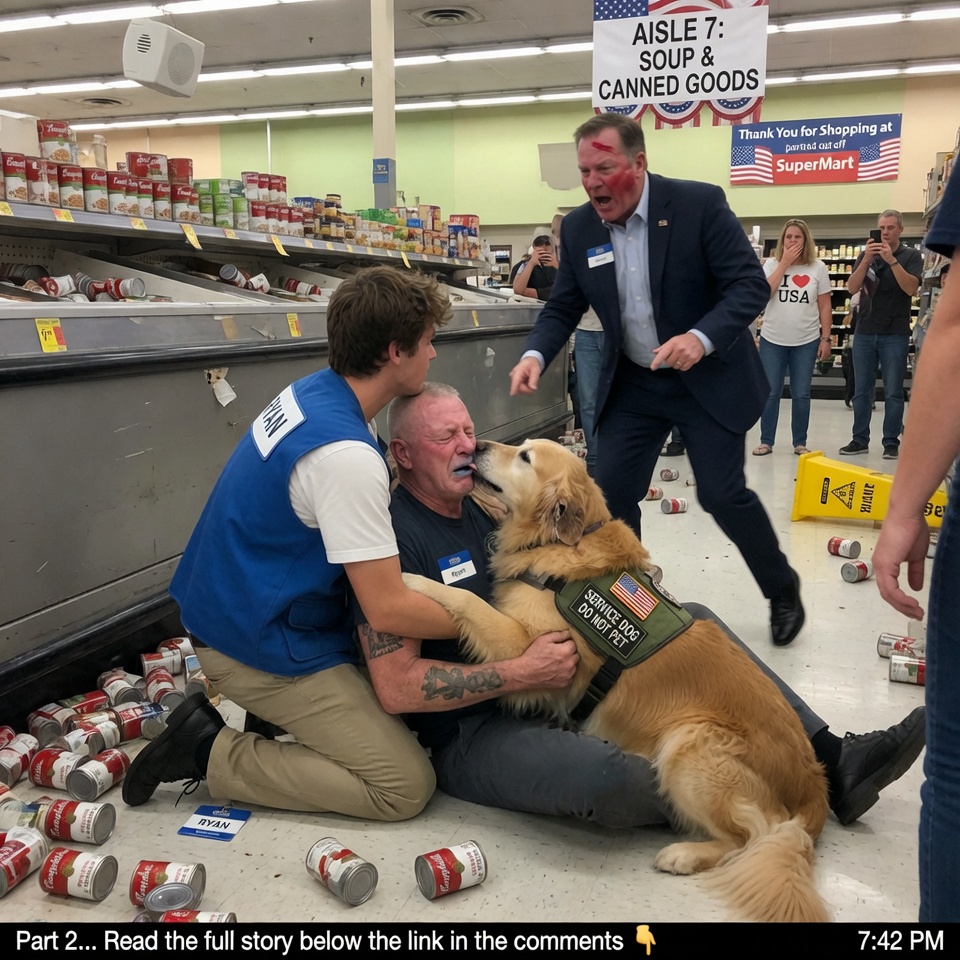
It was breathing. But not normal breathing. It was the kind of air a man takes when he’s drowning on dry land. I saw the cans first—hundreds of them, rolling like shrapnel across the scuffed linoleum. And in the middle of that red-and-white metal sea was Mr. Briggs.
Samuel Briggs. I knew him from the neighborhood. He walked with a limp and never made eye contact, but he always nodded once, sharp and respectful, like he was saluting a ghost only he could see. Now he was on the floor, knees pulled to his chest, eyes squeezed shut so tight the veins in his temples pulsed blue. His lips were turning a color I didn’t like.
Standing over him was a dog.
Max. Golden retriever. Old. Missing a chunk of his left ear and wearing a faded vest that read “SERVICE DOG — DO NOT PET.” He wasn’t barking. He wasn’t growling. He was just there, a wall of warm fur and steady weight pressed across the old man’s chest. He licked the salt from Mr. Briggs’ cheek, once, twice, methodical.
—Mr. Briggs. Hey. You’re in the supermarket. You’re safe. Max is right here.
I knelt down. I didn’t touch him. I just got low, making myself small, trying to be a barrier between him and the curious stares I could feel gathering at the end of the aisle.
And then the footsteps came. Dress shoes. The kind that click with the authority of someone who has never stocked a shelf in his life.
—What in the name of God is going on here? This is a health code violation! Get up! Get that animal off the floor!
Donovan. Regional Manager. He smelled like expensive cologne and cheap cruelty. He didn’t see a veteran having a flashback. He didn’t see a dog performing a medical task. He saw a mess. He saw a liability report. He saw a reason to yell.
—Sir, he’s having a panic attack. This is a service dog. You can’t separate them.
—I don’t care if it’s the President’s dog. It’s on my floor. It’s a hazard.
I stood up. My heart was banging against my ribs like a trapped bird.
—You need to back up. Now.
Donovan’s face went blotchy red. He wasn’t used to being told “no” by someone making twelve dollars an hour. He stepped forward, past me, and I saw his leg tense. He was going to do it. He was really going to kick this old dog to get him to move.
I don’t remember jumping.
I remember the impact. The dull thwack of a leather shoe connecting with the muscle of my shoulder blade. I remember the air leaving my lungs in a sharp grunt. I remember the cold of the linoleum on my knees as I wrapped my arms around that dog and that man, making myself as wide as possible.
Max turned his head. He didn’t flinch. He just looked at me with those cloudy, wise eyes and exhaled slowly, a warm puff of air against my neck.
—You’re done. You hear me? Fired! You just assaulted a member of management!
Donovan was screaming. Spit was flying. But it sounded far away, like hearing a storm from inside a basement.
I reached up, wincing at the fire in my shoulder. I unclipped the plastic badge that said RYAN. I held it out.
—You dropped this.
It hit the floor with a soft clatter.
—I’d rather eat out of a dumpster than stand here and watch you kick a hero’s dog.
I helped Mr. Briggs up. Max stayed glued to his leg, a furry anchor in a spinning world. We walked toward the sliding glass doors, past the silent cashiers, past the frozen stares of people holding their phones sideways.
I had no job. I had no paycheck. My back felt like someone had driven a nail into it. And I had absolutely no idea that three teenagers with iPhones had just filmed every single second.
PART 2 — THE WALK HOME
The automatic doors slid open with a soft hydraulic hiss, and the cold October air hit my face like a slap of reality. I had no job. No paycheck coming Friday. Forty-seven dollars and some change in my checking account. A bruise blooming across my shoulder blade that made every breath feel like I was inhaling broken glass.
But I had Mr. Briggs on my left and Max pressed against his right leg, and for the moment, that was enough.
The parking lot was nearly empty. Fluorescent lights buzzed overhead, casting long, distorted shadows across the cracked asphalt. A shopping cart sat abandoned near the cart return, one wheel spinning lazily in the wind. The air smelled like rain coming, that metallic tang that settles in the back of your throat before a storm.
Mr. Briggs hadn’t said a word since we left aisle seven. His breathing was still ragged, but it was slowing. Max walked with a deliberate, measured pace, his shoulder pressing into the veteran’s thigh with every step, a living reminder of where he was. Not in a jungle. Not in a desert. Here. Now. Pennsylvania. Safe.
—You don’t have to walk me home, son.
His voice was gravel wrapped in sandpaper. Quiet. Embarrassed. The voice of a man who had spent a lifetime being told to handle things himself and was now forced to accept help from a teenager who smelled like discount cereal and broke college student desperation.
—I know I don’t have to, Mr. Briggs. I want to.
He didn’t respond. But I saw his jaw tighten, the way men of his generation do when they’re trying not to show emotion. Max looked up at him, then back at me, and wagged his tail once. Just once. Like a nod of approval.
We walked in silence for two blocks.
The neighborhood changed fast. The supermarket sat on the edge of the commercial strip, but just beyond it, the streets turned residential. Small houses with peeling paint and sagging porches. Lawns that hadn’t been mowed in weeks. American flags hanging from front porches, some faded, some fresh. This was the part of town where people worked two jobs and still fell behind. Where a broken transmission meant choosing between fixing the car and buying groceries for the month.
I knew these streets. I’d grown up three blocks over, in a rented duplex with my mom before she got sick. Before the medical bills started piling up. Before I learned what it meant to be nineteen years old and already exhausted.
—You threw your job away.
Mr. Briggs said it like a statement, not a question. His eyes were fixed straight ahead, watching the sidewalk like it might crack open beneath his feet.
—It wasn’t much of a job.
—It was a paycheck. Those are hard to come by around here.
—I know.
—Then why’d you do it?
I stopped walking. Max stopped too, immediately alert, his ears swiveling toward me. Mr. Briggs turned slowly, his weathered face half-lit by a streetlamp. For the first time since the store, he looked me directly in the eyes.
—Because he was going to hurt Max, I said. And you were having a panic attack. And nobody else was doing anything. They were just… watching. Filming. Waiting for something bad to happen so they could post it online.
Mr. Briggs was quiet for a long moment. Then he reached down and scratched behind Max’s remaining ear. The dog leaned into the touch, eyes half-closing.
—Max saved my life more times than I can count, he said quietly. In the Sandbox. In my living room at three in the morning when the dreams get bad. In places I can’t talk about. And you—you just met him. You just met me. And you threw yourself between us and a man who could’ve hurt us both.
—It wasn’t a choice. It was just… what needed to be done.
He nodded slowly.
—That’s what they all say. The ones who really mean it.
We started walking again. The wind picked up, rustling dead leaves across the sidewalk. Somewhere in the distance, a dog barked. Max’s ears perked, but he didn’t react otherwise. He was on duty. He was always on duty.
Mr. Briggs’ house was small. A white clapboard structure with a sagging front step and a wheelchair ramp that looked newer than the rest of the building. A single light burned in the front window. The yard was neat, though. Military neat. The kind of neat that comes from needing to control something when everything else feels out of control.
—This is me.
He fumbled in his pocket for keys. His hands were shaking again, just slightly. The aftermath of the adrenaline crash. I wanted to help, but I knew better. Men like Mr. Briggs needed to do things themselves, even when it hurt.
The lock clicked. The door swung open. Inside, I could see a small living room with a worn recliner, a television that was probably twenty years old, and a wall covered in framed photographs. Some black and white. Some color. All of them showing young men in uniform, arms slung around each other’s shoulders, grinning at the camera like they had all the time in the world.
—You want to come in? Have some coffee?
I hesitated. My back was screaming. I needed to figure out what I was going to do about rent. About tuition. About the fact that I had just thrown away my only source of income.
But Mr. Briggs was looking at me with something I couldn’t quite identify. Not pity. Not gratitude exactly. Something else. Something older.
—Yeah. Coffee sounds good.
The inside of the house smelled like old books and dog fur and the faint, lingering ghost of pipe tobacco. It was warm, though. Warm in a way my apartment never was, even with the heat cranked up.
Mr. Briggs moved through the space with the practiced efficiency of someone who had memorized every inch. He didn’t need to look to know where the coffee canister was, where the mugs lived, where Max’s water bowl sat in the corner of the kitchen. Max himself padded over to a worn dog bed near the recliner and circled three times before settling down with a heavy sigh.
—Cream? Sugar?
—Black is fine.
He nodded approvingly and poured two mugs. The coffee was strong and bitter, the kind that leaves a film on your teeth. I wrapped my cold hands around the warm ceramic and took a sip. It burned going down, but it was real. Grounding.
We sat in silence for a while. The clock on the wall ticked. Max snored softly. Somewhere in the house, a furnace kicked on with a low rumble.
—I was in country for eighteen months, Mr. Briggs said finally. His voice was distant, like he was reading from a book written in a language he was still trying to forget. Saw things. Did things. Came home and couldn’t figure out how to be a person anymore.
I didn’t say anything. I just listened.
—My wife left. Can’t blame her. I wasn’t the man she married. I was something else. Something broken. Spent a lot of years drinking. Spent a lot of nights with a gun in my mouth, trying to work up the courage to pull the trigger.
Max lifted his head and whined softly. Mr. Briggs reached down and rubbed the dog’s ears.
—Then I got Max. Through a program. Wounded Warriors. They gave me a dog who’d seen combat too, who’d been retired after taking shrapnel in his shoulder. He knew. The moment we met, he knew. He climbed into my lap and put his head on my chest and just… breathed. Like he was showing me how.
He looked at me then, and his eyes were wet.
—That dog taught me how to breathe again. And tonight, when those cans fell, I was back there. I was back in the sand, hearing mortars, hearing screams. I couldn’t find my way out. But Max found me. He always finds me.
—And that manager was going to hurt him.
—He was going to try. Max would’ve let him. He’s trained not to react. He would’ve taken that kick and stayed right where he was, protecting me. Because that’s what he does. That’s who he is.
Mr. Briggs set down his coffee mug and leaned forward. His hands were steady now.
—And you—you saw that. You saw a man who was going to hurt a dog who couldn’t fight back, and you threw yourself in front of him. You didn’t know me. You didn’t know Max. You just knew what was right.
I swallowed hard. My throat felt tight.
—My mom used to say that courage isn’t about not being scared. It’s about being scared and doing the thing anyway.
—Your mom sounds like a smart woman.
—She was.
The past tense hung in the air between us. Mr. Briggs nodded slowly. He understood. He understood loss in a way most people my age couldn’t comprehend.
—She’d be proud of you tonight.
I looked down at my coffee. The surface was still, dark, reflecting the dim kitchen light.
—I hope so.
We talked for another hour. About nothing. About everything. About his time in the service and my time at community college. About Max’s favorite treats and the way the sunrise looked over the mountains in the fall. About the price of groceries and the weight of student loans and the quiet desperation of being young and broke in a world that didn’t seem to have room for either.
When I finally stood to leave, my back protested sharply. I winced, and Mr. Briggs noticed.
—Let me see.
—It’s fine.
—That’s not what I asked.
I hesitated, then lifted my shirt. Mr. Briggs sucked in a breath through his teeth. Even in the dim light, I could see the reflection of the bruise in his eyes. It was already turning purple and black, spreading across my shoulder blade like spilled ink.
—You need ice. And ibuprofen. And probably a doctor.
—Can’t afford a doctor.
He was quiet for a moment. Then he disappeared into the bathroom and came back with a bottle of pills and a frozen bag of peas wrapped in a dish towel.
—Sit.
I sat. He pressed the cold pack against my shoulder, and I hissed at the contact. Max got up from his bed and walked over, resting his head on my knee. His brown eyes looked up at me with something that felt like understanding.
—You’re a good kid, Ryan Holloway.
—I’m not a kid.
—You’re nineteen. That makes you a kid. But it also makes you a man. The two things aren’t mutually exclusive.
He stepped back and looked at me for a long moment.
—What are you going to do now?
—I don’t know. Find another job. Figure out how to pay rent. Try not to flunk out of school.
—That’s a lot for anyone to carry.
—It’s just life.
He nodded slowly.
—It is. But sometimes life has a way of surprising you. Sometimes, when you least expect it, the thing you did because it was right—it comes back to you. Not always in ways you expect. Not always in ways you want. But it comes back.
I didn’t know what to say to that. So I just sat there, with a bag of frozen peas on my shoulder and a retired military dog’s head on my knee, and I let myself breathe.
PART 3 — THE VIDEO
I didn’t check my phone until I got home.
My apartment was a studio, barely three hundred square feet, with a kitchenette that hadn’t been updated since the Reagan administration and a window that looked out onto a brick wall. The rent was four hundred a month, utilities not included, and it was the cheapest place I could find within biking distance of campus.
I locked the door behind me, dropped my keys on the counter, and pulled out my phone.
It was frozen.
The screen was completely unresponsive, overloaded with notifications. I stared at it for a long moment, my exhausted brain struggling to process what I was seeing. Finally, I did a hard reset. When the screen flickered back to life, the notifications started pouring in again. Hundreds of them. Thousands.
Text messages from numbers I didn’t recognize. Friend requests from strangers. Mentions on platforms I barely used. My email inbox had exploded from forty-three unread messages to over two thousand.
—What the…
I opened Instagram first. It was the platform I used least, mostly just to follow a few photography accounts and keep in touch with some high school friends I never actually talked to anymore. My last post had been six months ago, a blurry photo of a sunset with no caption.
Now I had over fifty thousand followers.
The number was so absurd that I laughed out loud. It had to be a glitch. A hack. Something. I refreshed the app three times, and each time the number climbed higher.
Then I opened TikTok.
The first video on my For You page was me.
I was kneeling on the floor of aisle seven, my arms wrapped around Max and Mr. Briggs, my face turned up toward Donovan with an expression I didn’t recognize. Defiance. Fear. Something else. The caption read: “TEEN CASHIER SACRIFICES JOB TO PROTECT VETERAN AND SERVICE DOG FROM ABUSIVE MANAGER ”
It had fourteen million views.

Daniel Carter is a senior staff writer at InspireChronicle, specializing in legal conflicts, family disputes, and real-life justice stories. His work focuses on high-stakes situations involving inheritance, betrayal, and complex moral decisions. Through detailed storytelling, he explores how ordinary people navigate extraordinary challenges and the long-term consequences that follow.
His articles have gained significant traction online for their emotional depth and realism, resonating with readers across the United States.
He writes extensively about justice, personal responsibility, and the hidden dynamics within families.