
The morning sun had yet to breach the horizon over Lubbock, Texas, but twelve-year-old Sophie Lane was already awake. The air inside the worn-down trailer park was thick with the lingering chill of the high plains, and the rusted tin roof above her head let out a metallic groan in the early breeze. It was five o’clock. While the other girls at Winslow Elementary were lost in dreams, comfortably nestled in warm beds, or perhaps later agonizing over which perfectly coordinated outfit to wear, Sophie was tying the laces of her scuffed sneakers. She had shifts to pull. Every morning, she stood shoulder-to-shoulder with her mother, Joanne, scrubbing the counters and sweeping the flour-dusted floors of a small, local bakery.
Joanne was a woman built of wire and grace, slender, perpetually exhausted, yet anchored by a quiet, immovable strength. As she wiped down the display cases, her hands red from industrial soap, she would often catch Sophie’s eye and offer a gentle, weary smile. “You don’t have to be rich to live kindly, sweetheart,” she would say, her voice a soothing balm against the harsh reality of their daily lives.
At school, that kindness was rarely returned. Sophie’s uniform, meticulously mended at the seams by her mother’s tired hands, and her badly worn shoes marked her as an easy target for the cruelty of children. She was a silent fixture in the back row of her classroom, absorbing the arithmetic and the thinly veiled taunts with equal stoicism. Yet, beneath her quiet exterior, her dark brown eyes held the profound depth of an old soul. They were eyes that harbored secret melodies, songs she only dared to hum in the safety of her own mind.
The rhythm of her invisible life shifted one mundane Monday morning. The PA system above the chalkboard crackled to life, the principal’s voice cutting through the morning chatter. “Welcome to Talent Week. If anyone would like to sign up to perform, please add your name to the list outside the office by Wednesday.”
Instantly, the classroom erupted into a hive of eager voices. Desks scraped against the linoleum as children boasted about their elaborate plans. A group of girls whispered excitedly about choreographing viral TikTok dances, while the boys argued over who would play the piano or bring their drum kits.
Sophie remained entirely still, her gaze fixed on the grain of her desk. But that evening, the air in their small trailer felt different. After the dinner dishes were washed and stacked, Sophie sat on her bed, listening to the soft hiss and warble of an old cassette tape. It was a recording of Joanne from years ago, her voice weaving through a gentle lullaby. Sophie reached for a pencil, the wood worn smooth beneath her thumb, and pulled a small slip of paper from her bedside table.
“I’ll sing that song,” she whispered into the dim room. “Mom, the one you used to sing when I was sick. Scarborough Fair.”
The following afternoon, the hallway outside the school office was deserted. Sophie stood before the bulletin board, her small hands trembling as she stared at the sign-up sheet. The list of names was already intimidatingly long, filled with confident signatures promising magic tricks and modern dance routines. She drew a slow, shuddering breath, uncapped her pen, and pressed it to the very last line. Sophie Lane, singing.
She hadn’t even made it ten minutes down the corridor before the giggles began to bounce off the metal lockers.
“Sophie signed up to sing? It has to be a comedy act.”
“Maybe she’ll sing through a rice cooker.”
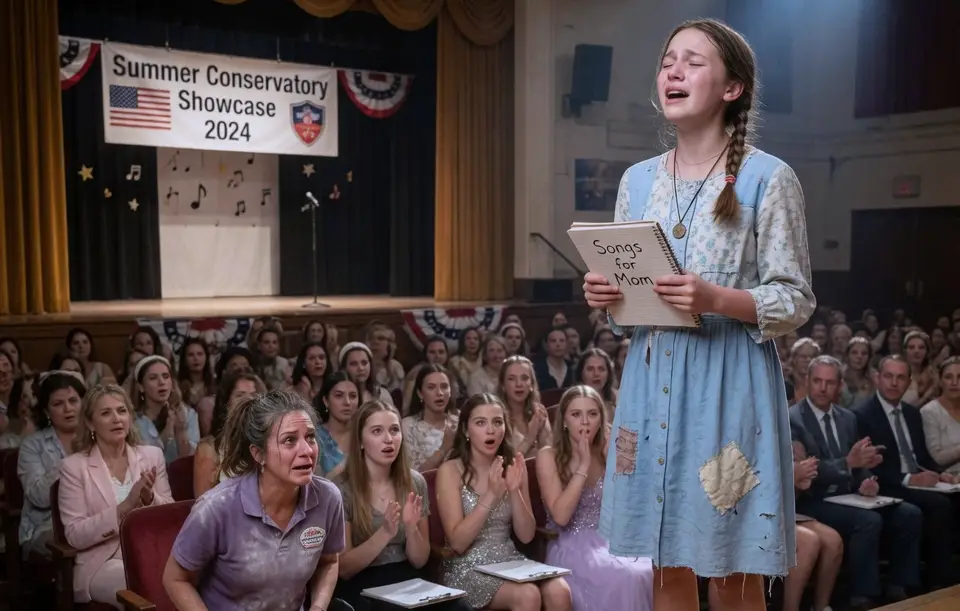
The cruel words stung, but Sophie didn’t allow the tears to fall. She simply lowered her chin, clutching the little spiral notebook where she had meticulously copied the lyrics in her tilted, careful handwriting, and walked away.
That night, the trailer was filled with the sound of a fragile, trembling melody. Joanne pushed open the bedroom door with a gentle creak to find her daughter standing in the center of the room. Sophie’s voice was shaky, yet it possessed a clarity that reminded Joanne of a crisp spring wind.
Saying nothing, Joanne crossed the faded carpet and sat softly on the edge of the mattress. She listened until the final note faded, then reached out to tuck a stray lock of hair behind Sophie’s ear.
“You know,” Joanne murmured, her eyes distant with memory. “I once dreamed of standing on a stage, too. But then your grandma got sick, and I had to leave school to take care of her.” She paused, her thumb gently tracing her daughter’s cheek. “I never regretted it. Not for a second. But if I could see you walk onto that stage today, that would be the most beautiful gift I’ve ever received.”
Sophie looked up, her brown eyes finally brimming with the tears she had held back all day. “Will you come?”
Joanne nodded, her expression fierce with maternal resolve. “Even if I have to walk there.”
The day of the dress rehearsal arrived with a suffocating wave of nerves. Sophie was the very last contestant called to the stage. The music teacher, a woman with a perpetually exhausted expression, looked up from her clipboard.
“Do you have a backing track, dear?”
“No, ma’am,” Sophie replied, her voice small but steady. “I… I’ll sing a cappella.”
A collective sigh rippled through the few students lingering in the auditorium, accompanied by a smattering of dramatic eye rolls. But Sophie ignored them. She planted her worn shoes firmly on the scuffed wooden floor, stood as tall as her twelve-year-old frame would allow, closed her eyes, and began.
“Are you going to Scarborough Fair?”
There was no microphone to amplify her. No sweeping orchestral track to hide behind. No spotlight to cast her in a glamorous glow. It was just the bare, unadorned truth of her voice.
Within seconds, the restless energy of the room evaporated. The music teacher stopped writing, her pen hovering uselessly over the paper. In the aisle, another teacher, who had been in the middle of pouring a steaming cup of coffee from a thermos, simply froze, the liquid suspended in her awareness. Sophie’s voice moved through the cavernous space like a fine, cool mist, seeping effortlessly through the cracks of even the most cynical, closed-off hearts.
When the last haunting note drifted into silence, absolutely no one clapped. It wasn’t born of malice or dislike; it was a profound paralysis. They had simply forgotten the social protocol for witnessing something so unbearably raw and fragile unfold before them.
Walking home along the cracked sidewalks, the Texas sun beating down on their shoulders, Sophie looked up at her mother. “Mom, if people laugh tomorrow, should I stop?”
Joanne smiled, her fingers warmly enveloping her daughter’s small hand, giving it a reassuring squeeze. “No, sweetheart. You keep singing. Because the world desperately needs to hear the voices that have never been heard.”
The morning of the performance, Winslow Elementary was a chaotic carnival of color and sound. The courtyard was packed to the brim with eager parents and chattering students. Festive flags and twisting crepe paper draped both main hallways, and the temporary stage erected in the auditorium was framed by an arch of vibrant, helium-filled balloons. Above it all, an LED board flashed a neon greeting: WINSLOW ELEMENTARY. Let your light shine.
Sophie arrived early, stepping carefully to avoid the scuffs of the crowded hallway. She was dressed in a simple, modest white cotton dress, the only garment in her closet that wasn’t visibly fraying. Joanne had stayed up late into the night, carefully pressing a hot iron over every single crease until the fabric was flawlessly smooth. Sophie’s brown hair was parted perfectly down the middle, woven into two neat, tight braids. Her face was taut with anxiety, but her eyes held a fierce, unyielding determination. Clutched tightly against her chest was the faded notebook filled with lyrics.
Joanne stood right beside her, an anchor in the storm. She had just finished a grueling night shift at the bakery, and the pale, bruised hollows under her eyes spoke of severe exhaustion. Yet, as she looked at her daughter, her gaze radiated absolute, undeniable pride.
The talent show commenced. A group of girls in matching sequined tops executed a flawless modern dance routine under flashing strobe lights. A fifth-grade boy hammered out a thunderous rhythm on a set of electronic drums hooked to a small speaker. Another girl, swathed in a glittering pink dress, belted out a top-forty pop song, strutting across the stage with a wireless microphone. Every single act was met with raucous, deafening cheers from devoted friends in the bleachers.
Sophie sat isolated in the cold metal chairs of the waiting area. Nobody offered her a word of encouragement. She caught the sideways glances, the muffled snickering behind cupped hands.
“Just wait,” one boy whispered loudly to his friend. “The fairytale act is coming up. Heard there’s no music. Gonna sing… what’s it called? A cappella?”
Finally, the young teacher acting as the Master of Ceremonies approached the microphone. He looked down at his card, a fleeting hint of hesitation crossing his features. “And finally, we have a solo performance. Without any background music, she will be singing Scarborough Fair. Please welcome Sophie Lane.”
A few scattered, pitying claps echoed in the massive room. In the front row, a cluster of older students pulled out their smartphones, grinning as they prepared to record a humiliating video for fun. One kid was already pulling up a mocking sticker to plaster over the footage for the school’s internal social network.
Sophie walked up the wooden stairs and out onto the center of the stage. The heat of the theatrical lights was blinding, rendering the sea of faces below into a dark, shifting blur. She couldn’t see the cruel smiles or the glowing camera lenses. But she knew exactly where her mother was. Joanne was sitting in the third row, right by the tall window. Knowing that was entirely enough to make her stand tall.
Sophie took a deep, grounding breath, allowing the air to fill her small chest, and opened her mouth.
“Are you going to Scarborough Fair? Parsley, sage, rosemary, and thyme…”
Her tone rose into the rafters, gentle and sweeping, like a sudden gust of wind across a sprawling meadow. It was completely unpretentious, incredibly soft, and heartbreakingly sincere.
In the first few moments, there were impatient sighs and hushed whispers from the back rows. But slowly, inevitably, the vast auditorium was blanketed in an absolute, breathless silence. It was a strange, heavy hush. This wasn’t the silence of a bored audience waiting for the next act; it was the magnetic, gravitational pull of total captivation.
The music teacher, who had been furiously jotting down notes on a grading rubric, abruptly set her pen down. Beside her, an elderly parent with thinning white hair and gold-rimmed glasses slowly reached up, pulled his spectacles from his face, and pressed a knuckle to his watering eyes.
Every single syllable that passed Sophie’s lips seemed to carry the weight of her reality, the quiet grief of poverty, the hunger-filled nights, and the profound, unspoken dreams of a mother and daughter. There was no aggressive vocal technique, no flashy choreography to distract the eye. It was simply a child, offering her soul to a room full of strangers.
When the final, haunting note dissolved into the air, the room remained entirely frozen.
Three seconds passed. Then four.
And then, a sound began to build. It wasn’t the rowdy, screaming applause of a pop concert. It was a rhythmic, surging ovation born of profound reverence.
The elderly man with the gold-rimmed glasses was the first to stand. A moment later, a mother a few seats down joined him. Then, like a wave sweeping over the auditorium, the entire crowd rose to their feet. They applauded fiercely, as if trying to thank the universe for the fleeting moment of purity that had just passed through them.
Sophie remained rooted to her spot, her small hands gripping the white cotton hem of her dress. Her dark eyes shimmered violently under the stage lights, but she refused to let the tears fall. In the span of three minutes, she had ceased to be the impoverished, bullied girl in the back row. She was a young artist, standing squarely inside her own dream.
Down in the third row, Joanne slowly pushed herself up from her folding chair. She placed one calloused hand firmly over her heart, her eyes red and overflowing, but her lips curved into a magnificent, triumphant smile.
As soon as the curtain closed and Sophie descended the wooden steps backstage, the adrenaline began to fade. Before she could find her mother, a woman wearing a crisp white blouse and a silver name badge approached her.
“You must be Sophie, right?” the woman asked, her voice carrying a warm, cultured cadence. “I’m Clara Jensen. I’m the conductor of the City Children’s Choir. I was actually here today because my daughter performed earlier, but it was you who made me want to come speak.” Clara knelt slightly to meet Sophie’s gaze. “Would you like to visit my studio for a voice audition? There’s a special scholarship program.”
Sophie blinked, entirely overwhelmed. She didn’t know how to respond. She turned over her shoulder just as Joanne hurried through the backstage doors.
Joanne looked from Clara to her daughter, her exhausted eyes suddenly blazing with fresh, glistening hope. She gave a single, firm nod.
“Go, sweetheart,” Joanne whispered, her voice cracking with emotion. “This is the voice the world has been waiting to hear.”
That Saturday morning, the Greyhound bus hissed to a halt at the station in downtown Amarillo. Sophie Lane stepped off the heavy metal stairs, her fingers gripping the strap of her canvas backpack. The city was a sprawling maze of concrete and exhaust, a stark contrast to the quiet, dusty expanse of their trailer park. Clara Jensen, true to her word, was waiting by the curb. In her tailored slacks and understated silk blouse, Clara looked every bit the polished woman of the arts, yet her smile was as warm and grounding as a Texas sunrise.
“Just think of today’s session as a little adventure,” Clara said smoothly as she guided Sophie and Joanne toward a sleek, silver sedan. “There is absolutely no need to worry. I just want to hear you sing the exact same way you did that day.”
The professional recording studio was a hidden sanctuary tucked away in a nondescript brick building. Stepping inside felt like entering a vacuum; the chaotic, buzzing traffic noise of Amarillo vanished, replaced by an intensely heavy, isolated silence. Every wall was meticulously lined with dark, geometric acoustic foam panels, and soft, recessed ceiling lights cast a muted, magical glow over the complex mixing boards.
Sophie felt terrifyingly small. She was dressed in an older white blouse and a pair of neatly pressed but faded denim jeans. She wore no makeup, no hair products—just herself, holding her spiral notebook of lyrics as though it were a shield.
Behind a massive wall of thick glass sat Leo, the studio engineer. He was a man in his late forties with a dusting of salt-and-pepper stubble across his jawline and the stoic, tired demeanor of someone who had spent decades filtering out manufactured pop voices. When he saw the scrawny twelve-year-old step into the vocal booth, his brow furrowed in evident skepticism.
He leaned forward, pressing a button on the mixing console. “This is the kid?” his voice crackled flatly through the intercom.
Clara, standing near the heavy soundproof door, didn’t flinch. “Yes. Trust me, Leo. Just let her sing.”
Sophie approached the microphone. It hovered inches above her head, designed for an adult. With a heavy sigh, Leo pushed himself out of his rolling chair, trudged into the booth, and adjusted the metal stand, locking it down to match her height.
Clara stepped into the booth beside her, resting a manicured hand lightly on Sophie’s tense shoulder. “You can sing Scarborough Fair again, sweetheart. Or absolutely any song you’d like.”
Sophie glanced through the glass at her mother, who was sitting on a leather sofa in the control room, offering a small, encouraging nod. Sophie turned her dark eyes back to Clara. “I’ll sing that one. My mother’s song.”
There was no sweeping orchestral track, no click-track in her headphones to guide her rhythm. There was only the dense silence of the soundproof room.
“Are you going to Scarborough Fair?”
In the control room, Leo abruptly stopped fidgeting with his equalizer dials. Clara folded her arms, leaning back against the wall, her gaze softening into profound admiration. Sophie had closed her eyes, and with every note, the lyrics flowed out like a warm, melancholic breeze, weaving its way through a sterile room accustomed only to auto-tuned perfection.
When the final echo faded, the control room remained dead silent for a long, heavy moment. Finally, Leo leaned toward his talkback mic, his earlier skepticism entirely erased.
“You haven’t had a single day of formal vocal training, have you?”
“No, sir,” Sophie replied quietly.
“Yet you somehow know exactly how to stay on tempo, how to manage your breath control, and how to convey grief without forcing it down the listener’s throat,” Leo muttered, almost to himself. “Kid, your voice isn’t the loudest I’ve ever recorded. It’s not technically perfect. But God, it’s real.”
Clara stepped back up to Sophie, gently taking the girl’s small hand. “Do you know that Scarborough Fair is a traditional folk song that has been around for hundreds of years?”
“My mom sings it often,” Sophie answered, glancing at the window. “She says it’s a lullaby for dreamers.”
Clara smiled, a look of profound understanding crossing her face. “Maybe that’s exactly why your voice reaches people the way it does.”
By that afternoon, Clara had securely transmitted the raw audio file to the admissions board of the prestigious Emerson School of Music in Austin, where she served as an advisory board member. The recording was a submission for a highly selective, fully funded summer scholarship program designed to pull raw talent from rural, underserved areas. Only two students from across the state were selected each year.
“You don’t have to beat anyone,” Clara had told Sophie as they parted ways at the bus station. “You just have to be yourself.”
Three agonizing weeks later, a thick, pale blue envelope bearing the ornate crest of the Emerson School of Music appeared in the dented metal mailbox of the trailer park. Joanne retrieved it, her hands trembling so violently she could barely tear open the paper flap.
Standing in their cramped kitchen, Joanne read the words aloud, her voice breaking. “Dear Sophie Lane, We are deeply impressed by your recording. With unanimous approval from the selection committee, we are honored to invite you to join Emerson’s distinguished summer scholarship program this June in Austin. All tuition, travel, and lodging expenses will be fully covered.”
Joanne covered her mouth, the tears she had held back for years finally spilling over her cheeks. Sophie simply stared at the embossed letterhead for a long, breathless moment before whispering, “Mom, I got in.”
June arrived in Austin with a blazing, unforgiving heat. The sun stretched like a canopy of woven gold over the rolling hills, casting deep shadows beneath ancient, sprawling oak trees. The Emerson Conservatory stood imposingly at the top of a manicured hill, its historic red brick façade accented by magnificent, hand-painted frosted glass windows. For the majority of the enrolled teenagers, this was just another affluent summer camp to pad their college applications. But for Sophie Lane, pulling her battered, squeaking suitcase up the paved walkway, it felt like landing on another planet.
She walked slowly through the dormitory courtyard, acutely aware of her surroundings. The other girls sauntered by in floral sundresses, pristine designer sandals, and monogrammed leather backpacks. They casually dropped city names like New York, Los Angeles, and San Francisco. As they unpacked, Sophie overheard them boasting about having private vocal coaches since the age of seven, or performing in elite international children’s choirs. Sophie, who had never even seen a sheet of classical music theory, quietly tucked her worn, handwritten notebook into the bottom drawer of her dorm dresser.
The opening orientation was held under the soaring, frescoed ceiling of the main domed hall. Clara Jensen stood at the polished oak podium, her voice echoing softly but with immense authority.
“Here, we do not seek sterile perfection,” Clara addressed the crowd of teenagers. “We seek souls that know how to tell stories through music. Always remember, sometimes the simplest, quietest voice is the one people will listen to the longest.”

Daniel Carter is a senior staff writer at InspireChronicle, specializing in legal conflicts, family disputes, and real-life justice stories. His work focuses on high-stakes situations involving inheritance, betrayal, and complex moral decisions. Through detailed storytelling, he explores how ordinary people navigate extraordinary challenges and the long-term consequences that follow.
His articles have gained significant traction online for their emotional depth and realism, resonating with readers across the United States.
He writes extensively about justice, personal responsibility, and the hidden dynamics within families.