
Price per pack of cigarettes in France: tax, margin and increase
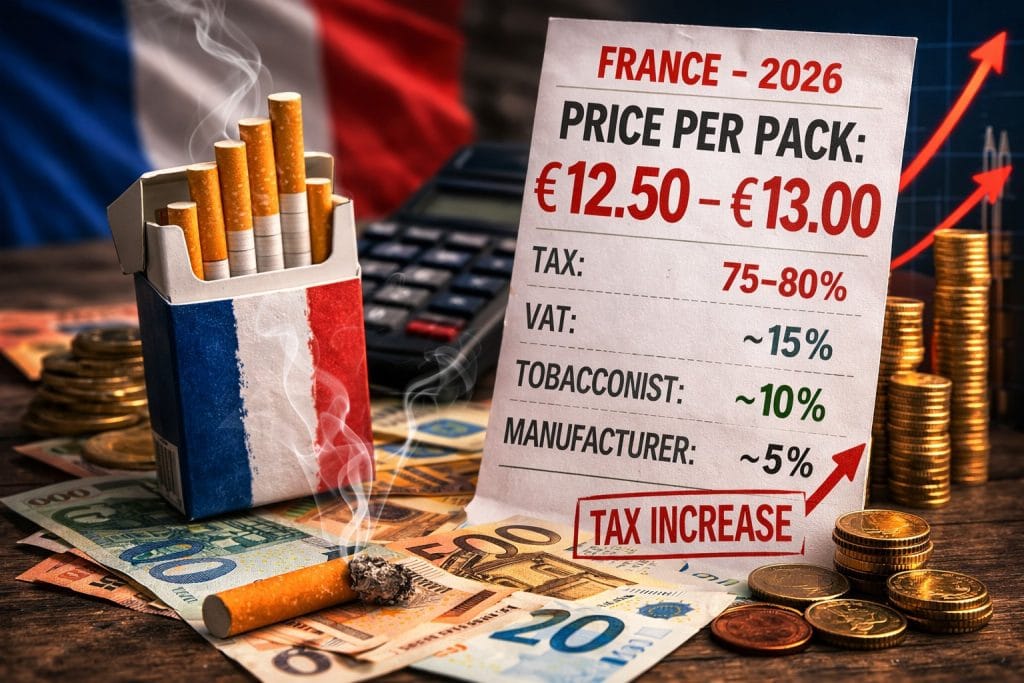
France did not arrive at €12.50 or €13 a pack by accident. The price of cigarettes is the result of a deliberate system in which manufacturers propose retail prices, but the state heavily shapes the final outcome through excise duty, VAT, minimum tax thresholds and rules for tobacconists. In 2026, the French customs administration shows that a typical 20-cigarette pack sits squarely in the €11.50 to €13.50 range, with many mainstream references around €12.50 and premium products around €13.50. Rolling tobacco has followed the same path: officially approved price lists effective 1 March 2026 include several 30 g pouches at €18.00.
For smokers, this is no longer just a health-policy story. It is a household-budget story. A carton now easily moves past €250 and often much more depending on the brand, format and point in the range. For people who smoke daily, tobacco has become a recurring fixed expense on the scale of fuel, groceries or utility bills. That is precisely the point of the French approach: make smoking progressively less affordable, normalize fewer places to smoke, and increase the financial pain attached to continuing the habit.
How the French state builds the price of a cigarette pack
The official customs breakdown is blunt. In metropolitan France, the retail price of tobacco is built from four main components: excise duty on tobacco, VAT included within the retail price, the tobacconist’s gross remuneration, and the manufacturer’s margin. Customs updated this framework on 5 January 2026 and published the 2026 excise parameters now in force. For cigarettes, the excise includes a proportional rate of 55%, a fixed amount of €73.30 per 1,000 cigarettes, and a minimum perception of €381.90 per 1,000 cigarettes. For rolling tobacco, the 2026 excise rate is 49.1%, with a fixed amount of €105 per 1,000 grams and a minimum perception of €358.60 per 1,000 grams.
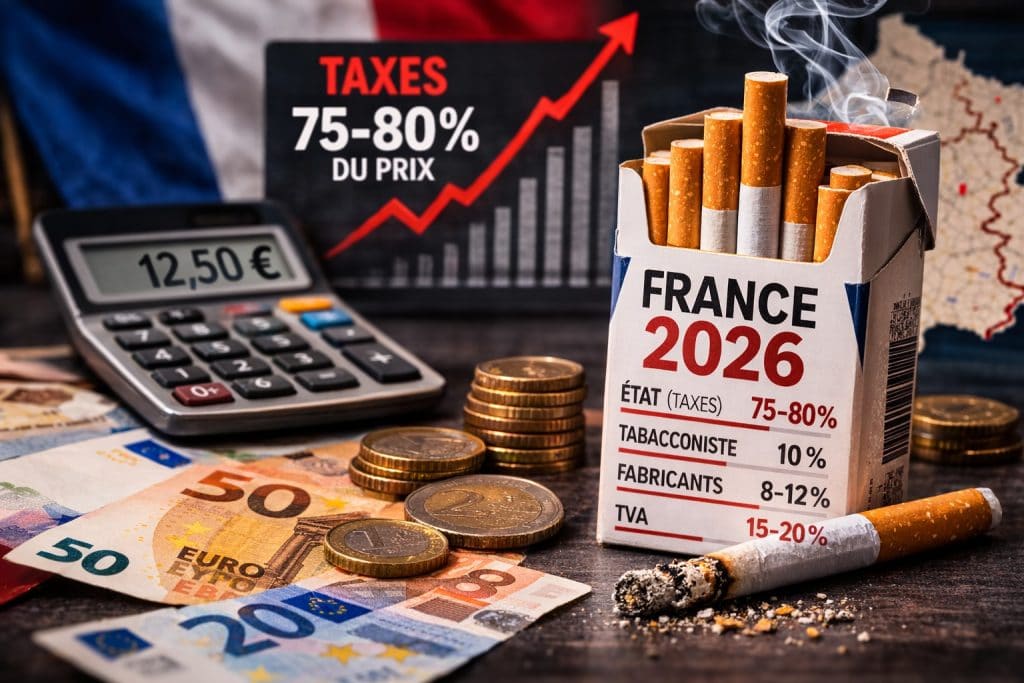
The customs example is especially useful because it shows what happens inside a real retail price. For a 20-cigarette pack priced at €11.50, the official breakdown gives €7.638 in excise, €1.92 in VAT, €1.183 for the tobacconist’s gross remuneration, and only €0.61 for the manufacturer’s margin. For a premium 20-pack priced at €13.50, the breakdown is €7.425 from the percentage-based excise, €1.466 from the fixed excise amount, €2.25 in VAT, €1.389 for the tobacconist, and €0.97 for the manufacturer.
That means the state’s fiscal take is not 50% or 60%. It is closer to roughly 82% to 83% of the retail price in the examples published by customs once excise and VAT are combined. The tobacconist also receives a defined slice, while the manufacturer keeps a relatively small residual margin. In practical terms, the official French system leaves little room for the old myth that cigarette brands are expensive mainly because of industrial greed. The dominant factor in France is taxation policy.
Why packs are now around €12.50 to €13 in 2026
The short answer is fiscal escalation. Customs confirmed that tobacco taxation increased again from 1 January 2026, which is why tobacconists had to file a mandatory stock declaration when the new excise rates came into force. The administration also makes clear that all fiscal categories of manufactured tobacco were affected. That matters because price increases do not happen only through a visible “tax hike” headline. They also happen through annual parameter adjustments, minimum tax floors and approved retail price schedules published in the Journal officiel.
France also made a structural change earlier by linking tobacco taxation to inflation from 2023 onward. The result is that price rises have become less episodic and more automatic. Even when a government avoids a dramatic one-off tobacco shock, the underlying tax mechanism keeps nudging retail prices upward. That is why 2026 feels less like a surprise spike and more like the continuation of a long, controlled squeeze.
The approved product lists effective 1 January 2026 and 1 March 2026 show this clearly. Standard 20-packs for major brands commonly sit at €12.40, €12.50, €12.60 or €13.00, while many premium references sit at €13.50. Rolling tobacco has also moved far from its old reputation as the budget alternative. In the March 2026 approved-price file, 30 g pouches such as Lucky Strike Red S and Pall Mall are listed at €18.00. Budget smokers have not escaped the price strategy; they have simply been pushed into a different expensive segment.
What tobacconists and manufacturers really make
This is where the debate often gets distorted. The official customs breakdown shows the tobacconist’s gross remuneration at 10.29% of the retail price in the published examples. That is not trivial, but it is also not the main engine of rising prices. Nor are manufacturers capturing huge amounts per pack in France relative to the final shelf price. In the customs examples, the manufacturer margin is €0.61 on an €11.50 pack and €0.97 on a €13.50 pack.
So when a smoker sees a €13 pack, the instinct is often to think that everyone along the chain is cashing in. The official data says otherwise. In France, tobacco is above all a tax product. The state takes the overwhelming share. Tobacconists receive a regulated gross remuneration. Manufacturers keep the smallest visible slice of the four main components published by customs. The model is designed this way because the policy objective is not only to raise revenue, but also to discourage consumption through price pressure.
The public-health argument behind higher tobacco prices
French authorities do not hide the reason for this strategy. Service-Public states that tobacco kills 75,000 people every year in France, or more than 200 deaths per day. That figure is consistent with long-standing French public-health estimates and remains central to anti-smoking policy. The argument is straightforward: if smoking remains the leading preventable killer, then making cigarettes less affordable is a legitimate intervention, not an unfortunate side effect.
This is also why the anti-tobacco agenda is no longer limited to price alone. From 1 July 2025, France extended smoking bans to new outdoor public areas during opening periods, including public parks and gardens, beaches bordering bathing waters, bus shelters and covered waiting areas, areas around schools and places used by minors, and the open spaces around libraries, swimming pools and sports facilities. The policy direction is clear: higher prices on one side, fewer socially accepted spaces to smoke on the other.
That broader strategy aims to denormalize tobacco use, especially around children. It also makes smoking more visibly inconvenient. A smoker now pays more to buy the product, faces more restrictions on where to use it, and is exposed to more public messaging that tobacco is neither neutral nor routine. France is not only taxing smoking; it is shrinking its space in everyday life.
Fines, bans and the cost of smoking beyond the pack
The financial pressure does not stop at the cash register. Throwing a cigarette butt into the street falls under the broader rules on littering and abandonment of waste. Service-Public states that the standard fine is €135 if paid quickly, €375 after the normal deadline, and can rise to €750 through judicial action, or even €1,500 with vehicle confiscation in certain cases linked to waste transport. A cigarette butt is tiny, but under the law it still counts as litter.
That matters because it changes the real cost of smoking in public. The purchase price is one layer. The ban on smoking in more public spaces is another. Then there is the enforcement risk attached to the cigarette once it is finished. In other words, the French model increasingly treats tobacco not as an ordinary consumer good, but as a tightly managed product whose use, sale and disposal all carry regulatory consequences.
Why smokers look across the border
This is where the French system runs into a hard reality. High prices do reduce consumption for some smokers, but they also create a strong incentive to buy elsewhere. The customs-backed TAFE 2025 study estimated that 17.7% of tobacco consumed in France in 2023 escaped French national taxation, equivalent to about 8,081 tonnes. Customs says the largest source by far was cross-border purchasing, estimated at 6,863 tonnes, while local trafficking and street sales were much smaller at around 366 tonnes.
That point matters more than the usual moralizing debate about “smuggling.” Not every pack outside the French tax net comes from criminal trafficking. According to customs, the biggest driver is simply legal or quasi-legal purchasing outside France’s taxed retail network, especially in border zones. The European Parliament’s 2025 overview also notes long-standing French concerns about lower VAT rates and cheaper tobacco in neighboring countries such as Luxembourg, which fuel cross-border buying by French consumers.
So the contradiction is obvious. France raises prices for public health. But the bigger the price gap with nearby markets, the stronger the incentive to bypass the French tobacconist. That weakens revenue, frustrates licensed retailers, and creates a parallel market that is partly cross-border shopping and partly illicit trade. In policy terms, this is the central tension of French tobacco strategy in 2026: the tax signal is strong, but the geographic escape route remains real.
Is the strategy working?
That depends on the metric. If the goal is to make smoking less cheap, the answer is yes. France has succeeded. A mainstream pack that once felt like a casual purchase is now expensive enough to force repeated budget decisions. Rolling tobacco no longer offers the same easy refuge. New smoke-free zones make public consumption less convenient. On pure pressure, the policy works exactly as designed.
If the goal is to eliminate the market distortions created by price gaps, the answer is no. Customs’ own figures show that a meaningful share of tobacco consumption still escapes French taxation, mostly through cross-border purchases. That means price increases do not operate in a sealed system. They interact with geography, addiction, inequality and enforcement limits. Higher prices can encourage quitting, but they can also encourage shopping elsewhere or shifting into informal channels.
And if the goal is to make smoking socially harder, then France is clearly moving in that direction. Since July 2025, smoking bans cover far more outdoor spaces linked to children and public life. The policy message is no longer subtle. Tobacco is being pushed out of both budgets and public space at the same time.
What comes next for cigarette prices in France
The most realistic expectation is not a sudden reversal, but continued upward pressure. The 2026 customs framework is already in force, the anti-smoking regulatory framework tightened in 2025, and the fiscal logic built into recent reforms points toward further increases rather than stabilization. That does not mean every brand will jump at the same speed or on the same date, but it does mean the structural trend remains upward.
For smokers, the message is blunt. In France, tobacco is no longer priced as an everyday indulgence. It is priced as a targeted public-health disincentive. Most of the money goes to the state through excise and VAT. Tobacconists receive a regulated gross share. Manufacturers take a relatively modest remainder. Packs around €12.50 to €13 are not an anomaly in 2026; they are the system working exactly as intended.
For policymakers, the harder question is whether taxation alone can keep doing the job without pushing ever more smokers into cross-border buying or the parallel market. Customs’ own data suggests that this pressure point is already significant. France may continue to turn the fiscal screw, but the closer it gets to the limits of affordability, the more the border becomes part of the story.

Daniel Carter is a senior staff writer at InspireChronicle, specializing in legal conflicts, family disputes, and real-life justice stories. His work focuses on high-stakes situations involving inheritance, betrayal, and complex moral decisions. Through detailed storytelling, he explores how ordinary people navigate extraordinary challenges and the long-term consequences that follow.
His articles have gained significant traction online for their emotional depth and realism, resonating with readers across the United States.
He writes extensively about justice, personal responsibility, and the hidden dynamics within families.