
It ripples outward.
And in the months after the ruling, Jacob began to understand that reclaiming land was only the first layer of what he had unearthed beneath that barn floor.
Because when property lines shift, histories shift with them.
And buried stories do not stay quiet once brought into daylight.
The Survey
The new boundary survey arrived on a cool March morning, delivered in a long cardboard tube stamped with the county seal.
Jacob spread the map across his kitchen table, smoothing the creases with both hands.
The redrawn Miller acreage stretched outward like a lung taking its first full breath in decades.
Fields that had once been sold. Pastures long assumed lost. Even a narrow strip of creek-bottom timber.
But what caught Jacob’s eye wasn’t the size.
It was the overlap.
The restored Miller boundary cut directly through a small triangle of land at the far edge of the Turner parcel — land that technically included the very barn he had purchased.
Which meant something unexpected.
The barn, legally speaking, had never belonged to the Turners at all.
It had always been Miller land.
Misfiled. Misrecorded. Misremembered.
Jacob sat back slowly.
For over eighty years, his family had believed they’d sold this structure along with the acreage.
But the paperwork said otherwise.
The barn had never changed hands.
It had simply been absorbed into someone else’s title during the reconstruction chaos after the courthouse fire.
Which meant Samuel Miller had built it.
Not the Turners.
Jacob’s throat tightened.
This wasn’t just recovered land.
It was recovered inheritance.
The Second Discovery
Restoration work resumed in spring.
Jacob hired a small local crew to help reinforce beams and rebuild the loft floor. The structure was sound now, but he wanted it fully functional before bringing in cattle.
One afternoon, while replacing a cracked support post near the west wall, a carpenter named Luis paused mid-hammer swing.
“Hey, Jacob,” he called. “You ever see this?”
Jacob stepped over.
Luis pointed to a beam scarred by age but bearing faint carved letters — shallow, worn by decades of dust.
Jacob brushed the surface with his palm.
S M 1912
His breath left him in a slow exhale.
Samuel Miller.
The barn hadn’t just been built on Miller land.
It had been built by Miller hands.
Jacob stood there for a long time, fingertips resting against the carved initials.
It felt less like ownership and more like reunion.
The Photograph
That evening, Jacob returned to the cellar beneath the glass panel.
He had already removed and archived the legal documents in protective sleeves. But he still kept the original chest in place, empty now except for fragments of old twine and dust.
As he knelt beside it, something caught his eye in a crack between stones — a thin edge of paper he hadn’t noticed before.
He reached carefully and slid it free.
A photograph.
Sepia-toned, curled at the corners.
Three men stood in front of the barn shortly after its construction — hats tilted back, sleeves rolled, proud in the way only builders are.
Jacob recognized Samuel instantly from family photos.
But the other two men mattered too.
One was identified by a penciled note on the back: Thomas Hale.
The other: Edwin Turner.
Jacob’s pulse ticked upward.
The Turner family — whose name the barn had carried for decades — hadn’t owned it.
They had helped build it.
Partners. Neighbors. Friends.
The misattributed ownership wasn’t theft.
It was erasure by accident.
And suddenly Jacob understood something profound:
The barn didn’t just belong to Millers.
It belonged to a community that history had blurred.
The Meeting
Jacob drove to Earl’s farm the next morning.
Earl opened the door with his usual skeptical squint.
“What’s wrong now?” he asked.
Jacob held out the photograph.
Earl’s brows lifted slowly.
“Well I’ll be,” he muttered. “That’s old man Turner’s grandfather.”
“And Hale,” Jacob said. “And Miller.”
Earl studied it longer.
“Looks like they built it together.”
Jacob nodded.
“Which means this place wasn’t just mine.”
Earl leaned against the porch rail, gaze drifting toward the horizon.
“Funny how land remembers better than people,” he said quietly.
Jacob took a breath.
“I’m thinking about doing something.”
Earl smirked faintly. “You usually are.”
“A dedication,” Jacob said. “Restoration plaque. All three families.”
Earl’s expression shifted — not mocking now, but thoughtful.
“Turners would like that,” he said. “Hales too. They moved west in the ’60s, but some still around.”
Jacob nodded.
“Then let’s bring them back.”
The Gathering
By summer, the restored barn stood straight and gleaming — red boards sealed, roof replaced, beams reinforced but still bearing their century-old scars.
Jacob installed a bronze plaque near the entrance.
Built 1912 by Samuel Miller, Thomas Hale, and Edwin Turner
Restored 2025 by Jacob Miller
A shared legacy of land, labor, and community
On a warm August evening, trucks rolled up the gravel drive from every direction.
Millers. Turners. Hales.
Some elderly. Some children. Some strangers bound only by surnames.
Jacob stood near the barn doors, hands nervous despite himself.
He had expected modest turnout.
Instead, the pasture filled with folding chairs and quiet conversation.
History had traveled faster than he’d realized.
Earl clapped him on the shoulder.
“Told you folks care,” he muttered.
Jacob swallowed.
“I just dug up a floor.”
Earl snorted.
“You dug up belonging.”
The Speech
As sunset washed the fields gold, Jacob stepped forward.
He wasn’t a speaker. Words had never been his currency.
But land had taught him something: truth matters more than polish.
“This barn was always part of my family’s land,” he began, voice steady but quiet. “But it was never just ours.”
He held up the photograph.
“Three men built it. Three names got tangled in time. Today we straighten that.”
He gestured to the plaque.
“Samuel Miller didn’t lose this land. He ran out of time. And we all inherited the confusion.”
A murmur passed through the crowd.
Jacob continued.
“This barn fed families. Sheltered animals. Held harvests. It mattered long before any paperwork said whose it was.”
He looked across faces — strangers becoming kin through shared origin.
“So tonight isn’t about ownership. It’s about remembering that land and people are rarely separate stories.”
Silence followed.
Then applause — not loud, but deep.
The kind that carries gratitude rather than excitement.
The Hale Woman
Afterward, an elderly woman approached Jacob slowly, leaning on a cane.
“Name’s Ruth Hale,” she said. “Thomas Hale’s granddaughter.”
Jacob took her hand gently.
“Thank you for coming.”
She looked toward the barn, eyes bright.
“My grandfather talked about this place,” she said. “Said building it was the hardest work he ever loved.”
Jacob smiled faintly.
“I found his name carved inside.”
Her breath caught.
“He did that with Samuel,” she whispered. “They argued over whose initials went first.”
Jacob laughed softly.
“Samuel won.”
“Of course he did,” she said.
They stood quietly for a moment.
Then Ruth squeezed his hand.
“You didn’t just restore a barn,” she said. “You restored memory.”
The First Cattle
Autumn brought the final transformation.
Jacob purchased his first cattle herd in over a decade — modest, but healthy.
The animals stepped into the restored barn as if it had always been theirs.
Straw rustled. Hooves shifted. Warm breath filled the air.
Jacob leaned against a post, watching.
For years he had feared decline was inevitable.
That farms only shrank.
That legacy only faded.
But here stood proof otherwise.
Recovery existed.
Sometimes delayed by generations.
But possible.
The Letter
Winter arrived early that year.
One snowy afternoon, Jacob received a padded envelope postmarked Colorado.
Inside was a letter.
Mr. Miller,
I am Edwin Turner’s great-grandson. Our family moved west decades ago. We heard about the restoration. My grandfather always said our family owed yours more than anyone remembered. Enclosed is something we kept — we believe it belongs with the barn.
Jacob unfolded the tissue wrapping.
Inside lay a small brass tool — worn smooth by decades of use.
A hand auger.
Initials etched faintly on the handle: S.M.
Samuel’s tool.
Returned after nearly a century.
Jacob sat very still at the kitchen table.
History wasn’t just being uncovered.
It was coming home.
The Final Reflection
That night, Jacob walked to the barn through falling snow.
Inside, cattle shifted softly in the straw.
He placed the auger on a shelf beside the cellar glass panel.
Then he stood beneath the carved beam: S M 1912.
He thought about Samuel — sick, unable to finish his fight.
About Thomas Hale — partner forgotten by paperwork.
About Edwin Turner — name carried by mistake for generations.
And about himself — a farmer who bought a leaning barn others laughed at.
All connected now by something deeper than deeds.
Continuity.
Jacob rested his palm against the beam.
“You didn’t lose it,” he murmured again. “None of you did.”
The wind moved gently through the Kansas night.
But the barn no longer leaned.
And neither did the story it held.
The Truth Beneath
Years later, when visitors asked Jacob how he recovered so much land from a collapsing barn purchase, he always answered the same way:
“I didn’t recover land,” he said. “I uncovered truth.”
Because the real inheritance wasn’t acreage.
It was perseverance passed quietly through bloodlines.
And the understanding that history does not vanish.
It waits.
Sometimes beneath floorboards.
Sometimes inside mislabeled records.
Sometimes in stories told wrong for so long they become fact.
Until someone stubborn enough pries up the planks.
As the Kansas sun rose over fields that once again carried the Miller name, Jacob stood on his porch and watched cattle move through morning mist.
The barn stood solid against the horizon.
Not just restored.
Reclaimed.
And Jacob Miller knew with certainty something few people ever fully grasp:
The past is never truly gone.
Sometimes it simply waits for the right hands to uncover it.
And when it does —
It can change a family’s fate forever.
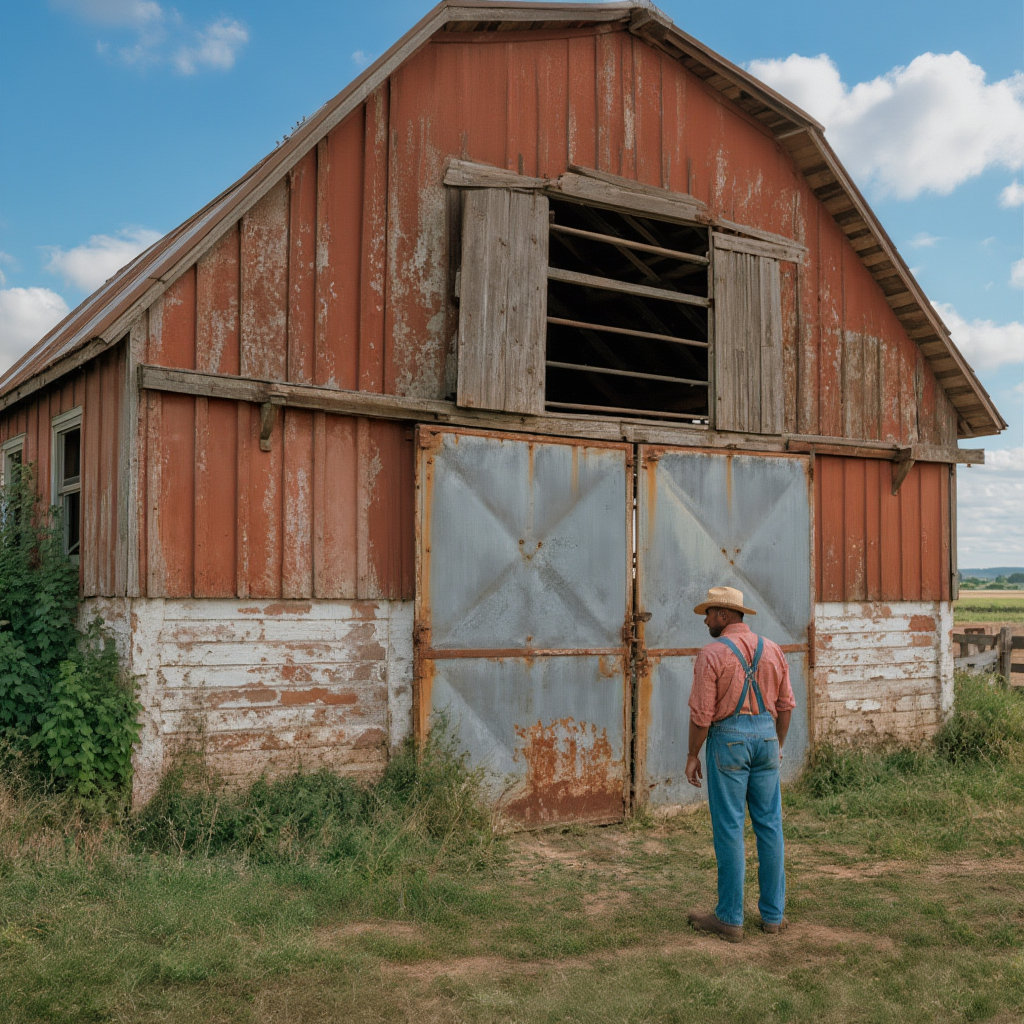
When Jacob Miller bought the barn, people laughed.
It leaned slightly to the left, like it had given up arguing with gravity years ago. The red paint had long faded into a tired pink, and half the roof was patched with mismatched sheets of tin that rattled in the Kansas wind.
“Five thousand dollars?” his neighbor, Earl, scoffed. “You could’ve bought a decent used truck for that.”
Jacob just nodded.
He hadn’t bought it for what it was.
He bought it for what it meant.
At thirty-nine, Jacob was a third-generation farmer barely holding onto land that had once stretched twice as far. Droughts had taken their toll. Commodity prices had dipped. His father’s medical bills before he passed had eaten through most of the family savings.
The old Miller farmhouse still stood proud, but the barns that once surrounded it had been sold off parcel by parcel over the years.
This one—the abandoned Turner barn—sat on a neighboring five-acre plot that had recently gone up for auction after its elderly owner died without heirs.
Most bidders were developers sniffing around for future subdivisions.
Jacob saw something else.
The barn had been built in 1912. Hand-hewn beams. Limestone foundation. History.
And if he could restore it, maybe he could expand into livestock again. Maybe bring the farm back to life.
So he emptied his emergency savings and bought it.
The first time he unlocked the massive wooden doors, a cloud of dust and the smell of old hay rolled out to greet him.
Sunlight streamed through cracks in the boards, slicing the darkness into golden beams.
“Alright,” he murmured to himself. “Let’s see what we’ve got.”
The interior was cluttered but not trashed. Rusted tools hung on nails. A broken wagon wheel leaned against the far wall. Stacks of old feed sacks were piled in a corner.
It looked abandoned, but not looted.
Jacob spent the first week hauling out junk. He found old horseshoes, antique milk cans, even a cracked porcelain sign from a long-forgotten seed company.
Nothing valuable enough to change his situation.
By the second week, he started focusing on structural repairs.
One afternoon, while prying up warped floorboards near the back wall, his crowbar hit something hollow.
Thunk.
He paused.
He tapped again.
Not dirt beneath.
Space.
Jacob knelt and brushed aside loose hay and debris. The wooden planks here were slightly newer than the rest—different grain, different nails.
“Now that’s interesting,” he muttered.
He worked carefully, removing the boards one by one.
Beneath them was a rectangular opening, about four feet long and three feet wide.
A hidden cellar.
A narrow ladder descended into darkness.
Jacob’s pulse quickened.
Kansas farms were full of secrets—storm shelters, root cellars, sometimes even hiding spots from the Prohibition era.
He grabbed a flashlight from his truck and returned, heart thudding louder than the cicadas outside.
The air that rose from below was cool and dry.
He climbed down slowly.
The space was small—no more than six feet deep, with dirt walls reinforced by stone.
And in the center sat a large iron-bound chest.
Jacob’s breath caught.
The chest was old—very old. The metal bands were rusted but intact. A thick padlock hung from the latch, corroded nearly through.
He stared at it for a long moment.
“This can’t be real,” he whispered.
He climbed back up, grabbed bolt cutters, and returned.
The lock snapped with a sharp metallic crack.
For a second, he hesitated.
Then he lifted the lid.
Inside were bundles of papers tied with twine.
Not gold.
Not cash.
Documents.
His heart sank slightly—until he picked one up.
The paper was thick, official-looking. The top read:
United States Department of the Interior
Land Patent Certificate
1889
Jacob frowned.
The name printed below made his knees go weak.
Samuel Miller.
His great-grandfather.
“This… no,” he breathed.
He flipped through more documents.
Original land deeds. Survey maps. Property boundaries carefully drawn in ink.
One map in particular caught his eye.
It showed a tract of land far larger than what the Miller family currently owned—stretching across what was now three separate properties, including… the Turner plot where this barn stood.
Jacob’s mind raced.
His family had always believed they lost that land during the Great Depression—foreclosed, sold off to pay debts.
But the documents in his hands told a different story.
He kept digging through the chest.
There were letters—legal correspondence from the 1930s referencing a disputed claim over property lines after a courthouse fire destroyed county records.
One letter, dated 1934, stood out.
To Mr. Samuel Miller,
Due to the destruction of official filings, certain boundary adjustments have been made based on available documentation. Unless contested within thirty days, these adjustments will stand…
There was no signature from his great-grandfather contesting the changes.
But tucked behind the letter was something else.
A notarized affidavit.
Signed by two witnesses.
It stated that the original land boundaries extended beyond what the county later recorded—and that Samuel Miller intended to challenge the revised survey.
But below that, in faded ink, was a final note:
Illness prevents immediate action. Will pursue when able.
Samuel Miller died in 1935.
Jacob sat back against the dirt wall, heart pounding.
Had his family lost their land because his great-grandfather got sick before he could file the challenge?
Had the corrected survey never been properly recorded?
He climbed out of the cellar in a daze, clutching the documents.
For the next week, Jacob did little else but research.
He visited the county clerk’s office.
Many records from the early 1900s had indeed been reconstructed after a fire.
Property lines had been redrawn based on partial documentation.
When he showed the clerk the original land patent certificate and survey map, her eyebrows shot up.
“Where did you get these?” she asked.
“In a barn,” Jacob said quietly.
She made copies and referred him to a property attorney in Wichita.
The attorney, a meticulous woman named Laura Chen, examined the documents carefully.
“These are authentic,” she said finally. “And if the affidavit was never formally resolved, you may have grounds to petition for a boundary correction.”
Jacob swallowed.
“What does that mean?”
“It means,” she said carefully, “that portions of land currently titled to neighboring properties may legally belong to your family.”
His mind spun.
“That’s… hundreds of acres.”
“Possibly,” she said. “But it won’t be simple. There will be disputes. Challenges.”
Jacob thought about the developers who had been circling the area. About the Turner barn itself.
“Do we have a chance?” he asked.
She nodded slowly.
“Yes. But you need to be prepared for a fight.”
The legal battle lasted nearly a year.
Neighbors were shocked. Some angry. Some supportive.
Earl, the same neighbor who had mocked him for buying the barn, shook his head in disbelief.
“All this from that falling-down shack?” he muttered.
Court hearings revealed that during the chaotic reconstruction of records after the courthouse fire, surveyors had relied on incomplete maps. Without Samuel Miller’s formal challenge—due to his illness—the revised boundaries had been assumed correct.
But the original land patent certificate and notarized affidavit were strong evidence.
Finally, after months of litigation, the judge ruled in Jacob’s favor for a significant portion of the disputed land.
Not all of it.
But enough.
Enough to double his acreage.
Enough to secure his farm’s future.
The day the ruling came down, Jacob stood in the restored Turner barn—now straightened, repainted a deep, proud red.
Sunlight streamed through new windows.
He walked to the spot where the hidden cellar had been.
He had preserved it, covering it with reinforced glass so the stone walls could still be seen.
Inside the farmhouse, framed copies of Samuel Miller’s land patent and affidavit hung above the fireplace.
Jacob often stood before them, imagining his great-grandfather—sick, worried, unable to finish what he started.
“You didn’t lose it,” Jacob whispered one evening. “You just ran out of time.”
The additional land allowed Jacob to expand into cattle and diversify his crops. Financial pressure eased. For the first time in years, he wasn’t calculating which bill to delay.
But the change wasn’t just economic.
It was personal.
He felt connected—to history, to legacy, to resilience.
One autumn afternoon, as golden wheat rippled across fields that now officially bore the Miller name again, Earl pulled up in his truck.
“Guess that barn was worth five grand after all,” he said with a crooked grin.
Jacob laughed.
“Best money I ever spent.”
He walked Earl through the restored structure, showing him the cellar, the documents.
Earl shook his head.
“All that time, it was just sitting there.”
“Waiting,” Jacob said softly.
That night, Jacob sat on his porch watching the sunset bleed orange across the horizon.
He thought about fate.
If he hadn’t emptied his savings…
If the developers had bid higher…
If he’d never pried up those floorboards…
Sometimes destiny doesn’t shout.
Sometimes it hides beneath rotten planks in an abandoned barn, waiting for someone stubborn enough to look.
The barn had seemed like a burden when he bought it.
A gamble.
Instead, it had given him back more than land.
It had restored his family’s story.
And as the Kansas wind swept across acres once nearly forgotten, Jacob Miller understood something simple and profound:
The past isn’t always lost.
Sometimes, it’s just buried.
And sometimes, when you’re brave enough to dig—
It changes your fate forever.