
The first time Jack Mercer saw the letters, he thought they were a trick of the light.
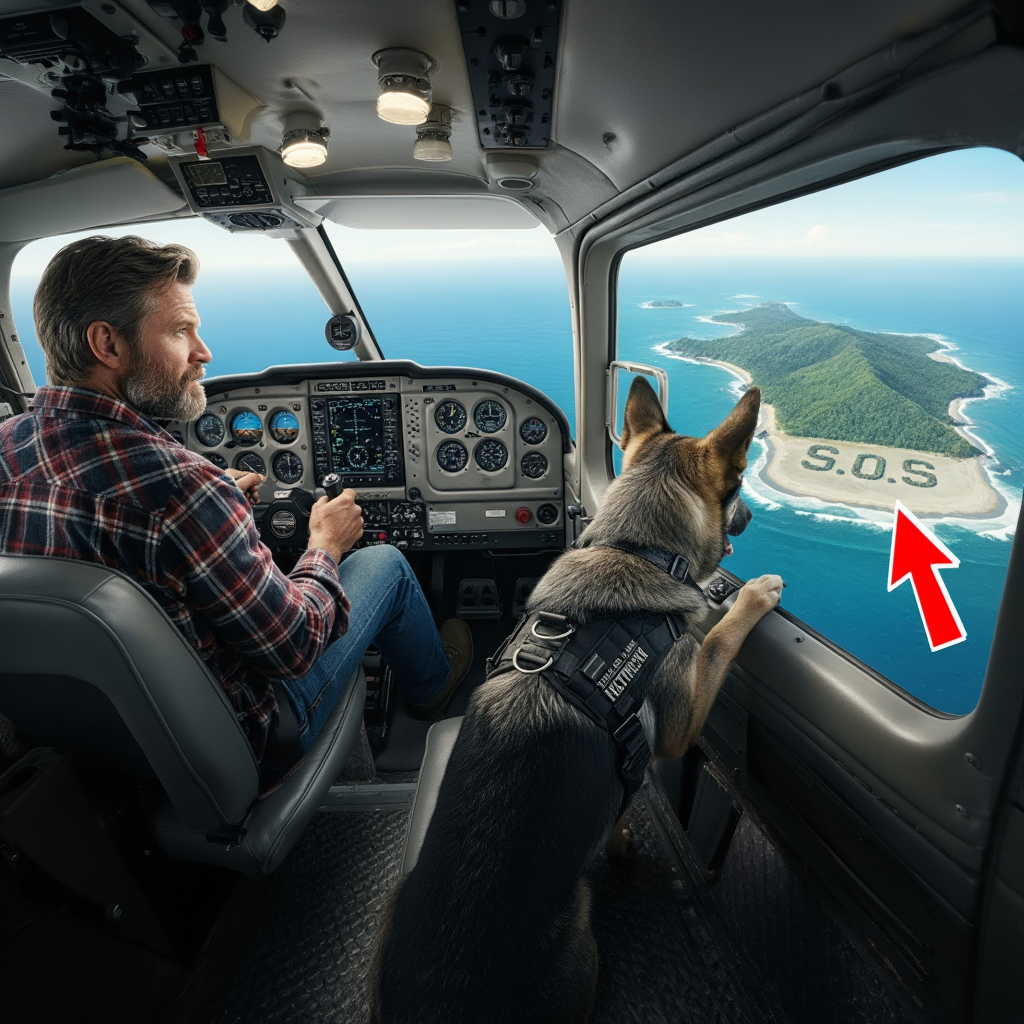
He was flying low along the Gulf Coast, skimming above a chain of barrier islands that most maps barely acknowledged. His floatplane’s engine hummed steadily, the late afternoon sun turning the water into sheets of molten gold.
Beside him, in the copilot seat, his German Shepherd, Ranger, lifted his head.
“What is it, boy?” Jack murmured.
Ranger’s ears were up, alert, his nose twitching as if he could smell something through the glass.
Jack followed the line of the shoreline below.
And there they were.
Three massive letters etched into the pale sand:
S O S
They stretched nearly fifty yards across a strip of beach on an island so remote that even seasoned fishermen avoided it. The tide lapped close to the final “S,” threatening to erase it with the next high water.
Jack’s stomach tightened.
He checked his coordinates. The island wasn’t inhabited. No docks. No cabins. Just scrubby brush, mangroves, and a crumbling lighthouse long since decommissioned.
He circled once.
The letters were unmistakable.
“Hang on,” he told Ranger.
Jack adjusted the flaps and brought the seaplane down in a smooth arc, landing in the shallow cove on the island’s northern side. The pontoons skimmed the surface before settling into a gentle glide.
He cut the engine.
The silence that followed was enormous.
Jack Mercer had been flying since he was seventeen. Born and raised in Sarasota, Florida, he’d grown up around water and wind. His father ran a fishing charter; his mother managed a marina café. Planes had fascinated him from the first time he saw a crop duster sweep low over a citrus grove.
By thirty-eight, Jack owned his own seaplane charter service—Mercer Air & Sea—specializing in island tours, aerial photography, and the occasional emergency transport.
Ranger had been with him for five years.
The dog had started as a rescue from a hurricane shelter—underweight, skittish, suspicious of everyone except Jack. Over time, Ranger became not just a companion, but a partner. He flew dozens of hours each month, sitting steady as a seasoned co-pilot.
And he had instincts Jack had learned never to ignore.
As Jack secured the plane and stepped onto the shallow water, Ranger leapt down beside him, splashing eagerly toward shore.
“Easy,” Jack warned, scanning the tree line.
The island felt wrong.
Too quiet.
No gulls. No rustle of small animals in the brush.
Just wind and distant surf.
Jack slung a small emergency pack over his shoulder—water, first aid kit, flare gun—and followed Ranger up the sandy incline.
The “SOS” was carved deep into the beach, clearly made by human hands. Not driftwood arranged randomly, but trenches dug with effort.
And recently.
The sand edges were still sharp.
Jack crouched, running his fingers along the groove.
Less than a day old.
“Hello?” he called.
His voice carried across the island and dissolved into nothing.
Ranger moved ahead, nose low, tail stiff.
Jack followed the dog’s line of sight toward the southern end of the island—where the old lighthouse stood like a skeletal finger pointing at the sky.
It had been abandoned since the early 1980s. Jack remembered reading about it. Structural damage. Erosion. Too expensive to maintain.
No one should be here.
Ranger barked once and bolted toward the brush.
“Ranger!” Jack hissed, breaking into a jog.
Branches scraped at his arms as he pushed through scrub oak and sea grape vines. The lighthouse loomed larger with each step, its white paint long peeled away by salt and sun.
The door at its base hung crooked on rusted hinges.
Ranger reached it first and began pawing furiously at the threshold.
Jack slowed, heart pounding.
“Easy,” he whispered.
He stepped inside.
The interior smelled of damp concrete and salt.
Broken glass littered the floor. A rusted metal staircase spiraled upward into darkness.
But that wasn’t what made Jack’s breath catch.
Against the far wall, near a stack of old crates, lay a backpack.
Modern.

Daniel Carter is a senior staff writer at InspireChronicle, specializing in legal conflicts, family disputes, and real-life justice stories. His work focuses on high-stakes situations involving inheritance, betrayal, and complex moral decisions. Through detailed storytelling, he explores how ordinary people navigate extraordinary challenges and the long-term consequences that follow.
His articles have gained significant traction online for their emotional depth and realism, resonating with readers across the United States.
He writes extensively about justice, personal responsibility, and the hidden dynamics within families.