
Homeless Man Won a Storage Unit Packed With Junk — What He Found Inside Changed His Life
The first time Caleb Morris saw the storage unit, he almost laughed.
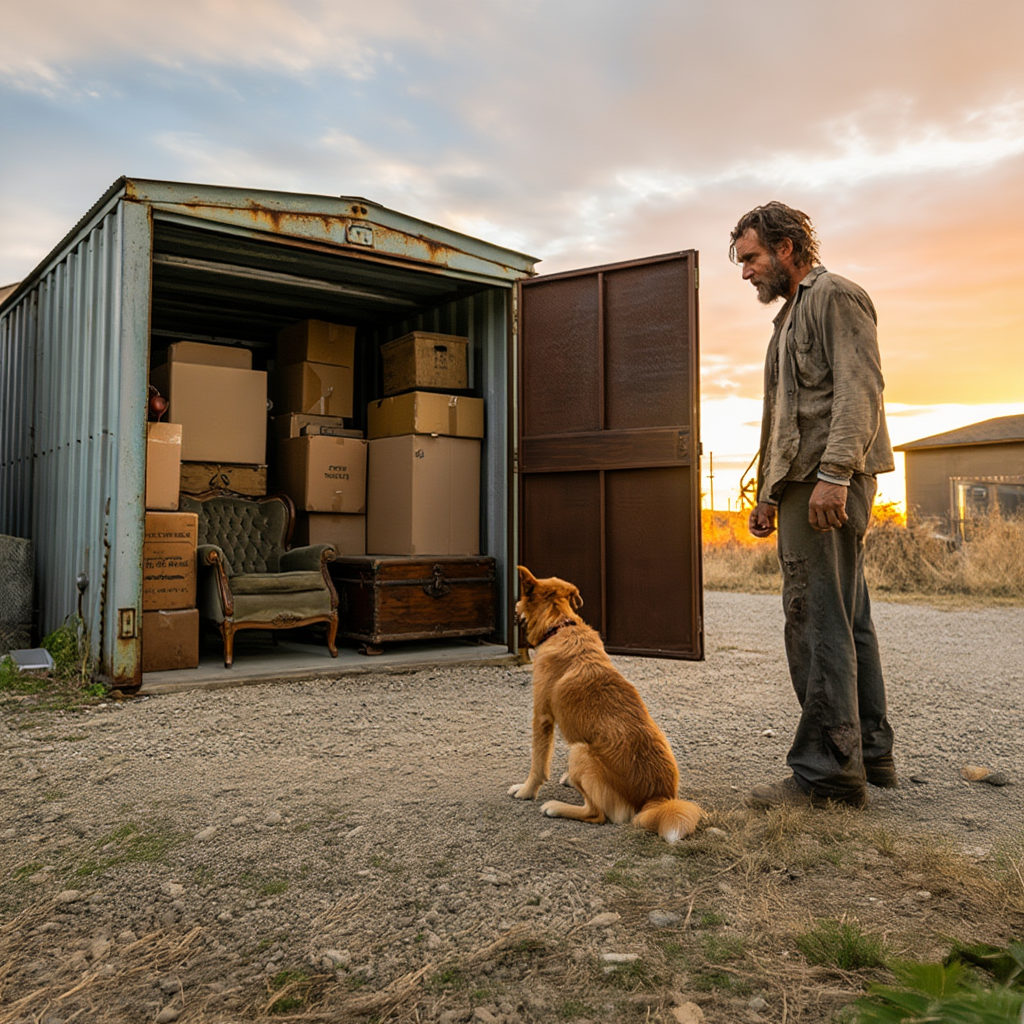
The corrugated metal door rattled upward with a shriek, revealing what looked like the aftermath of a yard sale that had gone wrong. Broken lamps. Mismatched dining chairs. Yellowed newspapers spilling from damp cardboard boxes. A cracked mirror leaning against a bicycle with no front wheel. It smelled like mildew and forgotten years.
Caleb scratched his beard and glanced at the auctioneer. “That’s it?”
“That’s it,” the man replied with a shrug. “Unit 317. Defaulted three months ago. No family claimed it.”
Caleb had only bid because the crowd had been small and the opening price lower than usual. Twenty-five dollars. That was all he had risked—nearly half of what sat folded in his sock.
It wasn’t much, but lately, “not much” was the story of his life.
He’d been sleeping in his ’98 Ford pickup for seven months now, ever since the construction company he worked for shut down after a lawsuit drained it dry. At fifty-two, Caleb found it harder to get hired. Younger guys moved faster. Lifted heavier. Asked for less pay.
When the rent notices started stacking up, he sold what he could. First the television. Then the couch. Then his tools. The landlord had given him two weeks’ mercy. After that, the locks changed.
Now he showered at a truck stop when he could afford it and picked up odd jobs—hauling scrap metal, fixing fences, clearing debris. A few weeks earlier, he’d stumbled upon a small-time storage auction and realized some people made money flipping abandoned units.
He figured he had nothing left to lose.
So here he stood, staring at a mountain of junk he technically owned.
The crowd dispersed quickly. Nobody envied his win.
Caleb sighed and stepped inside.
“Well,” he muttered, rolling up his sleeves. “Let’s see what you’re hiding.”
For the next hour, he hauled broken furniture into a pile outside. Most of it wasn’t worth salvaging. The chairs were warped. The lamps were rusted through. The newspapers dated back nearly twenty years.
But then he noticed something odd.
Behind the bicycle frame, tucked beneath a sagging bookshelf, sat a long wooden trunk. Unlike the rest of the junk, it looked solid—oak, maybe. Dusty, but intact. It had brass corners and a heavy latch.
Caleb brushed it off with his sleeve.
No lock.
He lifted the lid.
Inside were bundles of fabric—old quilts and wool blankets, neatly folded. Beneath them, a stack of leather-bound journals. And under those, a small metal lockbox.
Caleb felt a flicker of curiosity.
He set the lockbox aside and flipped open the first journal.
The handwriting inside was tight and deliberate.
March 3, 1994.
I never imagined I’d be writing down my life this way, but maybe someday someone will need to know what happened…
Caleb frowned.
The entries continued for years—carefully dated, chronicling a man’s life. His name appeared in the margins occasionally: Thomas Granger.
The journals described a modest existence. Thomas had worked as an engineer for a railroad company in Ohio. He never married. No children. But he invested wisely—real estate, stocks, savings bonds.
Caleb flipped forward.
August 18, 2003.
I have decided to sell the lake property. The offer was too good to refuse. I’ve placed the funds where they will grow quietly. I trust no one but myself.
Caleb swallowed.
He reached for the lockbox.
It was heavier than he expected.
The latch wasn’t locked—just stiff. He pried it open carefully.
Inside lay a thick envelope and several documents in plastic sleeves.
He pulled out the envelope first.
Cash.
Neatly stacked hundred-dollar bills, bound with a bank strap.
Caleb stared at it.
His hands trembled as he counted.
Ten thousand dollars.
He felt dizzy.
“Is this real?” he whispered to the empty unit.
He set the envelope down and reached for the documents.
Stock certificates. Property deeds. And one folded paper labeled Trust Agreement.
Caleb’s heart pounded as he read.
Thomas Granger had established a trust decades earlier, naming himself as sole beneficiary during his lifetime. But beneath that, in smaller text, was a clause:
In the event that no lawful heirs are located within five years of my passing, and should my property be disposed of through public auction or abandonment, all remaining assets are to be transferred to the legal possessor of the associated personal property, upon verification.
Caleb read the sentence three times.
Legal possessor.
He looked around the storage unit.
He had the receipt in his pocket.
Unit 317.
Twenty-five dollars.
That night, Caleb didn’t sleep in his truck.
He couldn’t.
Instead, he drove to the public library and sat in the parking lot under a flickering streetlamp, rereading the documents. The trust papers appeared legitimate—signed, notarized.
But he didn’t trust hope. Hope had betrayed him before.
The next morning, he visited a legal aid clinic downtown. The waiting room smelled of burnt coffee and anxiety.
When his name was called, he stepped into a cramped office where a middle-aged attorney with silver-framed glasses gestured for him to sit.
“I’m Linda Chavez,” she said. “What can I help you with?”
Caleb placed the documents on her desk.
“I bought a storage unit yesterday,” he began carefully. “I think… I think it might contain more than junk.”
She skimmed the pages.

Daniel Carter is a senior staff writer at InspireChronicle, specializing in legal conflicts, family disputes, and real-life justice stories. His work focuses on high-stakes situations involving inheritance, betrayal, and complex moral decisions. Through detailed storytelling, he explores how ordinary people navigate extraordinary challenges and the long-term consequences that follow.
His articles have gained significant traction online for their emotional depth and realism, resonating with readers across the United States.
He writes extensively about justice, personal responsibility, and the hidden dynamics within families.